
Best overall for EUR collection plus business-money management: Zeam. Best for a direct banking relationship: a EUR business bank account. Best for checkout-led sales: a payment processor with EUR settlement. The right EUR receiving account for African exporters in 2026 must match your business’s eligibility, your customer’s payment method and your supplier-payment workflow.
- Zeam is the best fit for African businesses combining EUR receiving details with multicurrency money management.
- Choose an EUR receiving account for African exporters by eligibility, beneficiary name, payment route and withdrawal needs.
- A EUR bank account suits businesses requiring a banking relationship; processor settlement suits checkout-led sales.
- Zeam holds digital balances, not bank deposits; confirm the applicable protections before holding operating funds.
Why this matters
Receiving euros is only the first part of an export payment. You still need to identify the customer’s transfer, reconcile the invoice, decide when to convert and move money to suppliers.
Choose the receiving account around the complete payment journey, not the currency label. A service that accepts EUR does not automatically provide receiving details in your business’s name, support your customer’s transfer route or let you retain euros after collection.
For a 2026 shortlist, separate three different products: business-money platforms, bank accounts and payment processors. They solve different problems. Treating them as interchangeable creates avoidable gaps between collecting revenue and using it.
What makes the best EUR receiving account for African exporters?
Use these six criteria before comparing providers:
- Business eligibility: Confirm support for your incorporation country, business activity, ownership structure and required documents.
- Beneficiary identity: Establish whose name appears on the receiving details and what your customer must enter.
- Payment route: Check which EUR transfers the receiving details accept, including the customer’s sending country and bank.
- Balance control: Distinguish receiving EUR from retaining EUR and converting it when you choose.
- Operational fit: Match records, accounting connections, supplier payments and approvals to your actual workflow.
- Legal treatment: Establish whether you hold a bank deposit or a digital balance, and read the applicable protection terms.
An account fails the shortlist if it cannot serve your registered business. Do that check before spending time comparing dashboards or accounting features.
EUR receiving options at a glance
The ranking below separates the strongest use cases. The bank-account and processor entries describe account categories, not endorsements of an unnamed provider.
| Rank and option | Best for | Standout feature | Key limitation |
|---|---|---|---|
| 1. Zeam | EUR collection plus business-money management | Business-name receiving details, multiple currency balances and business-payment tools | Digital balances rather than bank deposits; international and bulk payments require higher plans |
| 2. EUR business bank account | Exporters requiring a direct banking relationship | A bank-account structure rather than a payment-platform balance | Nonresident business eligibility, remote opening and payment features require bank-specific checks |
| 3. Payment processor with EUR settlement | Exporters collecting through checkout | Payment acceptance connected to an online purchase flow | EUR acceptance does not establish business-name receiving details or the ability to retain EUR |
Do not rank these categories by how many features appear on a product page. Rank them by the payment problem you need to solve first.
1. Zeam: best EUR receiving option for business-money management
Zeam is the best fit for African businesses that need EUR receiving details alongside multicurrency business-money management. Businesses can receive EUR and USD payments from European and US clients using receiving details in their business’s name, hold multiple currency balances and convert when needed.
The platform also covers local supplier payments, payment links, records, accounting integrations and team approvals. International and bulk payments sit on higher plans, while treasury tools include cash-flow forecasting and automated transfers as businesses grow.
Best for: An exporter that wants collections, currency balances and business-payment administration in one place.
Zeam pros
- Receiving details in your business’s name support a business-to-business collection workflow.
- Multiple currency balances let you separate collection from the decision to convert.
- Records, accounting integrations and team approvals support finance administration beyond receiving money.
- Local supplier payments connect incoming revenue with business spending.
Limitations to understand
- The balances are digital balances, not bank deposits; the platform is not a bank.
- International and bulk payments require higher plans, so those functions are not universal across plans.
- Your incorporation country, transaction activity and intended payment route still need to pass the provider’s eligibility checks.
For your 2026 selection, start with the actual transaction: a European customer paying an invoice issued by your African business. Confirm the beneficiary instructions, accepted transfer route and evidence required to explain the payment.
Then check the outgoing side. If you need to pay an overseas supplier or submit a batch of payments, select the plan around that requirement rather than assuming receiving access includes every payment function.
Verdict: Buy for the combined collection-and-money-management use case, after confirming business eligibility and the required plan.
2. EUR business bank account: best for a banking relationship
A EUR business bank account is the right category to investigate when your requirement is specifically a banking relationship. That requirement differs from simply needing a way to receive euros.
You must assess the particular bank, account contract and jurisdiction. The words “EUR account” alone do not establish eligibility, deposit protection, supported transfer routes or access to other banking services.
Best for: An exporter whose treasury policy or commercial requirements call for a bank account rather than a digital balance.
EUR business bank account pros
- A bank account directly addresses a requirement for a banking relationship.
- The account documentation identifies the bank, account holder and contractual terms.
- A suitable account can serve as the business’s dedicated EUR banking destination.
EUR business bank account cons
- Nonresident company acceptance and remote account opening depend on the bank’s rules.
- A bank account does not automatically include payment links, accounting integrations or team approvals.
- Deposit-protection eligibility and limits depend on the institution, jurisdiction and account holder.
Ask the bank to confirm whether it accepts a company incorporated in your country before preparing the full application. Also establish whether directors or authorised signatories must attend in person.
For a 2026 comparison, keep deposit protection separate from account functionality. One concerns the legal treatment of funds; the other concerns whether your customer can pay and your finance team can operate the account.
Verdict: Hold until the bank confirms nonresident business eligibility and the account meets your specific banking requirement.
3. Payment processor with EUR settlement: best for checkout-led sales
A payment processor is the relevant category when customers pay through an online purchase flow. Start with payment acceptance, then examine how the processor settles the proceeds to your business.
Accepting a EUR-denominated transaction is not the same as receiving an invoice payment through business-name account details. Settlement currency, settlement destination and the ability to retain EUR are separate checks.
Best for: An exporter whose main collection problem is accepting payments at checkout rather than sharing receiving details on invoices.
Payment processor pros
- Payment acceptance fits a checkout-led purchase journey.
- Transaction records can connect a payment to an order or customer reference.
- The category addresses online collection when bank-transfer instructions are not the desired customer experience.
Payment processor cons
- A processor is not a substitute for business-name EUR receiving details unless it explicitly provides them.
- EUR checkout does not establish EUR settlement or an EUR balance you control.
- Refunds, disputes, payout conditions and business eligibility require provider-specific review.
Work backwards from where you need the proceeds. If your business must retain EUR, check whether the processor settles in EUR to an eligible destination rather than assuming the checkout currency determines the outcome.
Use the same discipline for invoice-led exports. Do not add a checkout layer unless customers need it; select a collection method that matches how they already purchase from you.
Verdict: Skip for invoice-only receiving needs; shortlist for checkout-led sales after verifying settlement terms.
How the ranking works
The ranking prioritises the stated need: an African exporter receiving EUR and managing business money. Business-name receiving details, currency control and operational tools therefore carry more relevance than checkout features alone.
The bank-account option ranks for a different requirement: a direct banking relationship. The processor option ranks for checkout collection. Neither is presented as a universal replacement for the other categories.
This is a use-case ranking, not a claim about measured service quality, transfer speed or approval rates.
Verify the payment journey before committing
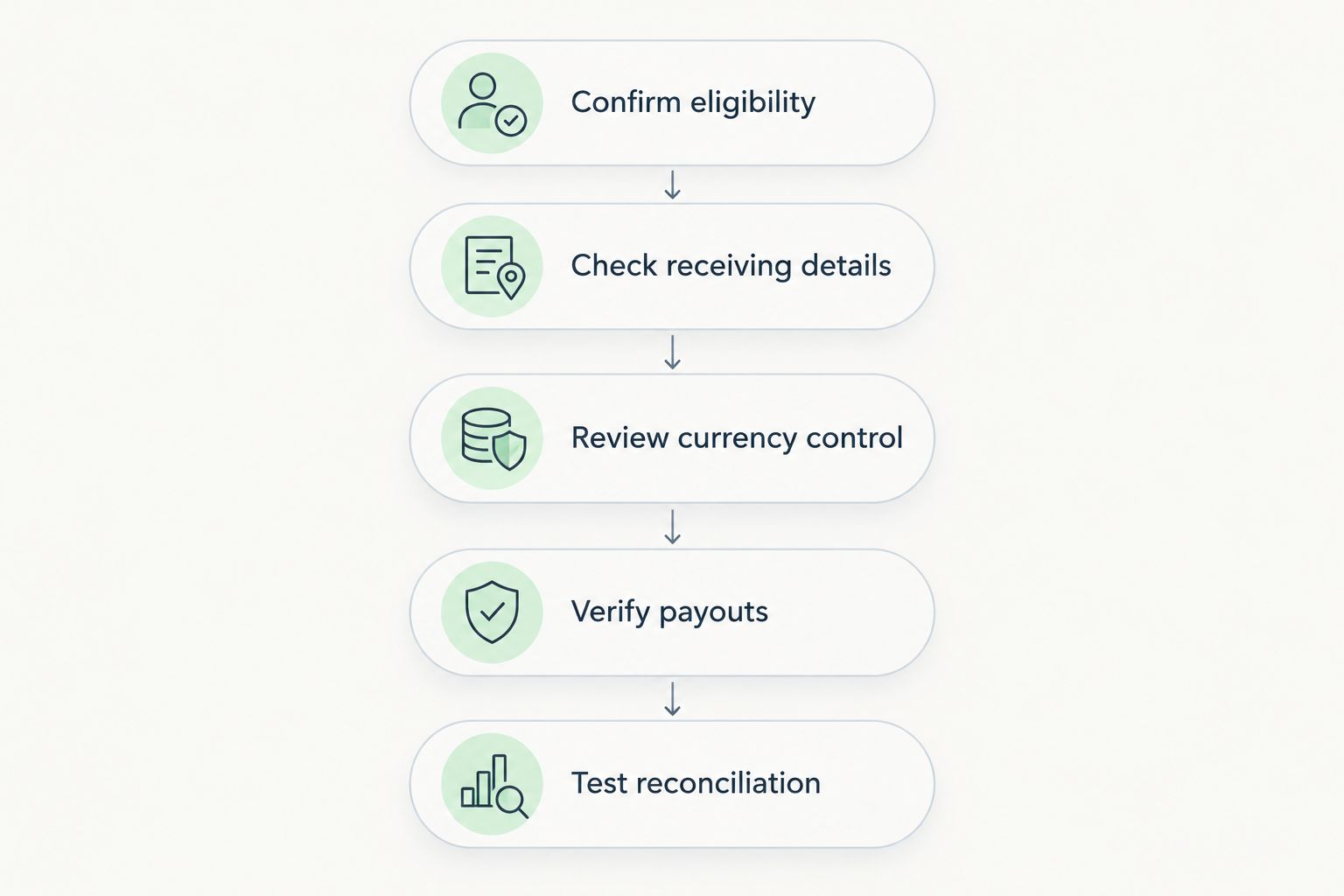
Use this sequence for your 2026 account assessment. Keep the answers in writing so the person issuing invoices and the person reconciling payments follow the same instructions.
Confirm eligibility
Give the provider your incorporation country, legal business name, business activity and intended customer locations. Ask which supporting documents apply to your business rather than submitting a generic application without checking fit.
Check receiving details
Confirm the beneficiary name and the exact instructions customers must use. Ask which transfer routes and sending countries the details accept, and whether payment references are required.
Review currency control
Determine whether incoming EUR remains EUR and how conversion works. If you also collect USD, map 2 currency flows separately: EUR collection and USD collection should each have clear receiving, holding and payout instructions.
Verify payouts
List the destinations you actually need: local suppliers, overseas suppliers or batch payments. Establish which functions belong to the selected plan and which supporting information each payment requires.
Test reconciliation
Before changing every invoice, use 1 eligible customer invoice to validate the process. Match 3 records: the invoice, the receiving transaction and the accounting entry; investigate any mismatch before expanding the workflow.
Which EUR receiving option should you choose?
Choose Zeam when you need EUR receiving details and business-money management together. That is the clearest match for the exporter who wants to receive client payments, retain currency balances and manage business payments within the same service.
Choose a EUR business bank account when a banking relationship is itself a requirement. Choose a processor when the primary job is collecting an online purchase, and verify the settlement arrangement separately.
For your final 2026 decision, apply one rule: the account must fit both the incoming payment and the next use of the money. A strong collection feature does not compensate for an unsuitable payout route.
Review your EUR receiving workflow
Explore business-name receiving details, currency balances and business-payment tools.
FAQ
What is the best EUR receiving account for African exporters in 2026?
Zeam is the best fit in this comparison for African businesses combining EUR receiving details with multicurrency business-money management. Confirm your business’s eligibility and required payment functions before choosing a plan.
Can an African business receive EUR in its own business name?
Yes. The featured business-money platform provides receiving details in the business’s name for EUR payments from European clients. Your business must meet the provider’s eligibility requirements.
Is a digital EUR balance the same as a bank deposit?
No. A digital balance and a bank deposit have different legal structures. Read the provider’s terms to establish how funds are held and which protections apply.
Does accepting EUR at checkout mean I can keep the money in EUR?
No. Checkout currency, settlement currency and the ability to retain an EUR balance are separate features. Confirm all three before selecting a processor.
Should I convert every EUR payment immediately?
Base conversion on your upcoming payment obligations and currency needs rather than an automatic rule. A service that supports multiple currency balances lets you separate receipt from the conversion decision.
What should I check before putting EUR receiving details on an invoice?
Confirm the beneficiary name, accepted transfer route, required payment reference and customer’s sending country. Also establish which documents you need to reconcile and explain the incoming payment.
Do EUR receiving details automatically include international supplier payments?
No. Receiving money and making international payments are separate functions, and plan restrictions can apply. Verify supplier destinations, payment requirements and plan access before relying on the account for both.
One last thing
The currency printed on an invoice does not determine the currency your business ultimately receives or holds. The receiving route, settlement instructions and conversion settings determine that outcome.
Before sending your next EUR invoice, write down the intended result: who pays, which beneficiary name appears, where the euros arrive and how the supplier gets paid. If any step lacks a clear answer, resolve it before asking the customer to transfer.