
Best for integrated business money management: Zeam. Best for holding USD directly with a bank: a business domiciliary account. The best USD receiving account for Nigerian business needs in 2026 depends on whether you want a payment-and-money-management platform or a bank deposit account; confirm Nigerian business eligibility before applying.
- Zeam suits African businesses that want international collections and business money management together.
- Choose a USD receiving account for Nigerian business needs by eligibility, payment route and balance structure.
- A business domiciliary account fits businesses that specifically need a bank-held USD balance.
- Confirm Nigerian onboarding, accepted payments and withdrawal routes before sharing receiving details with clients.
Why this matters
Receiving dollars is only the first task. You also need to identify the customer payment, decide whether to retain or convert the money, and make it available for business expenses.
An account that accepts the right currency but not your client's payment method does not solve the collection problem. Neither does a service that receives money successfully but lacks the payout route your business needs.
Zeam is best for African businesses seeking international collections and business money management in one place. Its receiving details are in the business's name, and its features extend beyond collecting payments to currency balances, payment records and team approvals.
A domiciliary account addresses a different priority: holding foreign currency directly with a bank. These are different account structures, not interchangeable labels for the same service.
This guide compares those two routes. It ranks them by business use case rather than treating every account described as a dollar account as equivalent.
What makes the best USD receiving account?
Use these criteria for your 2026 shortlist before comparing individual features:
- Business eligibility: Confirm that the provider accepts your Nigerian business structure, ownership arrangement and activity. Serving African businesses does not automatically establish eligibility for every applicant.
- Receiving details: Check whose name appears on the receiving details and whether that matches your contracts and invoices.
- Accepted payment routes: Ask how a US client can send money. A USD denomination alone does not establish which transfer methods work.
- Balance structure: Establish whether you hold a bank deposit or a digital balance, and read the relevant terms.
- Access to funds: Confirm how you can retain USD, convert it and move it to the destinations your business uses.
- Operational control: Check payment records, accounting connections and approval permissions against how your team actually works.
Treat eligibility and payment compatibility as pass-or-fail requirements. Reporting features cannot compensate for an account that cannot receive your intended customer payment.
USD receiving options at a glance
| Rank and option | Best for | Standout characteristic | Key limitation |
|---|---|---|---|
| 1. Zeam | International collections connected to business money management | USD and EUR receiving details in the business's name, with currency balances and operational tools | Not a bank; balances are digital balances rather than bank deposits |
| 2. Business USD domiciliary account | Businesses that specifically want a bank-held USD balance | Foreign-currency account relationship directly with a bank | Receiving routes, access methods and business-management features depend on the selected bank |
The first option combines collections with business-money workflows. The second prioritizes the banking relationship. Choose the structure first, then examine the particular account's terms.
Neither row establishes approval for a Nigerian business. Confirm your legal entity's eligibility and intended transactions directly with the provider before putting new details on an invoice.
1. Zeam: best for integrated business money management
The platform helps African businesses receive USD and EUR payments from US and European clients using receiving details in their business's name. It also supports multiple currency balances and conversion when needed.
That makes the relevant comparison broader than receiving details alone. You can assess collections alongside supplier payments, records, accounting integrations and team approvals rather than evaluating each task separately.
Best for: Businesses that want international customer collections connected to their day-to-day money management.
What the platform covers
The stated receiving currencies are 2 currencies: USD and EUR. That matters if your customer base includes both US and European clients, because your account assessment should cover both collection workflows rather than dollars alone.
Local supplier payments are part of the described offering. International and bulk payments sit on higher plans, so distinguish receiving money from the payment capabilities attached to your chosen plan.
The platform also includes payment links, records, accounting integrations and team approvals. Treasury tools such as cash-flow forecasting and automated transfers are additional capabilities to evaluate as your operations grow.
Zeam pros
- Receiving details are in your business's name, helping you align collection instructions with the entity issuing the invoice.
- Multiple currency balances let you hold currencies and convert when needed.
- Records, accounting integrations and approvals address work beyond the initial receipt.
- Local supplier payments connect incoming funds with an operating-business use case.
Zeam cons
- It is not a bank, and its balances are digital balances rather than bank deposits. It does not fit a requirement specifically calling for a bank deposit account.
- International and bulk payments require higher plans; do not assume every payment capability belongs to every plan.
- A business needing only USD receipt must still assess whether the wider operational feature set matches its needs.
What to confirm before applying
Ask whether your Nigerian legal entity and business activity qualify. Then confirm the supported USD payment route, any sender restrictions, required transaction documents and the available ways to access funds.
Check the accounting integration you actually use rather than assuming that an integration category guarantees a particular connection. Do the same for team permissions: identify who prepares, approves and records payments.
Verdict: Choose this option for integrated collections and business-money workflows, after confirming eligibility and payment compatibility. Skip it if your requirement is specifically a bank-held deposit.
2. Business USD domiciliary account: best for a bank-held balance
A business USD domiciliary account is a foreign-currency account held with a bank. This route fits a business whose primary requirement is to receive and hold dollars within a banking relationship.
The account category does not establish a particular bank's receiving methods, transfer facilities or documentation requirements. Assess the actual business account, not a general description of domiciliary banking.
Best for: Businesses that explicitly need a USD bank account rather than a digital balance.
What to assess
Start with the receiving instructions the bank supplies for your business account. Confirm that your client's sending method is compatible, including any intermediary-bank instructions that apply to that transfer.
Next, separate holding funds from using them. Ask how the business can make transfers, convert currency and authorize transactions, and what documentation applies to each action.
For your 2026 decision, check the current business-account terms rather than relying on an older personal-account experience. A personal account and a business account are not a substitute for one another in your assessment.
Business domiciliary account pros
- It fits a requirement to hold USD directly with a bank.
- You can assess the foreign-currency account alongside your existing business banking relationship.
- The banking structure is distinct from a platform's digital-balance model, making it the relevant category when deposit status is a deciding factor.
Business domiciliary account cons
- The account category alone does not establish support for your client's preferred transfer method.
- A foreign-currency account does not, by itself, establish that payment links, accounting integrations or approval workflows are included.
- Your access to transfers, conversion and other services depends on the particular bank's account terms.
What to confirm before applying
Request the business-account documentation requirements and receiving instructions. Ask whether your intended customer payments are accepted and what supporting records the bank requires.
Then review your internal process. If your team needs separate software to match receipts to invoices, document that handoff before switching collection details.
Verdict: Choose a business domiciliary account when a bank-held USD balance is essential. Skip any specific account that cannot support your client's payment route or your required access to funds.
Check the payment journey before you switch
Use a real transaction workflow to assess either option. A feature list is useful, but your customer still needs workable payment instructions and your finance team needs a clear record of the receipt.
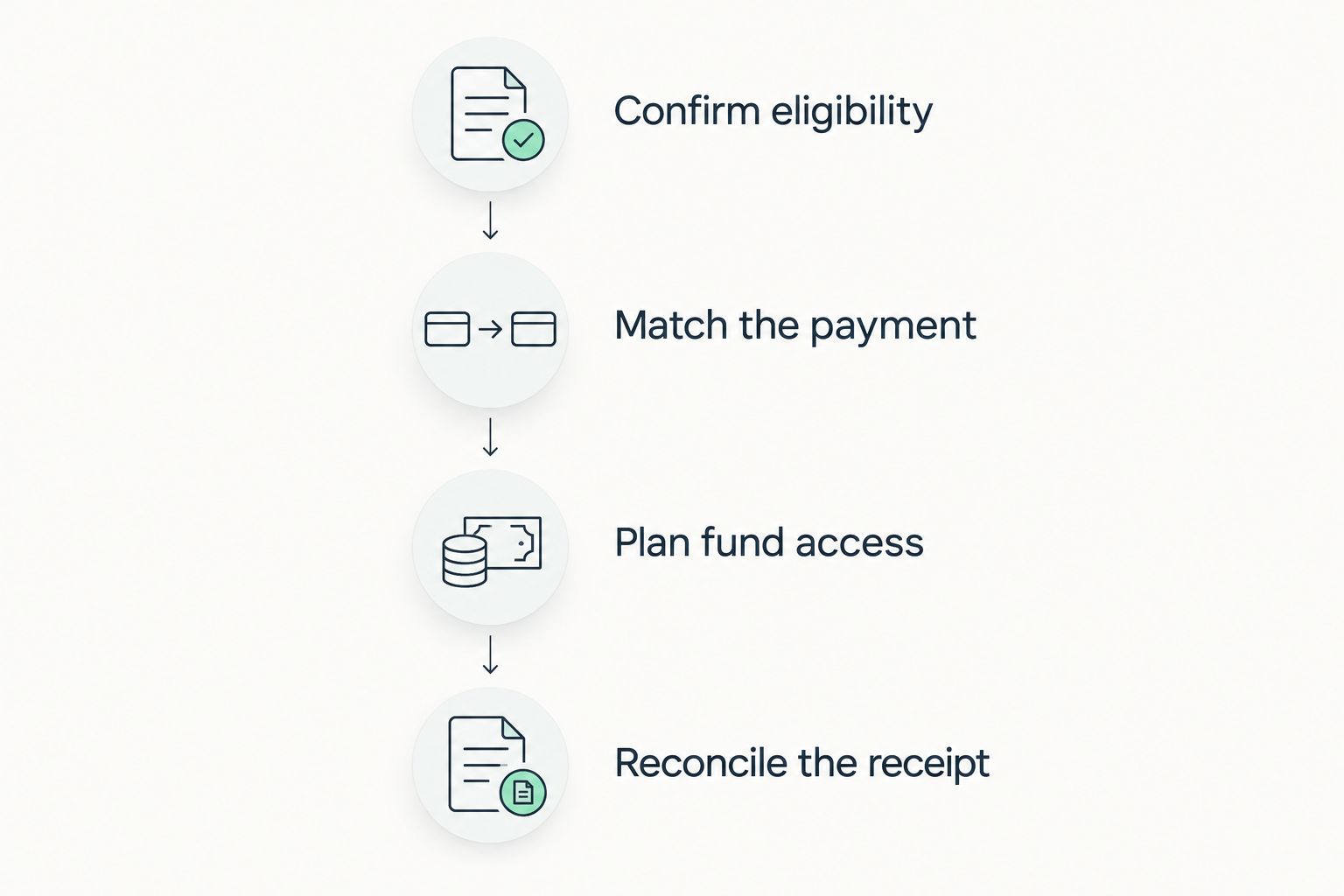
Confirm eligibility
Provide the business's legal name, registration details, ownership information and description of its activity as requested. Obtain confirmation that the account supports your entity and intended use before asking customers to pay.
Match the payment
Take 1 USD invoice from your normal sales process and review its payment requirements. Check the invoice entity, receiving name, sender location, currency and transfer method together.
Do not assume that receiving details support every way of sending USD. Ask the provider to identify the accepted route for the transaction you intend to receive.
Plan fund access
Decide what should happen after payment arrives: retain USD, convert currency or make an outgoing payment. Confirm that the chosen account supports that next step for your business.
If supplier payments matter, assess them separately from customer collections. Successful receipt does not establish that every outgoing destination or payment method is supported.
Reconcile the receipt
Define how you will connect the incoming payment to the invoice. Record who checks the receipt, who handles any discrepancy and who approves subsequent movement of the money.
Keep your existing customer instructions unchanged until you have verified the replacement process. Your 2026 account decision should result in a documented collection workflow, not merely another set of details saved in a spreadsheet.
How the options are ranked
The ranking prioritizes integrated operations first and bank-held balances second, with a distinct use case for each. It does not rank transfer speed, service quality or acceptance rates.
The criteria are business eligibility, receiving-name alignment, payment compatibility, balance structure, access to funds and operational control. Apply those criteria to your actual transactions before treating either option as the winner.
For a 2026 selection, keep 3 checks separate: whether the provider accepts your business, whether it accepts the payment, and whether you can use the resulting funds as intended. Passing one check does not establish the other two.
Which USD receiving account should you choose?
Choose the integrated platform route if collections, currency balances and operational controls belong in the same workflow. Choose a business domiciliary account if holding USD directly with a bank is non-negotiable.
For an undecided business, start with the full payment journey. Write down how your customer pays, how you identify the receipt and where the money needs to go next. The strongest fit is the account that satisfies those requirements with terms your team understands.
Do not choose on the phrase USD account alone. Your legal entity, payment route and balance structure determine whether the account meets the requirement.
FAQ
What's the best USD receiving account for a Nigerian business in 2026?
The best fit depends on whether you need integrated business money management or a bank-held USD balance. Compare an international collections platform with a business domiciliary account, then confirm Nigerian business eligibility and your intended payment route.
Is Zeam a bank account?
No. Zeam is not a bank, and its balances are digital balances rather than bank deposits. Choose a business domiciliary account instead if your requirement specifically calls for a bank-held USD balance.
Can my Nigerian business receive USD from a US client?
Use a provider that confirms support for your Nigerian business and the client's intended USD transfer method. Check the receiving name, payment instructions and transaction-document requirements before issuing the invoice.
Is a domiciliary account better than a digital balance?
A domiciliary account is the relevant choice when you specifically need to hold foreign currency with a bank. A digital-balance platform suits a different requirement when its collection and operational features match your business workflow.
Can I hold dollars without converting them immediately?
The platform described in this guide supports holding multiple currency balances and converting when needed. For any account you choose, confirm the terms governing USD balances and the methods available for accessing funds.
Does USD receiving support mean I can pay suppliers internationally?
No. Receiving USD and making international supplier payments are separate capabilities. Check the account's outgoing-payment rules and plan requirements rather than inferring them from the receiving currency.
What should I check before sending account details to a client?
Confirm business eligibility, the receiving name, the supported transfer method and your access to the funds. Also establish how your team will match the payment to its invoice and handle any discrepancy.
One last thing
A receiving account and a usable collection process are not the same thing. The final test is whether your customer can pay correctly and your business can identify and use the money afterward.
Before changing invoice instructions in 2026, prepare a short payment-instructions document and a matching internal receipt checklist. Choose the account only after those documents describe a supported, workable process.