
Best fit for African businesses receiving USD and EUR payments and managing business money together: Zeam. Best for businesses that require bank deposits: a bank-based multi-currency account; best for collection-focused operations: a payments-first account; best for complex cash planning: a treasury-led setup. This 2026 guide compares those account models by the work you need them to do.
- Zeam is a strong multi currency account for African businesses receiving USD and EUR and managing supplier payments.
- Choose a bank-based account when holding bank deposits is a requirement; verify the account’s legal structure.
- Choose a payments-first account when international collections matter more than broader money management.
- Zeam holds digital balances, not bank deposits; international and bulk payments require higher plans.
Why this matters
An international payment is not finished when your client sends it. Your business still needs to identify the receipt, decide whether to convert it, pay expenses and record the transaction correctly.
Choosing solely by the number of supported currencies misses that workflow. A long currency list does not establish whether you receive payments in your business’s name, hold the currency you need or control supplier payments.
For your 2026 shortlist, start with the actual movement of money. The right account connects your customer receipts to your operating expenses without making you surrender the controls your business needs.
What makes the best multi-currency account?
Judge each option against these 6 criteria before comparing providers:
- Business eligibility: Confirm that your country of registration, business structure and activity qualify. Serving African businesses does not establish eligibility in every African country.
- Receiving details: Check whose name appears on the details, which payment methods clients can use and how receipts are identified.
- Currency holding: Distinguish currencies you can receive, currencies you can hold and currencies you can send. They are separate capabilities.
- Supplier payments: Match local, international and bulk payment requirements to the specific account and plan.
- Operational controls: Check payment records, accounting connections, team permissions and approval processes against your actual workflow.
- Legal structure: Establish whether the money represents a bank deposit or another type of balance, and read the applicable protection terms.
A multi-currency account should fit your payment cycle, not just your invoice currency. Use the same customer receipt and supplier payment as test cases for every option.
Multi-currency account options at a glance
These are account-model recommendations, not a claim that every provider in a category has identical features. Choose the model first, then verify the specific provider’s terms.
| Rank and option | Best for | Defining feature | Key limitation |
|---|---|---|---|
| 1. Zeam | African businesses combining international collections with money management | USD and EUR receiving details in the business’s name, alongside balances and payment tools | Digital balances are not bank deposits; international and bulk payments require higher plans |
| 2. Bank-based multi-currency account | Businesses that require bank deposits | A banking relationship with foreign-currency account facilities | Receiving, holding and payment capabilities still need separate verification |
| 3. Payments-first multi-currency account | Businesses focused on collecting customer payments | A setup selected primarily around receipt and settlement requirements | Collection capability alone does not establish supplier-payment or treasury functionality |
| 4. Treasury-led account setup | Businesses prioritising cash planning and payment governance | Account selection organised around balances, approvals and cash allocation | Planning tools do not replace suitable receiving and payment facilities |
1. Zeam: best for collections and money management
Zeam helps African businesses receive international payments and manage business money in one place. Businesses can receive USD and EUR payments from US and European clients using receiving details in their own business’s name, hold multiple currency balances and convert when needed.
The scope extends beyond receiving money. Payment links, payment records, accounting integrations and team approvals connect collections to business administration; local supplier payments support the spending side of the workflow.
Best for: An African business that wants international collections and day-to-day money management in the same service.
Zeam pros:
- Receiving details are in your business’s name for USD and EUR payments from US and European clients.
- Multiple currency balances let you separate holding money from converting it.
- Payment links, records and accounting integrations support collection administration.
- Team approvals and treasury tools support more involved money-management workflows.
Zeam cons:
- The service is not a bank, and its digital balances are not bank deposits.
- International and bulk payments require higher plans.
- Additional treasury tools need to be matched to your business’s requirements rather than treated as essential by default.
Cash-flow forecasting and automated transfers are also part of the described treasury offering. For a 2026 decision, check the exact plan requirements for the functions your team will use.
Verdict: Buy if the supported payment routes and plan match your business, and digital balances meet your requirements.
2. Bank-based accounts: best for bank-deposit requirements
A bank-based multi-currency account is the category to assess when your business specifically requires bank deposits. The defining question is the legal relationship behind the balance, not whether the interface displays several currency symbols.
Keep that requirement separate from deposit protection. Whether protection applies depends on the institution, jurisdiction, account holder and applicable rules; a banking label alone does not answer every protection question.
Best for: A business whose financial policy or contractual obligations require money to be held as bank deposits.
Bank-based account pros:
- It directly addresses a requirement for a banking relationship.
- Foreign-currency accounts provide a structure to evaluate against your holding requirements.
- Account terms give your finance team a basis for reviewing ownership, access and legal treatment.
Bank-based account cons:
- Bank status alone does not establish which currencies you can receive, hold or send.
- A foreign-currency account does not automatically include payment links, accounting integrations or approval workflows.
- Deposit-protection eligibility still requires a separate assessment.
Ask the bank to explain a complete customer-to-supplier payment cycle. Identify the receiving instructions, the currency credited, the conversion decision and the outgoing payment route before choosing the account.
Verdict: Buy when bank-deposit status is a firm requirement and the account also passes your operational checks.
3. Payments-first accounts: best for collection-focused businesses
A payments-first account is selected primarily for getting customer money into the business. Assess this model when your immediate problem is accepting and identifying international receipts rather than managing a wider treasury operation.
The distinction is one of buying priorities, not a guarantee about a particular provider. Your shortlist should start with how customers pay, how the recipient is named and how incoming payments connect to invoices.
Best for: A business whose main requirement is collecting international customer payments and organising those receipts.
Payments-first account pros:
- A collection-led assessment keeps the customer payment experience central.
- Receipt identification becomes a selection criterion rather than an administrative afterthought.
- A narrow buying brief helps you avoid choosing advanced functions without a defined use.
Payments-first account cons:
- Receiving a currency does not prove that you can hold a balance in that currency.
- Collection features do not establish whether supplier payments are supported.
- Payment records alone do not establish whether the account fits your accounting process.
Write down your collection requirements before reviewing dashboards. Include the customer’s payment method, recipient details, invoice reference and what happens after settlement; those details determine whether a collection-focused account solves your problem.
Verdict: Buy when collections are the priority; skip a collection-only fit if supplier payments and approvals are equally important.
4. Treasury-led setups: best for cash planning and governance
A treasury-led setup starts with decisions about where business money sits, when it moves and who authorises those movements. Select the underlying accounts and tools around those decisions rather than starting with a receiving-account feature list.
This is a selection approach, not a promise that a single account includes every treasury function. Forecasting, transfers and payment approvals must connect to the balances and payment routes your business actually uses.
Best for: A business that needs to coordinate currency balances, cash planning and payment responsibility across its team.
Treasury-led setup pros:
- It makes cash allocation an explicit part of account selection.
- Approval responsibilities are considered alongside payment execution.
- Forecasting requirements help define which records and balances the team needs to see.
Treasury-led setup cons:
- Planning functions do not replace the ability to receive customer payments.
- Automated transfers need defined purposes and approval rules.
- Adding tools without a clear workflow creates more administration to manage.
Before selecting this model, name the decision each function supports. A forecast should inform a cash decision; an approval should assign responsibility; a transfer rule should serve an identified payment need.
Verdict: Buy when cash planning and governance are active requirements; wait if your immediate need is simply receiving client payments.
Test the account against your payment cycle
Use these 4 stages to assess your 2026 shortlist. Work through an actual invoice and an actual supplier obligation, keeping confidential customer details out of demonstrations.
Customer receipt
Confirm the payment instructions your customer will receive. Check the recipient name, payment currency and required reference, then establish how your team will recognise the incoming payment.
Currency balance
Confirm whether the received currency remains as that currency or follows a conversion process. Decide who should authorise conversion and which business obligation the held balance is intended to cover.
Supplier payment
Check the supplier’s destination and required currency against the account’s outgoing payment capabilities. If your team needs international or bulk payments, verify those functions at the plan level rather than relying on a general feature description.
Accounting record
Follow the transaction into your records. Your team should be able to explain the original receipt, any conversion and the supplier payment without treating the final balance as the entire transaction history.
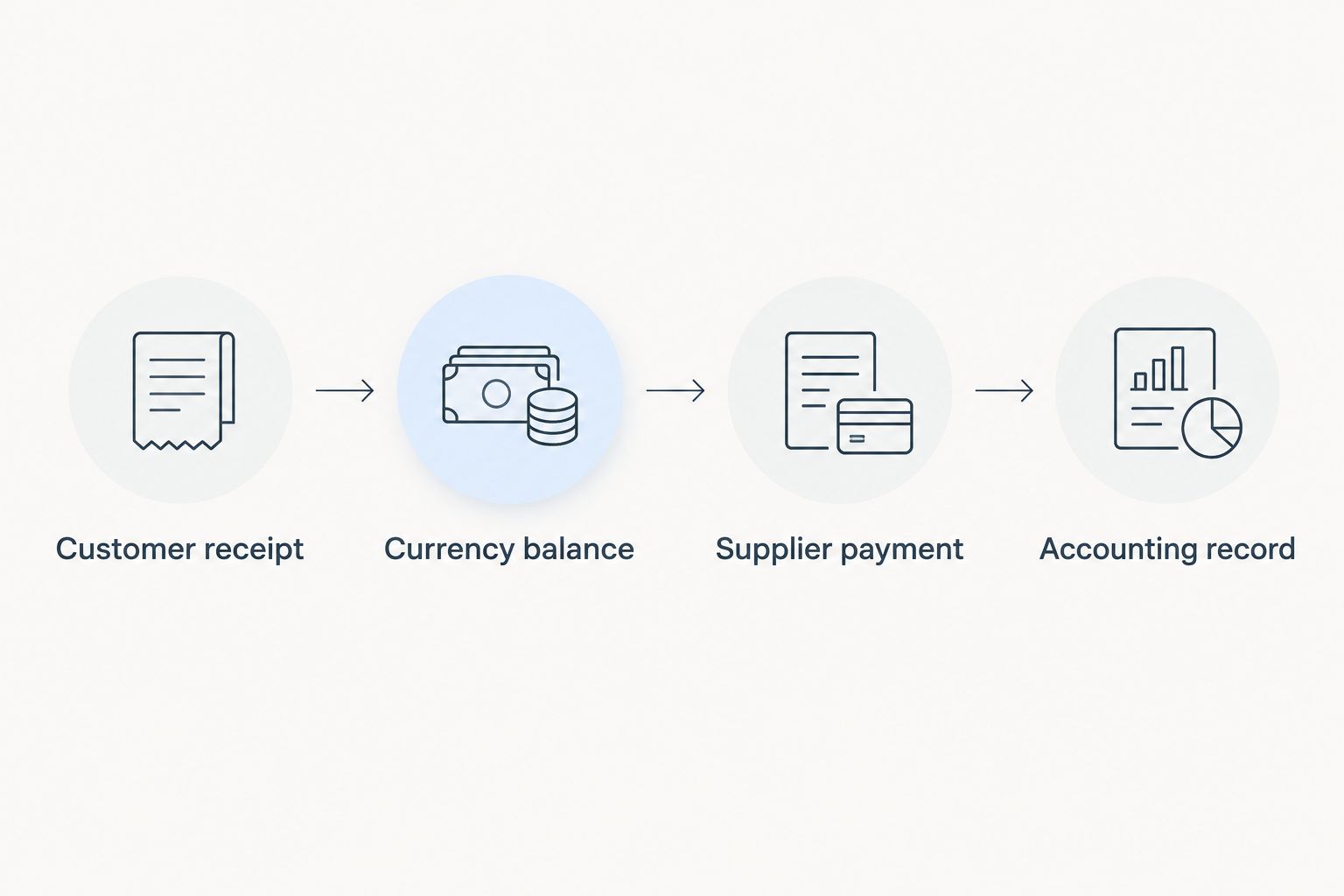
A provider that passes the receiving stage but fails your supplier-payment requirement is not a complete fit. Decide whether a separate service is an intentional part of your setup or an unresolved gap.
How the options are ranked
The ranking prioritises the stated use case: African businesses receiving international payments while managing business money. The criteria are receiving details, currency holding, supplier payments, operational controls and legal structure.
The first recommendation has explicitly described capabilities across that workflow. The remaining entries identify alternative account models for different requirements; their position is not a performance score or a finding that every provider in one category beats another.
Which multi-currency account should you choose?
Zeam is best for African businesses that want USD and EUR collections alongside business money management. Choose a bank-based account instead when holding bank deposits is a non-negotiable requirement.
For your 2026 decision, separate essential functions from future possibilities. A business that only needs international collections has a different brief from one coordinating supplier payments, approvals and cash-flow planning.
Use a written acceptance checklist before opening an account:
- Your business and intended activity qualify.
- Customer receiving instructions match your invoice process.
- Required currencies can be received, held and paid as needed.
- The selected plan includes essential payment and team functions.
- The legal treatment of the balance meets your requirements.
Do not trade away a required capability for an impressive feature list. An account earns its place by supporting the transactions your business needs to complete.
FAQ
What is the best multi currency account for African businesses in 2026?
Zeam is a strong fit for African businesses that need USD and EUR collections alongside business money management. It supports receiving details in the business’s name, multiple currency balances and payment tools; choose a bank-based account instead when bank deposits are required.
Is a multi-currency account the same as a bank account?
No. A multi-currency service can hold digital balances rather than bank deposits, so check the legal structure and applicable protection terms before opening an account.
Can an African business receive USD and EUR in its own name?
The described offering supports USD and EUR payments from US and European clients using receiving details in the business’s name. Confirm your business’s eligibility and the relevant payment instructions before invoicing customers.
Does receiving a currency mean I can hold it?
No. Receiving, holding, converting and sending are separate capabilities, so check each required currency against each stage of your payment cycle.
Should I choose a collection-focused account or a treasury-led setup?
Choose a collection-focused account when getting customer payments into the business is the main requirement. Choose a treasury-led setup when cash allocation, forecasting and payment governance are active operational needs.
What should I check before opening a business multi-currency account?
Check business eligibility, receiving details, currency holding, supplier payments, operational controls and legal structure. Then follow a customer receipt through to an outgoing payment and the accounting record.
One last thing
The most useful currency is not always the currency you convert first. Before converting a customer receipt, check whether an upcoming supplier obligation is payable in the same currency and whether your account supports that payment.
Make that a decision rule in your 2026 money-management process. Receiving, holding and spending are separate choices; assess the account against all of them.