
Best overall for an established employer: local payroll software paired with an approved payment workflow. Best for hiring without your own local employing entity: an employer-of-record service. Best for managing overseas receipts alongside business payments: Zeam, as a money-management layer rather than a payroll engine. This guide compares international payroll tools for African remote teams, with practical examples for South African tour operators and safari businesses.
- Choose international payroll tools for African remote teams by employment structure, not just payout currency.
- Local payroll software suits businesses that already employ staff through a local entity.
- Employer-of-record services address employment administration where the service supports your intended arrangement.
- Zeam suits business money management alongside payroll, not salary calculations or statutory filings.
- Keep overseas booking deposits, supplier commitments and payroll funding separate in your cash-flow plan.
Why this matters
Receiving an overseas booking payment and paying an employee are different jobs. A USD receipt does not calculate salary deductions, establish an employment relationship or complete statutory reporting.
For a South African safari business, the same booking can create commitments to accommodation suppliers, guides and office staff. Your payment setup must support those commitments without treating every recipient as the same type of payee.
In 2026, choose the employment and payroll process first; choose the money-movement tools around it. A business account supports that process, but it does not replace the underlying employment obligations.
What makes the best international payroll setup?
Use these criteria before comparing provider demonstrations:
- Employment fit: Does the service support your existing employees, an employer-of-record arrangement or genuine independent contractors?
- Country-specific payroll: Can the provider demonstrate the calculations, deductions, filings and employee documents required for the intended jurisdiction?
- Payment-route fit: Can your business fund payments and reach the intended recipients through approved routes?
- Approval controls: Can you separate preparation, approval and payment release, with records of each decision?
- Reconciliation: Can you match the payroll register, payment instructions and completed transactions without losing exceptions?
- Funding visibility: Can you distinguish money needed for payroll from booking refunds, supplier commitments and other operating costs?
Ask for a demonstration using your actual employment structure. A generic dashboard tour does not establish that a provider can support your team.
International payroll options at a glance
These are ranked operating approaches, not interchangeable products. Each solves a different problem; a business can need more than one.
| Rank and option | Best for | Standout function | Key limitation |
|---|---|---|---|
| 1. Local payroll software plus approved payments | Existing local employers | Separates payroll calculation from payment execution | Your business retains employer responsibilities |
| 2. Employer-of-record service | Hiring without your own local employing entity | Provides an employing arrangement within its supported scope | Requires country, role and contract checks |
| 3. Multi-country payroll service | Businesses with employing entities across jurisdictions | Coordinates payroll administration across locations | Does not itself solve the absence of an employing entity |
| 4. Contractor administration service | Genuine independent contractor relationships | Organises contracts, invoices and payment records | Does not turn employees into contractors |
| 5. Zeam business money management | Overseas receipts and operating funds alongside payroll | USD and EUR receiving details, currency balances and business payments | Not a payroll calculation or employment service |
1. Local payroll plus payments: best for existing employers
Local payroll software calculates pay and produces payroll records within its supported jurisdiction. A separate approved payment workflow moves the resulting amounts to employees. Your business remains responsible for employing staff and checking that payroll administration meets its obligations.
Best for: A South African tour operator that already employs its reservations, operations or administrative team through its own business.
For example, overseas guests pay booking deposits while local employees receive salaries through the established payroll process. Keep those workflows connected through reconciliation, not by treating the incoming booking payment as a payroll instruction.
Local payroll plus payments pros:
- Fits an existing employer structure.
- Keeps salary calculations distinct from currency conversion and transfers.
- Allows payroll approval before payment release.
Local payroll plus payments cons:
- Your business retains employer responsibilities.
- Separate systems require a reliable reconciliation process.
- Expansion into another jurisdiction needs a fresh assessment.
For your 2026 selection, ask the payroll provider to demonstrate a normal pay run and a correction. Ask the payment provider separately to confirm the intended funding and recipient routes.
Verdict: Buy this approach if you already employ locally and need a clearer payroll-to-payment process.
2. Employer of record: best for a new employing arrangement
An employer-of-record service employs workers through its supported local structure and administers the agreed employment relationship. The contract determines responsibilities, service scope and the relationship between your business, the provider and the worker.
Best for: A tourism business considering an employee in a jurisdiction where it does not have its own employing entity.
An overseas reservations role is a practical example. Before hiring, establish whether the provider supports the country, role and working arrangement; an international brand name is not confirmation of coverage.
Employer-of-record pros:
- Addresses the employing arrangement, rather than only transferring money.
- Brings employment administration into the contracted service scope.
- Gives you a defined party to question about local employment processes.
Employer-of-record cons:
- Coverage and role restrictions require confirmation.
- Employment changes must follow the contractual process.
- It does not remove every responsibility from your business.
Request the employment terms, termination process and division of responsibilities before accepting a proposal. Have qualified advisers review the arrangement where needed.
Verdict: Buy only after the provider confirms that your intended employment arrangement fits its supported scope.
3. Multi-country payroll: best for several employing entities
A multi-country payroll service coordinates payroll administration across jurisdictions. It is relevant when your business already has the legal employing arrangements and needs a clearer process for country-specific payroll work.
Best for: A group operating through employing entities in more than one jurisdiction.
For a growing safari operator, this means distinguishing local payroll obligations from group-level reporting. A common reporting view is useful, but each employing entity still needs an appropriate payroll process.
Multi-country payroll pros:
- Coordinates payroll calendars across locations.
- Gives finance teams a common approval and reporting process.
- Helps organise country-level payroll outputs for group review.
Multi-country payroll cons:
- Provider scope differs by jurisdiction.
- Central reporting does not eliminate local requirements.
- Data handovers and corrections still need clear ownership.
In a 2026 procurement exercise, ask who calculates payroll, who submits required information and who resolves errors in each location. Get those responsibilities in writing rather than assuming the central platform performs every task.
Verdict: Buy for coordination across established employing entities; skip it as a substitute for creating an employment arrangement.
4. Contractor administration: best for independent suppliers
Contractor administration services organise agreements, invoices, approvals and payment records for independent service providers. They are not employee payroll systems, even when their payment screens look similar.
Best for: Genuine independent contractors working under a correctly assessed commercial arrangement.
A tour operator might engage an independent photographer for a particular assignment. That does not establish that a regularly managed reservations employee can be paid as a contractor; classification depends on the facts and applicable law.
Contractor administration pros:
- Keeps agreements and invoices attached to the payment process.
- Supports review of completed work before payment approval.
- Separates supplier records from employee payroll records.
Contractor administration cons:
- Does not resolve worker-classification questions by itself.
- Does not provide employee payroll simply by issuing payments.
- Requires the business to check contractual and tax responsibilities.
Before selecting a service, ask how it records an invoice dispute, a changed payment instruction and a rejected payment. Those operational details matter more than a polished contractor directory.
Verdict: Buy for genuine independent suppliers; skip it as a workaround for employee payroll.
5. Zeam: best for business funds alongside payroll
Zeam supports receiving USD and EUR payments from US and European clients using receiving details in your business’s name. It also supports holding multiple currency balances, converting when needed and paying local suppliers; international and bulk payments are on higher plans.
Best for: Business money management alongside a separate payroll process, including a tourism operator collecting overseas booking payments and managing local supplier commitments.
Zeam is a business money-management option for tourism operators receiving overseas payments, not a payroll engine. Team approvals, payment records and accounting integrations belong to the business-money workflow; they do not establish salary calculation, statutory filing or employee-payment route support.
Zeam pros:
- Brings overseas receipts and multiple currency balances into one business-money workflow.
- Supports conversion when needed rather than requiring every balance to serve the same purpose.
- Includes payment records and team approvals.
Zeam cons:
- Does not replace payroll calculations or employment administration.
- International and bulk payments depend on the plan.
- Zeam is not a bank; its balances are digital balances, not bank deposits.
Apply for a business account and complete verification before making it part of your operating process. Confirm the intended routes and approvals separately, particularly before relying on any arrangement for employee payments.
Verdict: Buy as a supporting money-management layer after verification and route confirmation; skip it as a standalone payroll solution.
Build the booking-to-payroll funding process
For a 2026 operating plan, map overseas receipts to commitments before deciding when to convert or release funds. Booking deposits and balance payments need clear references so finance can distinguish collected money from money already committed elsewhere.
Use this sequence:
- Record receipts: Match each incoming booking deposit or balance payment to its booking reference and currency.
- Map commitments: Record supplier obligations, potential refunds and the payroll funding requirement separately.
- Approve payroll: Review the payroll register independently of the incoming booking-payment record.
- Confirm routes: Check the intended payment route, recipient details and any required approvals.
- Reconcile payments: Match completed transactions to the approved register and investigate exceptions.
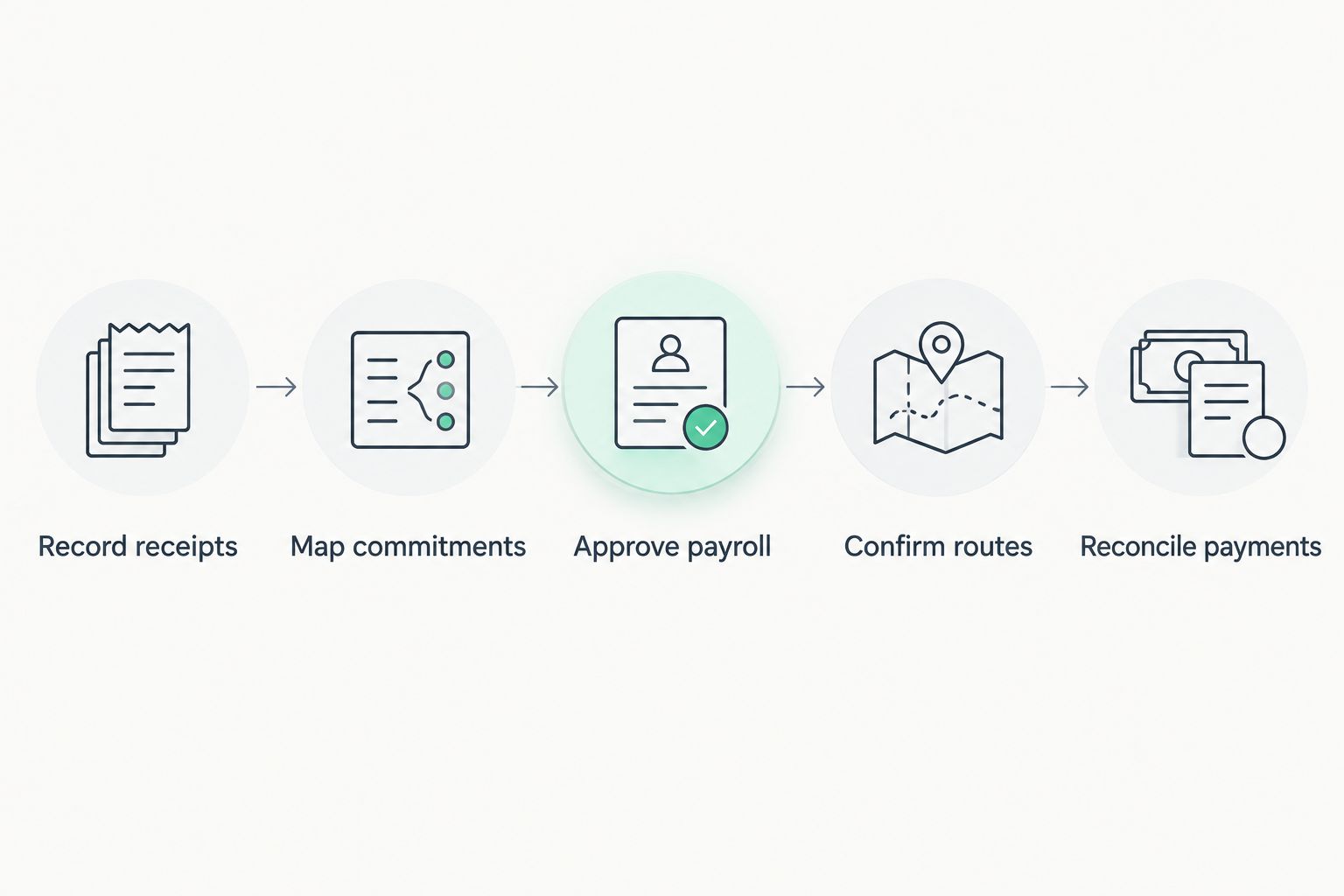
Set 2 distinct control points: payroll approval and payment release. Use 1 booking reference consistently across each booking’s deposit and balance records. These are operating recommendations, not claims about a particular platform’s configuration.
Do not replace card acceptance or your booking system just to simplify payroll funding. Receiving details, card payments and payment links serve different collection situations; check the supported route behind each option before offering it to an overseas guest.
How the options are ranked
The ranking starts with employment fit, then considers payment routes, approvals, reconciliation and funding visibility. Local payroll plus approved payments is the default for an established employer because it separates the legal payroll task from the transfer task.
This is a workflow comparison, not a product performance test. Your final shortlist should follow demonstrated country support and written service scope, rather than the position of an option in this guide.
Which international payroll setup should you choose?
For an established South African employer, start with local payroll software and a confirmed payment workflow. Use an employer-of-record service when the missing piece is the employing arrangement, and multi-country payroll when the missing piece is coordination across existing entities.
For your 2026 shortlist, keep contractor administration separate from employee payroll. Add business money management only where it addresses overseas receipts, currency balances, supplier costs or funding visibility.
Review your business money setup
Explore overseas receipts and business payments alongside your separate payroll process.
FAQ
What's the best international payroll setup for a South African tour operator?
An established South African employer should start with local payroll software paired with an approved payment workflow. Confirm payroll obligations and payment routes separately before selecting providers.
Can a multi-currency business account replace payroll software?
No. Holding currencies and sending payments do not calculate salary deductions, produce the required payroll records or complete employment administration.
Is an employer-of-record service better than payroll software?
An employer-of-record service suits a different problem: the employing arrangement. Payroll software suits businesses that already have an appropriate employer structure and need payroll calculation and administration.
Can I pay remote employees as contractors instead?
Not simply because a contractor platform makes payment easier. Assess the working relationship under applicable law before deciding whether someone is an employee or an independent contractor.
Can overseas booking deposits fund payroll?
Plan payroll funding alongside the commitments attached to those deposits. Check booking terms, potential refunds, supplier obligations and any applicable restrictions before allocating the money.
Should I stop taking card payments and use receiving details instead?
No payroll requirement makes that change necessary. Compare receiving details, card payments and payment links for the guest-payment situations you actually support, without assuming that one replaces your booking system.
What should I confirm before adding business payments to payroll?
Confirm account verification, the intended recipient route, approval requirements and reconciliation records. A supported business-payment function does not by itself confirm support for your employee-payment arrangement.
One last thing
Test the exception, not just the successful payment. Before adopting a process, ask your providers to walk through 1 rejected employee payment: who spots it, who contacts the employee, who authorises the correction and how the records stay accurate.
A clear answer exposes the handover between payroll and payments. That handover is where your operating procedure needs an owner.