
Best overall for receiving overseas booking payments and managing supplier money: Zeam, with bulk payments on higher plans. For bulk payment tools for African marketplaces in 2026, an existing bank’s batch workflow suits established supplier lists, a payout API suits transaction-driven payouts, and a booking-connected workflow suits reservation-led reconciliation—provided each supports your required routes and controls.
- Zeam leads bulk payment tools for African marketplaces needing USD and EUR receipts alongside supplier payments; bulk payments require higher plans.
- Business-bank batch workflows suit established supplier lists when the bank supports the required destinations and approval controls.
- Payout APIs suit transaction-driven distributions only after recipient eligibility, funding routes and failure handling are confirmed.
- South African tourism marketplaces should separate guest collection, booking reconciliation and supplier payouts before choosing tools.
Why this matters
A South African tourism marketplace has two different payment problems: collecting money from overseas guests and paying the businesses delivering their trips. Solving one does not solve the other. A successful booking payment still needs a booking reference, an allocation to suppliers and a decision about when money can leave.
For a tour operator or safari business, the practical question in 2026 is not simply whether a tool offers bulk payments. It is whether the tool fits the journey from an overseas deposit to a local supplier payment without losing the booking record or releasing money prematurely.
This guide ranks payment approaches by their operational fit. It does not treat business supplier payments, automated seller distributions and guest card acceptance as interchangeable services.
What makes the best bulk payment tools for African marketplaces
Choose against these criteria before comparing dashboards:
- Recipient and route fit: Confirm the paying business, recipient location, destination currency and payment route. An African business focus does not establish eligibility everywhere.
- Collection-to-payout fit: Check whether incoming booking funds can support the intended supplier payment workflow. Receiving details and payout destinations are separate checks.
- Booking-level records: Require a workable way to connect the guest payment, supplier obligation and outgoing payment to the same booking.
- Approval control: Check who creates beneficiaries, who approves payments and whether changes require another review.
- Exception handling: Ask how rejected, returned, duplicate and incomplete payments appear, and how the business resolves them.
- Plan and implementation fit: Confirm the relevant plan, verification requirements and any integration work before making the tool part of your booking process.
For your 2026 shortlist, treat any unresolved route or approval requirement as a reason to pause—not as a detail to fix after launch.
Bulk payment approaches at a glance
The first option is a named provider with capabilities stated in its product description. The remaining options are workflow categories to assess with your existing providers, not claims about unspecified products.
| Rank and option | Best for | Standout fit | Key limitation |
|---|---|---|---|
| 1. Zeam | Overseas booking receipts and supplier-money management | USD and EUR receiving details in the business’s name, multiple currency balances and local supplier payments | Bulk and international payments are on higher plans; required routes need confirmation |
| 2. Business-bank batch workflow | Established supplier lists | Keeps the proposed batch process within the business’s banking workflow | Batch support, destinations and approval controls depend on the bank |
| 3. Payout API workflow | Transaction-driven supplier distributions | A way to design payout instructions around marketplace events | Requires engineering and confirmation of recipient, funding and reconciliation support |
| 4. Booking-connected payout workflow | Reservation-led supplier settlement | Starts payment preparation from booking obligations | Booking records do not establish payment execution or destination support |
1. Zeam: best for overseas receipts and supplier payments
Zeam combines international receiving capabilities with business-money management. Businesses can receive USD and EUR payments from US and European clients using receiving details in their business’s name, hold multiple currency balances and convert when needed. Local supplier payments are included in the stated capabilities; international and bulk payments are on higher plans.
For a South African safari operator, the relevant situation is an overseas booking deposit followed by payments to local suppliers. The fit depends on approval of the business account and confirmation of the specific receiving and outgoing routes. Do not assume every guest’s payment method or every supplier destination is supported.
Zeam pros:
- Receiving details are in the business’s name for the stated USD and EUR use cases.
- Multiple currency balances let the business separate holding funds from converting them.
- Payment records and team approvals support a controlled payment workflow.
- Accounting integrations and treasury tools form part of the stated capabilities; confirm the particular requirements before relying on them.
Limitations:
- Bulk and international payments require higher plans.
- The stated capabilities do not establish automated marketplace split payments or every recipient route.
- Zeam is not a bank; its balances are digital balances, not bank deposits.
Best for: Tourism businesses that need overseas receipts and supplier-money management together, rather than a payout-only component.
Verdict: Buy only after business verification, plan suitability and the required payment routes are confirmed.
2. Business-bank batch workflow: best for established supplier lists
A business-bank batch workflow is the first alternative to assess when your supplier relationships and payment controls already sit with a bank. Ask whether the bank supports grouped payment instructions for your particular account and destinations. Do not assume a business account automatically includes batch processing.
This approach fits a tourism operator preparing supplier payments from an agreed schedule rather than generating a separate payout after every booking event. Its suitability rests on the bank’s actual batch format, authorisation process and payment-status records.
Business-bank batch workflow pros:
- Starts with an existing banking relationship rather than a new provider selection.
- Can be assessed against the supplier list the business already maintains.
- Gives an operations team a clear process to evaluate: prepare, approve, submit and reconcile.
Business-bank batch workflow cons:
- Batch processing and destination support must be established with the bank.
- A payment batch does not itself connect each transfer to the original guest booking.
- Manual preparation remains a risk if booking records and payment instructions are maintained separately.
Best for: Businesses with stable supplier lists and a scheduled settlement process.
Verdict: Hold until a sample batch demonstrates the required references, approvals and payment-status records.
3. Payout API workflow: best for transaction-driven distributions
A payout API workflow connects software-generated payment instructions to a payment provider. Assess this approach when your marketplace needs payout logic tied to defined events, such as an approved supplier obligation. The event alone must not authorise a transfer without the required business controls.
The key decision is architectural: does your operation need software-directed distributions, or does it simply need a reviewed supplier batch? An API should solve a defined workflow problem, not become an engineering project in search of one.
Payout API workflow pros:
- Makes the rules for generating payment instructions explicit.
- Creates a defined place to connect booking identifiers with payout instructions.
- Supports a detailed assessment of submission, status checking and exception handling before implementation.
Payout API workflow cons:
- Requires engineering ownership and ongoing operational support.
- API access does not prove that the required recipient countries or currencies are supported.
- Failed requests and uncertain payment status need a documented resolution process.
Best for: Marketplaces whose payment instructions depend on transaction events and whose teams can maintain the integration.
Verdict: Hold until recipient eligibility, funding, duplicate prevention and reconciliation have been demonstrated.
4. Booking-connected payout workflow: best for reservation-led settlement
A booking-connected payout workflow starts with the reservation record and the supplier obligations attached to it. It then prepares payment instructions for an appropriate payment service. The booking system is the source of operational context, not automatically the executor of supplier payments.
For a safari itinerary involving accommodation, transport and activities, this approach keeps the payment decision tied to what the business owes. Confirm whether the connection is an export, a manual process or a supported integration; none is established merely because a booking system records suppliers.
Booking-connected payout workflow pros:
- Starts from the booking and its supplier obligations.
- Keeps deposit and balance-payment decisions connected to the reservation.
- Makes changes to the itinerary relevant to the payment review.
Booking-connected payout workflow cons:
- Requires a separate check of how payments are actually executed.
- Booking changes must reach the payment preparation process before submission.
- A recorded supplier obligation does not establish that the supplier has been paid.
Best for: Tourism businesses whose main problem is translating reservations into accurate supplier settlement instructions.
Verdict: Hold until the booking-to-payment hand-off produces traceable instructions and confirmed outcomes.
Keep guest collection separate from supplier payouts
For a 2026 tourism payment setup, compare receiving overseas transfers with card collection and payment links on the guest side. Then assess bulk payments on the supplier side. A payment link is a way to direct a payer into a collection flow; it is not, by itself, evidence of a particular payment method or payout capability.
| Collection approach | Useful when | Advantage to assess | Limitation to check |
|---|---|---|---|
| Overseas receiving details | A client will pay by a supported transfer route | Business-name details and a clear invoice reference | Payer route, currency and how receipt is confirmed |
| Card acceptance | A guest wants to pay by card | Fit with the guest’s preferred checkout method | Provider terms, disputes and settlement arrangements |
| Payment link | A guest needs a payment request outside checkout | Connection between the request and the booking | Underlying payment methods and reconciliation support |
Do not remove card acceptance simply because overseas receiving details are available. Likewise, do not assume a payment link replaces your booking system. Choose the collection method the guest can use, then preserve the booking reference through the supplier-payment process.
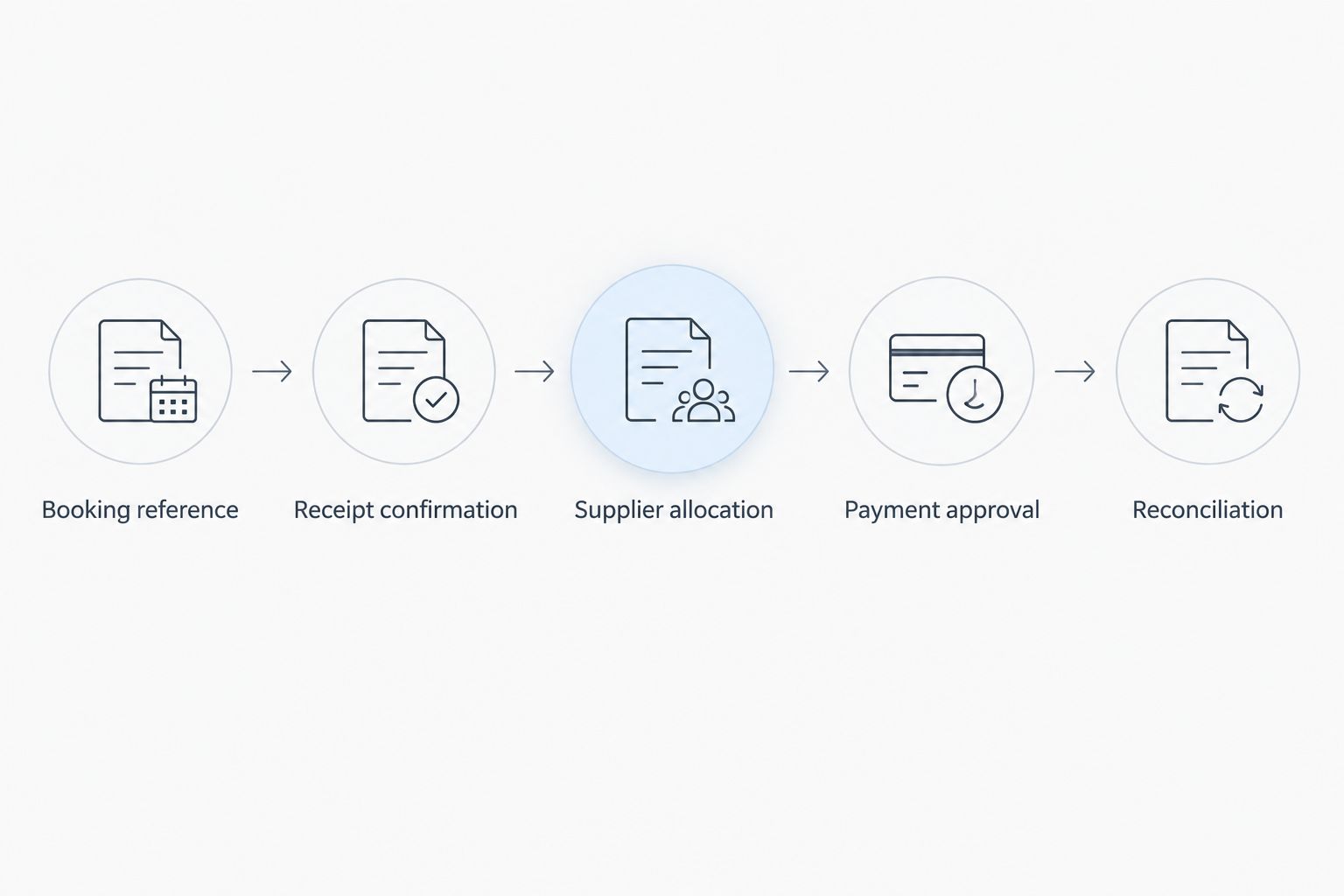
Build the booking-to-supplier payment sequence
Use 2 payment stages—deposit and balance—as separate booking events. Neither should become an automatic instruction to pay every supplier. The booking terms, supplier obligations and approved payment schedule determine the next action.
Booking reference
Use 1 booking reference across the invoice, payment request, receipt record and supplier allocation. Record the payer’s name as well, especially when the person paying is not the lead traveller.
Receipt confirmation
Check the payment’s recorded status before treating it as received. A guest’s transfer confirmation is supporting information, not a substitute for checking your own payment records.
Supplier allocation
Record what each supplier is owed and when payment is authorised. If the guest pays in USD or EUR and supplier obligations are local, keep the conversion decision visible rather than burying it inside a booking total.
Payment approval
Review recipient details, amount, currency, reference and authorisation before submission. A revised itinerary or changed beneficiary should trigger another check of the payment instructions.
Reconciliation
Keep 3 records together: the booking, the incoming receipt and the outgoing supplier payment. Mark incomplete or rejected payments as unresolved until the outcome is established; do not treat submission as completion.
Apply and verify before changing your payment instructions
Before adopting Zeam for a 2026 booking-payment workflow, apply for a business account and complete verification. Confirm suitability for your South African tourism business, the intended USD and EUR receipts, local supplier destinations and the higher-plan bulk-payment requirement.
Ask for the current requirements rather than inventing a document checklist. Also confirm how team approvals, records and any accounting connection work for your actual process. Only issue new payment instructions after the relevant account capabilities and receiving details are confirmed.
Start your business account application
Apply and complete verification, then confirm the receiving routes and supplier-payment capabilities you need.
How the ranking works
The ranking prioritises the stated South African tourism use case: overseas booking receipts, currency management and local supplier payments. The other approaches each own a different operational role—existing-bank batches, software-directed distributions or reservation-led preparation. None receives an assumed feature, approval or route guarantee.
Which bulk payment approach should you choose?
Choose Zeam for overseas booking receipts and supplier-money management when verification, plan and route checks confirm the fit. Choose a bank batch workflow for an established supplier schedule, an API for transaction-driven instructions, or a booking-connected workflow when reservation reconciliation is the main gap.
Your 2026 decision should follow the payment journey, not the longest feature list. If a provider cannot explain an unresolved payment or preserve your booking reference, stop before making it part of your supplier process.
FAQ
What's the best bulk payment tool for a South African tourism marketplace?
The best fit depends on whether the business needs overseas receipts, scheduled supplier batches or transaction-driven distributions. Confirm business approval, payment routes, supplier destinations and reconciliation before selecting a tool.
Can overseas booking deposits fund local supplier payments?
Only use received booking funds for supplier payments after checking the payment status, supplier obligation and applicable account capabilities. Keep the incoming receipt and outgoing payment linked to the booking.
Does a bulk payment tool replace card acceptance?
No, bulk supplier payments and guest card acceptance serve different purposes. Keep a suitable guest collection method and assess outgoing supplier payments separately.
Is a payment link the same as a bulk payment tool?
No, a payment link directs a payer into a collection flow, while a bulk payment tool handles grouped outgoing instructions. Check the link's underlying payment methods and booking-reference support.
Do African marketplace payment tools support every African country?
Do not assume continent-wide support. Confirm the paying business's eligibility, each recipient destination, the currencies and the specific payment routes.
Should a safari operator choose a payout API?
Choose a payout API only when software-directed payment instructions solve a defined operational need. The business also needs engineering ownership, approval controls and a process for failed or uncertain payments.
What should a tourism business check before submitting a supplier batch?
Check beneficiary details, amount, currency, booking reference and payment authorisation. After submission, reconcile each outcome rather than marking the entire batch complete automatically.
One last thing
Write the exception process before submitting the first supplier batch. Decide who investigates an unmatched receipt, who handles a changed beneficiary and who authorises a retry. A tidy payment file is useful; a clear response when a payment fails is essential.