
Best for international money management: Zeam. Best for collecting ad hoc card deposits: Yoco. Best for a reusable payment page: Paystack. This 2026 guide compares a payment link tool for African online sellers through the practical needs of South African tour operators and safari businesses collecting overseas booking payments.
- Zeam suits tourism businesses combining USD and EUR receipts, multi-currency balances and local supplier payments.
- Yoco is the card-first shortlist choice for sending individual booking deposit requests.
- Paystack suits reusable payment pages for clearly defined offers, subject to merchant approval.
- Choose a payment link tool for African online sellers by guest checkout, settlement and booking reconciliation.
- Receiving details, card payment links and booking systems serve different jobs; do not treat them as interchangeable.
Why this matters
A guest agreeing to a safari itinerary is not the same as your business having usable funds for accommodation, guides and transport. Your payment setup must connect the booking request, the guest's payment and the supplier obligations that follow.
For your 2026 shortlist, separate collecting money from managing it. Zeam combines payment-link management with international receiving details and business-money functions; that does not establish that every payment link accepts every overseas card or settles through the same route.
Choose the collection method first, then check where the money arrives. A convenient checkout does not remove the need to track the remaining booking balance or arrange supplier payments.
What makes the best payment link tool for African online sellers?
Use these criteria before comparing logos:
- Guest payment method: Establish whether the guest will pay by card, bank transfer or another supported method. A link alone does not identify the payment route.
- Business approval: Confirm that your business country, activity and intended transactions qualify before putting the provider into your booking instructions.
- Currency handling: Separate the currency shown to the guest from the currency you receive and the currency needed for suppliers.
- Booking reconciliation: Check how you will connect a payment with the correct itinerary, deposit request and outstanding balance.
- Refund and dispute handling: Understand the provider's process alongside your own cancellation terms. A payment tool does not write your booking policy.
- Supplier workflow: Decide whether you need only collection or also balances, conversion, local payments and team approvals.
The best tool matches a specific payment job, not the longest feature list. For an owner handling reservations personally, clear payment status and booking references deserve as much attention as the checkout page.
Payment link tools at a glance
These are workflow recommendations for 2026, not a ranking based on transaction testing. Merchant approval and supported payment routes remain conditions of use.
| Tool | Best for | Standout function | Key limitation |
|---|---|---|---|
| Zeam | International receipts and business-money management | USD and EUR receiving details in the business's name, alongside multi-currency balances and payment-link management | Receiving details do not establish the card methods available through payment links; digital balances are not bank deposits |
| Yoco | Ad hoc card deposits for individual bookings | Shareable payment links for card collection | A card collection tool does not, by itself, manage itinerary capacity or supplier commitments |
| Paystack | Reusable payment pages for defined offers | Hosted Payment Pages that can be shared with customers | A reusable page still needs a process for matching payments to bookings and checking capacity |
A payment page and a booking system are different products. None of these recommendations assumes that accepting a payment automatically reserves a room, guide, vehicle or departure slot.
1. Zeam: best payment tool for international money management
Zeam is best for tourism businesses that need overseas receiving details and multi-currency money management alongside payment links. The product lets businesses receive USD and EUR payments from US and European clients using receiving details in the business's name, hold currency balances and convert when needed.
That combination addresses more than the checkout moment. Consider a safari operator receiving an overseas booking payment while preparing to pay local accommodation and transport suppliers: receiving, holding, converting and paying are separate decisions within the same booking workflow.
Where it fits
Use this option when international receipts and business-money administration are central to your decision. The product also includes payment links, records, accounting integrations and team approvals; international and bulk payments sit on higher plans.
Do not assume that the receiving-details route and the payment-link route have identical currencies, methods or approval requirements. Confirm the exact collection route you intend to offer guests.
Pros:
- Combines international receiving details with multiple currency balances.
- Supports local supplier payments alongside collection and records.
- Includes team approvals for businesses separating payment preparation from authorisation.
- Provides additional treasury functions as business needs grow.
Cons:
- It is not a bank; balances are digital balances rather than bank deposits.
- International and bulk payments depend on the plan.
- Its stated functions do not establish that it replaces card acceptance or a booking system.
Best for: An operator evaluating overseas receipts and supplier payments together, rather than seeking only a card checkout link.
Before relying on the service for a live booking, apply for a business account, complete verification and confirm the relevant route. Verdict: Hold until verification and route checks are complete; then choose it for the wider money-management workflow.
2. Yoco: best payment link tool for ad hoc card deposits
Yoco offers payment links for collecting card payments without requiring the guest to use a physical card machine. That makes Yoco a relevant shortlist option when your immediate task is sending a card payment request for an individually quoted booking.
For a tour operator, the use case is straightforward: agree the itinerary and deposit terms, then send payment instructions connected to that booking. The link handles collection; your reservation process still handles the itinerary, guest details and supplier confirmations.
Where it fits
Yoco belongs in the comparison when guests want to pay by card and you need a remote collection method. Before adopting Yoco in 2026, check merchant approval, accepted cards, the guest-facing currency and settlement arrangements for your intended transactions.
Do not turn the existence of a payment link into a promise that every international guest can pay successfully. Confirm the relevant payment conditions before offering the method as your only option.
Pros:
- Provides a card-payment collection route that you can share remotely.
- Fits the task of requesting payment after a personalised quotation.
- Lets you keep the collection decision separate from replacing your booking process.
Cons:
- Card disputes require their own evidence and response process.
- Payment collection does not confirm supplier capacity or reserve inventory.
- You still need to establish how each payment will match the correct booking.
Best for: A South African operator whose immediate requirement is an individual card deposit request, subject to approval and payment-method checks.
Ask how payment status, refunds and settlement records will fit your existing administration. Verdict: Choose Yoco for the card-deposit shortlist; do not treat it as the entire booking operation.
3. Paystack: best payment link tool for reusable payment pages
Paystack offers hosted Payment Pages that businesses can share with customers. Paystack suits a different job from an individually negotiated payment request: presenting a reusable collection page for a clearly defined offer.
A defined excursion or standard booking deposit is a useful scenario to assess. Before publishing the page, decide how the payer will identify the booking and how your team will prevent payment for an unsuitable date or an unconfirmed place.
Where it fits
Paystack deserves consideration when you want a reusable destination for payment rather than issuing every request from scratch. Review the Payment Pages configuration against your actual booking process, including the information needed to identify the guest and payment purpose.
For a 2026 implementation, verify business eligibility and supported methods directly. A page that opens in a browser is not evidence that every customer country, currency or payment route is supported.
Pros:
- Provides a hosted payment page that you can share without building checkout yourself.
- Fits clearly described offers that use a repeatable collection process.
- Gives your team a single payment destination to assess for a defined booking use case.
Cons:
- A reusable payment page does not, by itself, check tour capacity.
- Variable itineraries need controls to prevent payment against an outdated quotation.
- Booking identification and reconciliation remain operational requirements.
Best for: An operator collecting against a defined offer with a clear process for confirming capacity and identifying each payer.
Keep the offer description, payment purpose and booking instructions aligned. Verdict: Choose Paystack for the reusable-page shortlist; skip that format when every itinerary needs a separate quotation and approval.
Build the booking-payment workflow before sending links
Use 2 payment milestones when your booking terms call for a deposit and a later balance. Set the amounts and due dates from your own terms and supplier obligations, not from a generic payment-link template.
The workflow below separates payment collection from booking confirmation. Keep those decisions distinct even when the same person handles both.
Quote approval
Record the itinerary, guest details, agreed currency and cancellation terms. Get the booking terms accepted before sending a payment request, and make the request consistent with the latest quotation.
Deposit request
Use 1 booking reference across the quotation, payment request and internal record. Tell the guest what the deposit relates to and how your business will confirm receipt; do not promise confirmation based solely on a screenshot.
Receipt matching
Check the provider's payment record and the relevant balance or settlement information. Record what was received, the currency and any remaining amount due before marking the deposit milestone complete.
Balance request
Check the outstanding booking amount before requesting the balance. If the itinerary has changed, update the quotation and payment instructions together rather than leaving conflicting versions in email threads.
Supplier payment
Pay according to the supplier agreement and your internal approval process. Do not assume that a guest's completed checkout means funds are ready for every onward payment route.
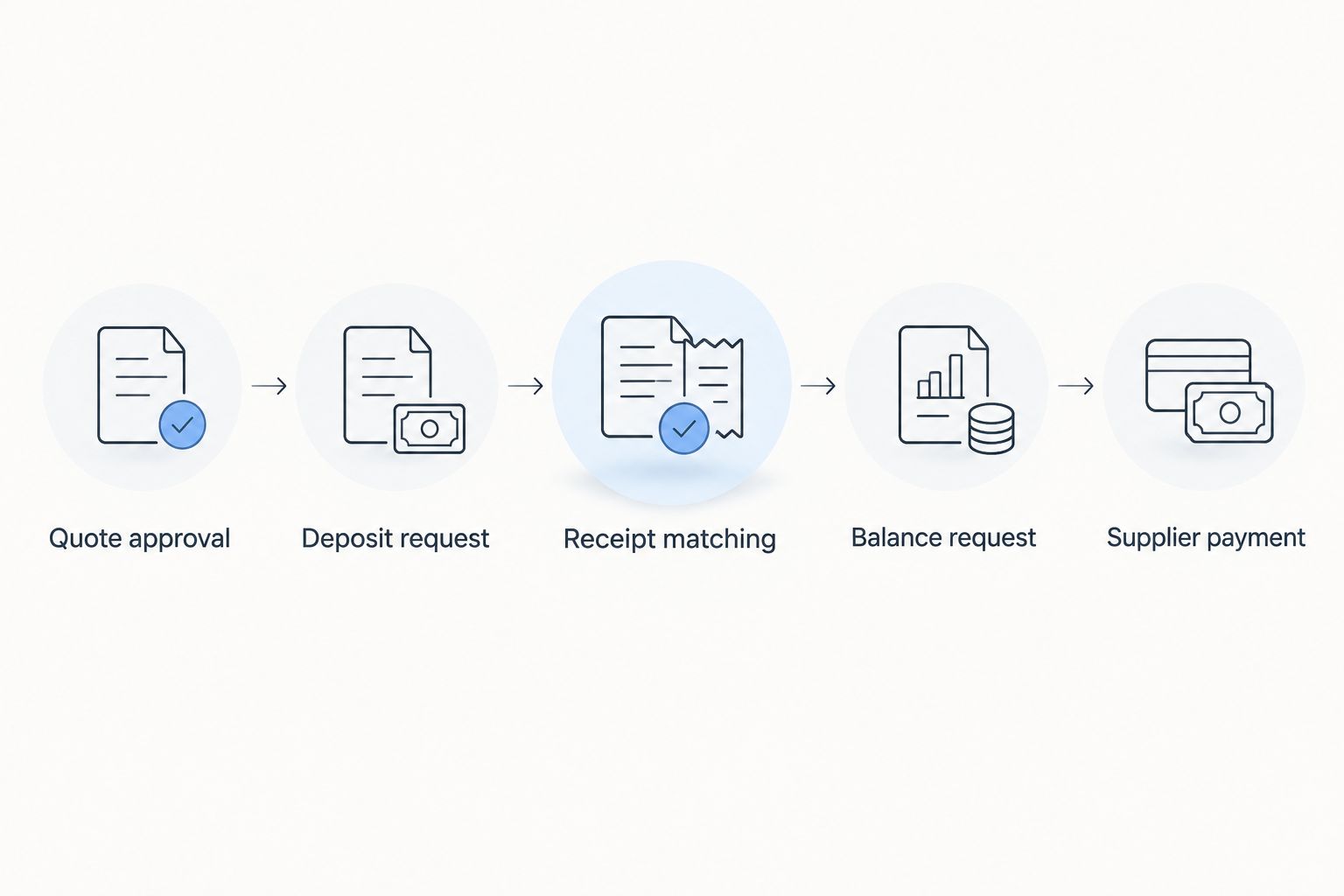
Reconcile 3 records before closing the booking financially: the customer booking record, the payment-provider record and the supplier payment record. This is a recommended control, not a claim that any listed tool automatically performs the reconciliation.
Apply and verify before changing guest instructions
For international receiving and business-money management, start with the business-account application and complete verification. Confirm that the approved setup covers your intended business activity, payer location, receiving currency and onward payment needs.
Then document the exact route your team will offer. Keep card instructions separate from receiving details, and explain which reference the guest must use for each booking.
Review your business account options
Assess overseas receipts, supplier payments and verification before changing your booking-payment process.
How the tools are ranked
The ranking uses the collection and administration criteria above: guest payment method, business approval, currency handling, booking reconciliation, refunds and supplier workflow. Each recommendation owns a different job rather than competing for an unsupported universal winner.
For your final assessment, ask each provider to explain the complete path from guest payment to usable business funds. Review the applicable charges, settlement conditions and refund process directly before committing.
Which payment link tool should you choose?
Choose Yoco first for assessment if the unresolved problem is collecting individual card deposits. Choose Paystack first for assessment if you need a reusable hosted page for a defined offer.
Choose the international money-management option when receiving USD or EUR and paying suppliers matter alongside collection. Keep card acceptance in the comparison rather than assuming that receiving details replace it.
Your 2026 decision should end with a documented workflow, not just an account login. Staff should know which method to offer, how to confirm payment and when a supplier commitment is authorised.
FAQ
What's the best payment link tool for African online sellers?
The best choice depends on the payment job: Yoco for assessing individual card deposit collection, Paystack for reusable payment pages, and Zeam for international receipts and business-money management alongside payment links. Confirm business approval and the exact payment route before choosing.
Can a South African safari business collect overseas booking deposits by payment link?
A safari business can use a payment link when its approved provider supports the intended transaction. Check accepted payment methods, currencies and settlement conditions before sending the link to an overseas guest.
Is a payment link the same as USD or EUR receiving details?
No. A payment link directs the guest to a payment flow, while receiving details provide instructions for a supported transfer route; do not assume they accept the same methods or currencies.
Does a payment link replace my booking system?
No, payment collection does not by itself manage booking capacity, itinerary changes or supplier confirmations. Keep a separate booking process unless a verified integration explicitly connects those functions.
Should I request the deposit and balance through the same link?
Use a process that clearly distinguishes the deposit from the balance and prevents an incorrect payment request. Whether the same link is suitable depends on the provider's configuration and your booking terms.
How much does a payment link tool cost?
Check the provider's current charges for your approved account and intended payment route. Include collection, conversion, settlement and refund conditions in your assessment rather than comparing only the headline transaction charge.
What should I check before paying suppliers from a guest payment?
Confirm the payment record, available funds, currency and supplier obligation before authorising payment. A completed guest checkout is not a guarantee that every onward payment route is ready.
One last thing
A successful payment against an outdated quotation can still create a booking problem. Before resending a link, check that the amount, currency, itinerary and payment milestone match the latest agreed booking. That small administrative check belongs before collection, not after a guest has paid.