
Best feature match: Zeam for managing USD and EUR receipts alongside business payments, subject to eligibility and route approval. Best for a bank-deposit requirement: a foreign-currency business bank account. Best for customers who want to pay by card: a card-acceptance setup with payment links. Choosing a multi currency account for nigerian exporters in 2026 starts with that distinction: holding currencies, receiving transfers and accepting cards are different jobs.
- Zeam is a feature-fit candidate for a multi currency account for nigerian exporters; confirm Nigerian eligibility before applying.
- Choose a foreign-currency business bank account when bank-deposit status is a requirement.
- Keep card acceptance available when overseas buyers need it; receiving details are not a substitute.
- Match USD and EUR receipts to supplier obligations before deciding when to convert.
Why this matters
An overseas sale creates more than a collection task. You need to identify the payment, decide whether to retain or convert it, and make sure supplier commitments remain covered.
A provider can suit your invoicing currency but fail your payout requirements. Another can collect a customer's card payment without giving you the currency-holding arrangement you need. Choose the complete payment workflow, not just the receiving details.
For your 2026 shortlist, separate product features from permission to use them. A provider's ability to receive USD does not establish that your Nigerian business, export activity or particular transaction qualifies.
What makes the best multi-currency account?
Use these criteria before comparing account names:
- Business eligibility: Confirm acceptance of your Nigerian legal entity, business activity and intended transaction types.
- Receiving suitability: Check the currencies, sender locations, receiving-detail ownership and permitted payment routes against your customers.
- Balance status: Establish whether you hold bank deposits or digital balances. Do not treat the two as interchangeable.
- Supplier-payment fit: Confirm the destination, currency, approval requirements and plan conditions for each necessary payout.
- Operational control: Assess payment references, records, accounting connections and team approvals against your actual process.
- Customer payment choice: Keep bank transfers, card acceptance and payment links distinct when deciding what buyers need.
Treat eligibility and essential payment routes as pass-or-fail checks. Forecasting features cannot rescue an account that cannot receive your customer's payment or support your required supplier payout.
Account and collection options at a glance
This is a use-case ranking, not a claim that one provider accepts every Nigerian exporter. The card option is a complementary collection setup, not a multi-currency account.
| Option | Best for | Standout role | Key limitation |
|---|---|---|---|
| Zeam multi-currency business account | Managing USD and EUR receipts with business-money tools | Receiving details in the business's name, multiple currency balances and conversion | Confirm Nigerian eligibility and required routes; balances are not bank deposits |
| Foreign-currency business bank account | Businesses requiring bank-deposit status | A banking arrangement assessed against your currency and export requirements | Receiving, conversion and payment capabilities depend on the bank's terms |
| Card acceptance with payment links | Customers who need a card-based checkout | Customer-facing collection alongside your account arrangements | Does not itself establish multi-currency holding or suitable settlement currencies |
1. Zeam: best feature match for currency and payment management
Zeam helps African businesses receive USD and EUR payments from US and European clients using receiving details in their business's name. Businesses can hold multiple currency balances, convert when needed and pay suppliers locally.
The product also includes payment links, records, accounting integrations and team approvals. International and bulk payments sit on higher plans, while treasury tools include cash-flow forecasting and automated transfers as businesses grow.
Zeam is best suited to eligible African businesses that need USD and EUR receipts and business-money management in one place. For a Nigerian exporter, that feature fit is the starting point—not confirmation that a particular application or payment route will be approved.
Multi-currency business account pros
- USD and EUR receiving capabilities match invoicing needs involving US and European clients.
- Multiple balances let you separate the decision to receive money from the decision to convert it.
- Local supplier payments connect collections with business outgoings.
- Records and team approvals support a more controlled payment process.
Multi-currency business account cons
- Digital balances are not bank deposits; this is not a bank account substitute where bank-deposit status is required.
- International and bulk payments require a higher plan.
- Nigerian eligibility and each required receiving or payout route need confirmation before you rely on the account.
Best for: An eligible exporter seeking combined currency holding, collections and business-payment management rather than receiving details alone.
Before applying, list your legal entity, export activity, customer countries, invoice currencies and supplier destinations. Complete verification and confirm the required routes before publishing new payment instructions on invoices.
Verdict: Hold until eligibility, verification and essential routes are confirmed; then assess the account against your operating needs.
2. Foreign-currency business bank account: best for bank deposits
A foreign-currency business bank account belongs on your shortlist when your business requires a banking relationship and foreign-currency deposits. Ask the bank to explain which currencies the account holds and how your export receipts must arrive.
Do not infer the full service from an account label. Receiving an overseas transfer, retaining its currency, converting it and paying a supplier are separate capabilities to confirm.
Foreign-currency business bank account pros
- Provides the bank-account category when that status is a requirement.
- Lets you assess export receipts within a banking relationship.
- Gives you a defined set of banking terms to compare against your business requirements.
Foreign-currency business bank account cons
- The account name alone does not confirm suitable receiving or payout routes.
- Payment links, accounting connections and team controls need separate checking.
- Currency holding does not establish that your intended supplier payments are supported.
Best for: An exporter whose contracts, internal policy or operational requirements call for foreign-currency bank deposits.
In your 2026 comparison, ask the bank to walk through an actual invoice and supplier obligation. Establish the documents required, the recipient details your buyer must use, and the steps between receipt and supplier payment.
Verdict: Buy into this category when bank-deposit status is essential, after checking the bank's specific terms.
3. Card acceptance with payment links: best for buyer convenience
Card acceptance addresses how customers pay. A payment link gives customers a route into a payment flow, but the link itself does not tell you which underlying methods are supported or how settlement works.
Compare the checkout and the settlement arrangement separately. If your overseas buyer wants to use a card, confirm card support explicitly rather than assuming that any business payment link includes it.
Card acceptance and payment-link pros
- Offers a collection route for customers who prefer to pay by card, where supported.
- Lets you provide a payment instruction alongside an invoice or booking request.
- Can sit alongside transfer-based collections rather than forcing every buyer into one method.
Card acceptance and payment-link cons
- A checkout does not automatically provide multi-currency balances.
- The currency charged to the buyer and the currency settled to your business need separate confirmation.
- Refunds, disputes and reconciliation require their own operating procedures.
Best for: An exporter whose customers need card checkout, including businesses collecting overseas booking deposits.
Do not describe a receiving account as a replacement for card acceptance or a booking system. Keep the systems' responsibilities clear: the booking system records the reservation, the collection method accepts payment, and the account arrangement handles the resulting business money.
Verdict: Buy as a complementary collection method when customer demand supports it; skip it as a substitute for a verified currency-holding account.
Match receipts to supplier obligations before converting
Start with the obligation, not a prediction about exchange rates. If an overseas invoice is denominated in USD and an approved supplier obligation is also in USD, check whether retaining that currency supports the payment you need to make.
If the supplier needs local currency, conversion becomes part of the funding plan. Confirm the supported payout route and when funds must be ready before committing to the supplier.
Keep 2 receiving currencies—USD and EUR—distinct in your operating records when you use both. Record the invoice currency, received currency and supplier-payment currency separately; they are not automatically the same.
For your 2026 workflow, also distinguish collected money from money available for new commitments. Customer receipts tied to an unfulfilled order still need an allocation against delivery costs, refunds and other obligations.
Run these checks before changing invoice instructions
A useful account comparison ends with a controlled implementation. Follow these steps before asking customers to use a new collection route.
Confirm eligibility
Describe your business accurately, including what you export and who pays you. Ask whether the legal entity, activity and intended transaction types meet the provider's requirements.
Complete verification
Apply for the business account and complete the requested verification. Do not tell customers that application submission means the account or a particular route is ready.
Check receiving
Confirm the receiving details, beneficiary name, currency and permitted sender route. Check what reference the customer should include and how your team will match the receipt to the invoice.
Check supplier payments
Confirm the supplier destination, payout currency and any approval or plan conditions. Local supplier payments and international supplier payments are different requirements; check both if your business needs both.
Reconcile receipts
Assign each invoice 1 unique reference and preserve the connection between invoice, receipt, conversion and supplier payment. Use the same discipline for partial payments rather than treating each incoming amount as a separate sale.
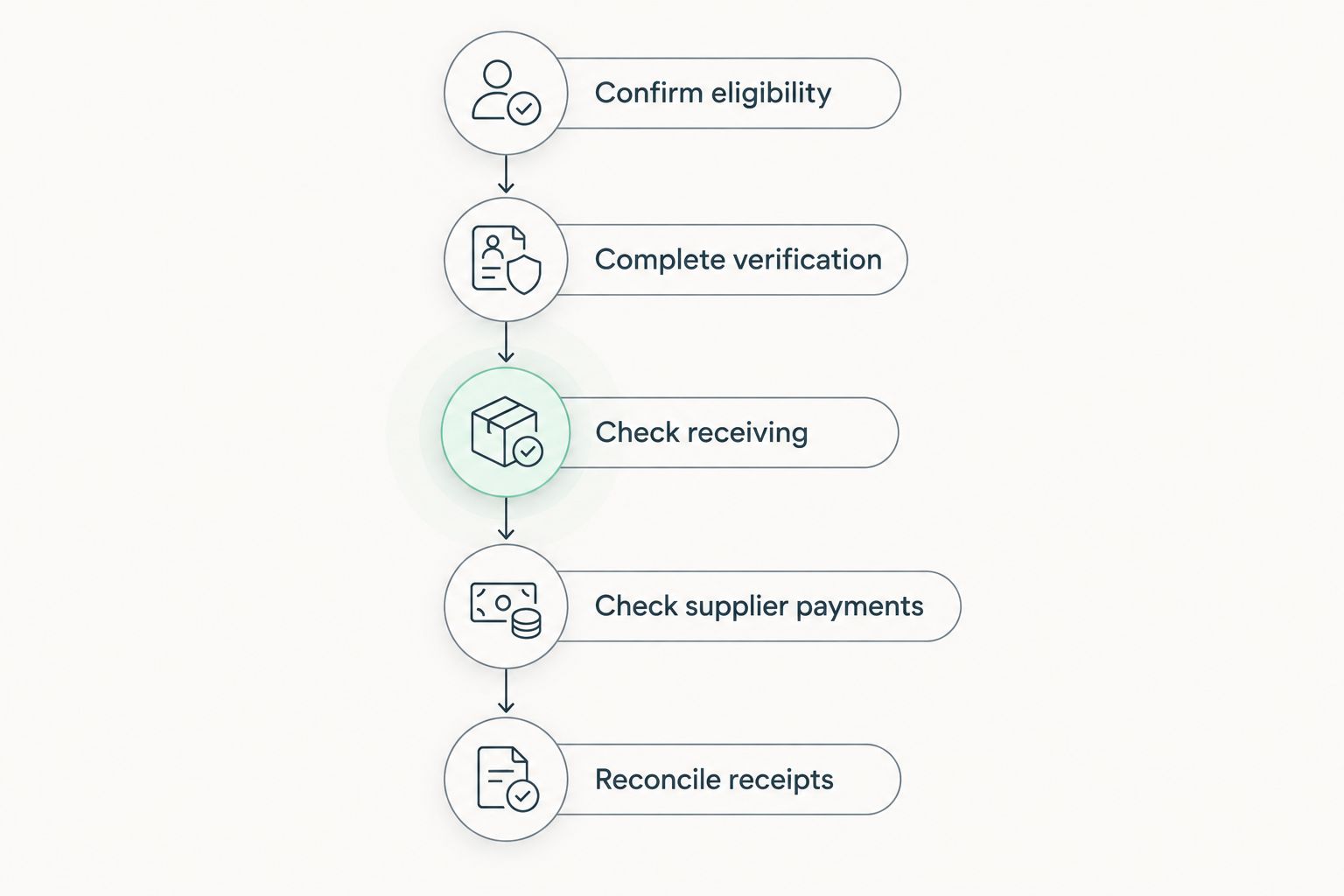
After these checks, give customers the approved instructions in writing. Keep a record of what you sent, particularly when replacing details used on an earlier invoice.
Assess your Zeam business account fit
Check your receiving and supplier-payment requirements, then apply and complete verification.
Apply the same discipline to booking deposits
South African tour operators and safari businesses face a related problem: overseas guest payments arrive against future local supplier commitments. A deposit, a balance payment and a supplier settlement belong to the same booking record, but they are different events.
Use **2 payment stages—deposit and balance—**when that matches your booking terms. Give each stage a clear purpose and reconcile both against the booking's unique reference before deciding what remains payable.
A guest paying in EUR does not determine the currency a lodge, guide or transport supplier requires. Confirm the supplier obligation independently, and retain card acceptance where guests need it. A currency account does not replace reservation management.
How this ranking works
This 2026 ranking separates three decisions: currency management, bank-deposit requirements and customer checkout. It places the multi-currency business account first for its stated combination of receiving, holding, conversion and business-payment functions—not for an unsupported claim about savings or universal eligibility.
The bank option wins when deposit status is essential. The card option wins when the immediate problem is how the customer wants to pay. Neither decision removes the need to verify the receiving and supplier routes.
Which option should you choose?
Start with a multi-currency business account if your main problem is managing overseas receipts and business outgoings together. Make eligibility, verification and essential routes conditions of adoption.
Choose a foreign-currency business bank account instead when bank-deposit status is non-negotiable. Add card acceptance when customers need it, without confusing checkout convenience with currency holding.
For an undecided Nigerian exporter, the next move is concrete: take an actual customer invoice and an actual supplier obligation to each shortlisted provider. Ask how both transactions work under the proposed arrangement. Reject a setup that solves only the incoming half.
FAQ
What's the best multi currency account for nigerian exporters?
The best account is one that accepts your Nigerian business and supports your actual receiving, holding and supplier-payment requirements. Zeam is a feature-fit candidate for USD and EUR management, subject to confirmation of Nigerian eligibility, verification and required routes.
Can Nigerian exporters receive USD and EUR with these accounts?
Confirm both currencies and the permitted receiving routes for your specific business before issuing instructions. A provider's general USD or EUR capability does not establish approval for every Nigerian exporter or transaction.
Is a multi-currency digital balance the same as a bank deposit?
No. Digital balances and bank deposits are different arrangements; check the provider's legal status and balance terms rather than relying on the word account.
Is a payment link better than receiving details?
A payment link and receiving details solve different collection needs. Confirm the methods behind the link, then compare them with the transfer route your customer can use.
Should an exporter convert every overseas payment immediately?
Base conversion decisions on supplier currencies, payment obligations and your business policy, not an automatic rule. Confirm that any intended retained-currency payout is supported before relying on it.
Can a multi-currency account replace card acceptance for tourism bookings?
No account should be treated as a replacement for card acceptance unless the required card functionality is explicitly confirmed. Tour operators should also keep booking records separate from the payment and currency-management functions.
What should I check before sending new account details to a customer?
Confirm eligibility, complete verification and check the approved receiving instructions. Also establish how you will identify the payment and fund the related supplier obligations.
One last thing
A successful incoming payment is not proof that the whole arrangement works. Your 2026 account decision is complete only when you can explain how that receipt connects to the invoice, any conversion and the supplier payment it must fund.