
Best overall for a custom forecast: Microsoft Excel. Best for connecting international receipts with business-money management: Zeam, subject to verification and the relevant plan; best for shared planning: Google Sheets. This 2026 guide compares cash flow forecasting tools for African businesses, with South African tour operators and safari businesses as the main use case.
- Microsoft Excel leads cash flow forecasting tools for African businesses needing a custom booking-payment model.
- Zeam suits businesses combining overseas receipts, local supplier payments and treasury tools, subject to verification and plan conditions.
- Google Sheets suits shared planning; Float suits cash-focused forecasting; Fathom suits forecasting alongside management reporting.
- Forecast deposits, balance payments and supplier commitments separately; a confirmed booking is not received cash.
Why this matters
A safari booking can create several different cash events: an overseas guest pays a deposit, accommodation requires a supplier payment, and the guest pays the balance later. A profitable booking still leaves a funding gap when supplier deadlines arrive before guest money does.
For your 2026 forecast, separate the booking date, expected receipt date and supplier payment date. Keep USD and EUR receipts visible before translating them into the rand amounts needed for local expenses.
The best forecast shows when you can pay suppliers, not just whether a booking makes a profit. It also distinguishes expected money from money already received.
What makes the best cash flow forecasting tools?
Use these six criteria before choosing a tool:
- Receipt timing: Can you distinguish an invoice, an expected deposit and a received payment?
- Currency handling: Can you keep foreign-currency assumptions separate from local spending requirements?
- Supplier commitments: Can you record payment deadlines before the corresponding guest balance arrives?
- Scenario planning: Can you model a delayed guest payment without changing the base forecast?
- Maintenance effort: Can your team update the forecast without rebuilding it?
- Payment boundaries: Does the tool forecast cash, move money, or do both? Do not assume these are interchangeable.
As a starting routine, build a 13-week forecast, review it every 7 days, and maintain 3 scenarios: expected receipts, delayed receipts and cancelled bookings. These are planning recommendations, not claims about a particular product.
Cash flow forecasting tools at a glance
The ranking below prioritises booking-payment decisions. Each option serves a different working style; the first entry connects business-money management with treasury tools rather than acting only as a standalone forecasting application.
| Tool | Best for | Standout feature | Key limitation |
|---|---|---|---|
| Zeam | Connecting international receipts and business money | USD and EUR receiving details, multiple currency balances and treasury tools | Verification, payment-route and plan conditions require checking |
| Microsoft Excel | Custom booking and supplier models | Formula-based models tailored to your operating calendar | You maintain formulas, assumptions and version control |
| Google Sheets | Shared forecast ownership | Collaborative spreadsheet editing | Shared access does not prevent modelling errors |
| Float | Cash-focused forecast reviews | Dedicated cash-flow forecasting workflow | Fit depends on your accounting setup and required detail |
| Fathom | Forecasting alongside management reporting | Financial reporting, analysis and forecasting | Broader reporting does not replace booking-level payment records |
None of these options should be treated as a booking system merely because it helps you forecast cash. Equally, a forecasting tool does not automatically give your guests card acceptance or a suitable payment route.
1. Zeam: best for international receipts and business money
Zeam is best for South African tourism businesses that want international receipts and business-money management in one place. Businesses can receive USD and EUR from US and European clients using receiving details in their business’s name, hold multiple currency balances and convert when needed.
The product also supports local supplier payments, payment links, records, accounting integrations and team approvals. Treasury tools include cash-flow forecasting and automated transfers as businesses grow; confirm the relevant plan and suitability before making them central to your process.
For a tour operator, the practical question is whether the account and forecasting arrangement supports the path from an overseas booking receipt to a local supplier payment. Do not assume a specific guest payment route is supported simply because the guest pays in USD or EUR.
Pros:
- Connects receiving and money management rather than treating them as unrelated tasks.
- Supports holding different currency balances before conversion.
- Includes local supplier payments and payment records.
Cons:
- Account use requires application and verification; confirm approval and route conditions.
- International and bulk payments sit on higher plans.
- Digital balances are not bank deposits; the provider is not a bank.
Best for: Businesses aligning overseas booking receipts with local obligations.
Verdict: Hold until verification, route suitability and the relevant treasury features are confirmed; then adopt if they match your workflow.
2. Microsoft Excel: best for custom booking forecasts
Microsoft Excel lets you build a forecast around your own booking calendar. You decide how deposits, balance payments, supplier commitments and currency assumptions feed the closing cash balance.
For a safari business, create separate inputs for guest receipts and supplier payments, then group them by the dates cash should move. Keep foreign-currency amounts alongside the exchange-rate assumptions used to estimate local spending power.
The strength is control. The weakness is that control rests with whoever maintains the workbook: a formula error or an overwritten assumption can change the forecast without changing the underlying business.
Microsoft Excel pros:
- Accommodates booking-specific payment schedules.
- Supports explicit formulas and separate scenario worksheets.
- Lets you distinguish confirmed receipts from expected receipts.
Microsoft Excel cons:
- Requires disciplined formula checks and ownership.
- Manual updates create reconciliation work.
- A workbook does not receive guest payments or execute supplier payments.
Best for: An owner or finance lead who needs a tailored forecast and can maintain it.
Verdict: Buy into this approach when custom detail matters more than automation. For 2026 planning, begin with a clear weekly model before adding complex dashboards.
3. Google Sheets: best for shared forecast ownership
Google Sheets suits a tourism business where booking, operations and finance staff each hold part of the payment picture. A shared spreadsheet gives the team one place to record expected guest receipts and upcoming supplier commitments.
Assign responsibilities rather than giving everyone responsibility for everything. Your booking lead updates expected guest payment dates; operations updates supplier deadlines; finance reconciles actual receipts and payments.
Keep assumptions visible. A shared forecast becomes unreliable when one person treats a balance payment as certain while another quietly moves its expected date.
Google Sheets pros:
- Supports collaborative editing in a shared document.
- Allows a forecast structure built around your bookings.
- Makes comments and supporting explanations part of the working process.
Google Sheets cons:
- Shared editing still needs access controls and a named owner.
- Formula mistakes remain possible.
- Payment collection and transaction reconciliation require their own processes.
Best for: Small teams that need shared accountability more than a dedicated forecasting application.
Verdict: Buy into this approach when team participation is the main obstacle. Skip unnecessary spreadsheet complexity: separate input cells from calculated outputs and protect formulas where appropriate.
4. Float: best for cash-focused forecast reviews
Float is a dedicated cash-flow forecasting tool. It belongs on your shortlist when you want a forecasting application rather than a spreadsheet you must design yourself.
Evaluate it against a real booking-payment problem, not a polished demonstration alone. Ask whether your intended setup can represent a delayed balance payment, a supplier bill due earlier, and the currency assumptions behind the resulting cash position.
Check current accounting compatibility and the detail your team needs before committing. Do not infer that a forecasting connection also supplies payment collection, card acceptance or supplier-payment execution.
Float pros:
- Centres the workflow on cash-flow forecasting.
- Offers an alternative to maintaining a custom spreadsheet model.
- Gives forecast reviews a dedicated application rather than an informal collection of files.
Float cons:
- Suitability depends on your accounting setup and required forecasting detail.
- Booking commitments still need accurate underlying records.
- Dedicated forecasting does not remove the need to reconcile actual cash.
Best for: Businesses ready to make cash forecasting a regular finance process.
Verdict: Hold until a demonstration reproduces your booking and supplier-payment timing accurately. Choose it for demonstrated fit, not for an assumed connection to your existing systems.
5. Fathom: best for forecasts alongside management reporting
Fathom combines financial reporting, analysis and forecasting. It suits an owner who wants cash planning discussed alongside broader financial performance rather than reviewed in isolation.
That wider view is useful when your management meeting needs to examine both trading performance and upcoming payment commitments. However, the source records still need to distinguish money earned, money invoiced and money actually received.
For tourism businesses, test how the proposed setup represents deposits and future supplier obligations. An attractive reporting pack is not a substitute for knowing which guest payment funds the next accommodation bill.
Fathom pros:
- Brings reporting and forecasting into the same application.
- Supports a broader financial-management discussion.
- Suits a structured owner-and-accountant review process.
Fathom cons:
- Broader analysis adds work if you only need a simple payment calendar.
- Booking-level detail depends on the records and model you supply.
- Payment collection remains a separate requirement.
Best for: Businesses that want forecasting within a wider management-reporting routine.
Verdict: Hold unless reporting and analysis are genuine requirements. Choose a simpler model when your immediate problem is only identifying the next supplier-payment gap.
Build the forecast around booking cash
Use this sequence when setting up your 2026 model. Keep the original booking record available so every forecast entry has a clear business reason.
- Booking schedule: Record expected deposits and balance payments separately, with their currencies and due dates.
- Supplier commitments: Record accommodation, transport, guiding and other agreed supplier payment dates.
- Currency assumptions: Show the assumptions used to translate foreign receipts into local spending capacity.
- Cash reconciliation: Replace expected entries with actual receipts and payments without counting both.
- Scenario review: Move uncertain receipts later and inspect which supplier commitments become unfunded.
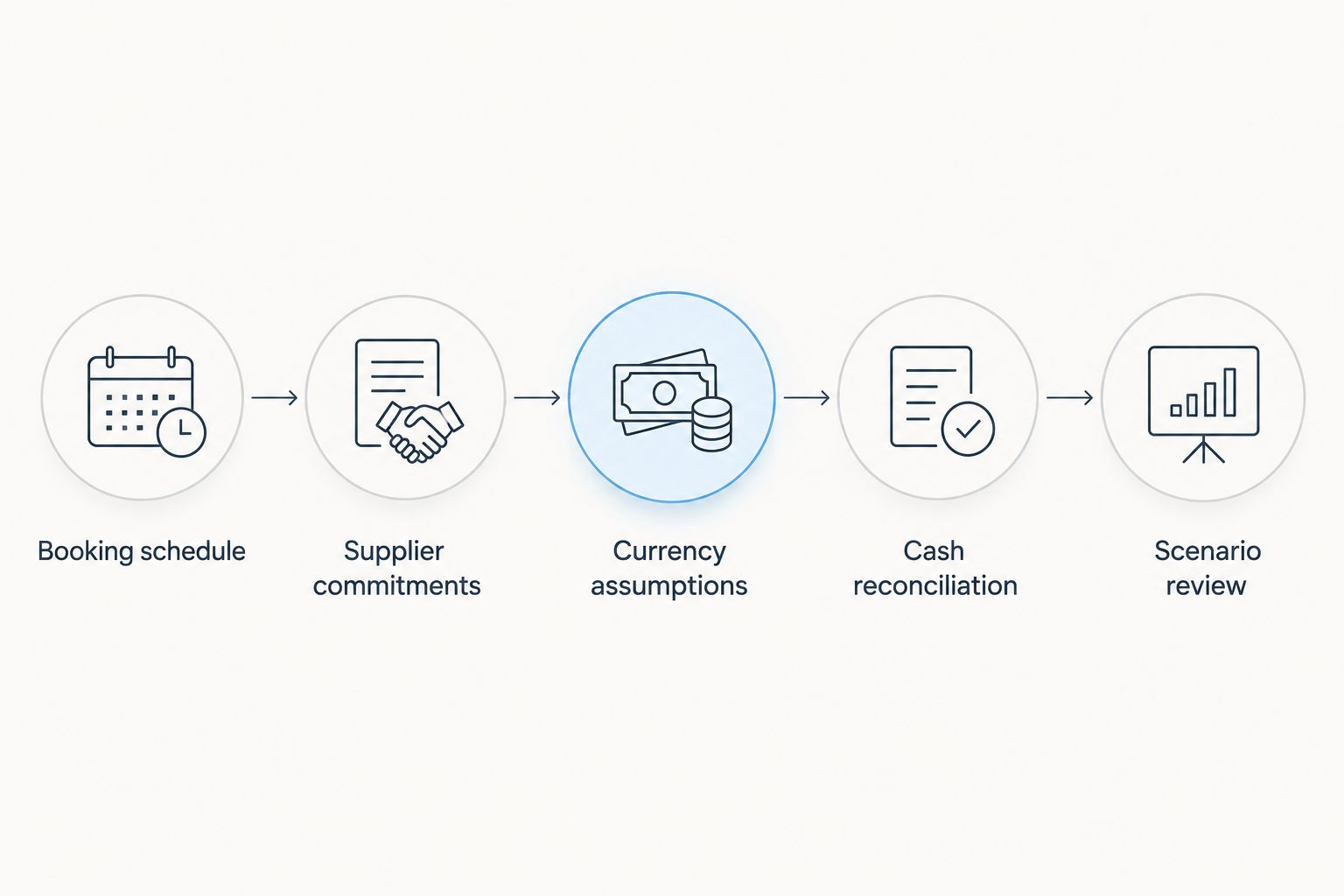
A forecast entry should answer two questions: what cash movement does this represent, and why is it expected on that date? If neither answer is clear, investigate before relying on the closing balance.
Do not count an expected USD deposit as available rand merely because the booking is confirmed. First distinguish receipt, conversion and the local supplier-payment obligation.
Keep receiving methods separate from forecasting
Receiving details, card payments and payment links address collection. Forecasting addresses timing and commitments. Your business needs a clear process connecting them, not an assumption that one replaces another.
For each proposed collection method, check the supported route, relevant conditions, reconciliation process and how payment status reaches your booking records. Retain card acceptance where your business requires it; this comparison does not establish a replacement for it.
Before applying for Zeam, identify the USD or EUR receipts you want to collect and the local supplier payments they must support. Complete business verification and confirm the relevant route and plan conditions before issuing new payment instructions to guests.
Review your business account options
Check receiving and treasury features before applying and completing business verification.
How the ranking works
This 2026 ranking uses the six criteria above: receipt timing, currencies, supplier commitments, scenarios, maintenance and payment boundaries. The use-case labels distinguish business-money management, custom modelling, shared editing, cash-focused forecasting and wider reporting.
This is a fit-based shortlist, not a performance-test ranking. Your final check should use your own booking schedule and supplier deadlines, with approval, plan and route conditions confirmed separately.
Which forecasting tool should you choose?
Choose Microsoft Excel by default if you need a custom forecast and have someone accountable for maintaining it. Choose Google Sheets when shared updates matter more than desktop modelling.
Consider Zeam when international receipts and business-money management are part of the same decision, subject to verification and the relevant features. Shortlist Float for a dedicated cash workflow and Fathom for forecasting alongside financial reporting.
FAQ
What's the best cash flow forecasting tool for a small African tourism business?
Microsoft Excel is the default choice for a custom booking-payment forecast when someone can maintain the model. Google Sheets suits shared ownership, while dedicated applications deserve evaluation when spreadsheet maintenance becomes a problem.
Can Zeam help with cash-flow forecasting?
Zeam includes cash-flow forecasting among its treasury tools as businesses grow. Confirm the relevant plan, complete business verification and check payment-route suitability before building your process around it.
Should I forecast a booking deposit when the guest confirms?
Record the deposit as an expected receipt, not received cash. Keep its expected payment date separate from the booking confirmation date and reconcile it when payment arrives.
How should I forecast USD and EUR booking payments?
Keep the original currency amounts and expected receipt dates visible. Use explicit conversion assumptions when estimating the local currency needed for supplier payments.
Is a payment link the same as a cash-flow forecasting tool?
No, a payment link supports payment collection, while a forecast models expected receipts and payments. Connect payment records to your forecast without assuming the collection method also manages booking commitments.
How often should I update my tourism cash forecast in 2026?
Start with a review every 7 days and update sooner when a material booking receipt or supplier deadline changes. A 13-week horizon is a practical starting recommendation, not a requirement of the tools listed.
Does a business-money platform replace card acceptance or a booking system?
Do not assume that it does. Confirm collection methods and booking-system requirements separately, and keep the payment options your business needs.
One last thing
Test a delayed guest balance before testing a growth scenario. Move that receipt beyond its intended supplier-payment date and inspect the gap. For your 2026 forecast, that single exercise is a useful acceptance test: the tool should make the funding problem visible before you commit to the supplier.