
Best for combining overseas receipts with local supplier payments: Zeam. Best for bank-led invoice settlement: business bank transfers. Best for supplier checkout: business card payments. Best for approval-heavy operations: accounts-payable software. Choosing a supplier payment platform for African importers in 2026 starts with the supplier’s destination, invoice currency and your approved payment route—not a universal winner.
- Zeam suits businesses combining USD and EUR receipts with local supplier payments; international and bulk payments require higher plans.
- Choose a supplier payment platform for African importers by confirmed routes, currency needs and approval controls.
- Business bank transfers suit bank-led settlement; cards require supplier acceptance and suitable transaction terms.
- Accounts-payable software suits approval-heavy workflows, but confirm whether it executes payments or only manages instructions.
Why this matters
An importer needs to settle a supplier invoice. A South African tour operator or safari business buying overseas equipment also needs to protect the money committed to upcoming bookings. Those are related decisions, but they are not the same workflow.
For tourism businesses, separate overseas booking receipts from supplier obligations. Receiving a guest’s USD deposit does not establish that you can send USD to an equipment supplier through the same provider. Receiving, holding, converting and paying each need their own checks.
Choose the payment route before you send payment instructions or commit to a supplier deadline. An attractive account feature is irrelevant if the required destination, beneficiary or transaction is outside the approved service.
What makes the best supplier payment platform?
Use these criteria to assess a supplier payment platform for African importers in 2026. Treat route confirmation as a requirement, not a tie-breaker.
- Payment-route fit: Confirm your business can use the service and that the supplier’s country, currency and beneficiary details are supported.
- Currency control: Check whether you can receive, hold and convert the currencies your business actually uses.
- Supplier settlement: Establish how the supplier receives funds and what evidence confirms completion.
- Approval controls: Separate beneficiary creation, payment preparation and final approval where your workflow requires it.
- Booking reconciliation: Connect guest receipts, supplier invoices and payment records without treating them as interchangeable transactions.
- Total transaction terms: Review conversion terms, transaction charges, recipient-side deductions and cancellation conditions before authorising payment.
Apply 3 checks to every shortlisted route: business eligibility, beneficiary eligibility and transaction eligibility. Passing one does not establish the other two. Repeat the checks when your supplier, invoice currency or payment purpose changes.
Supplier payment options at a glance
The order below follows distinct operational needs, not a claim that every option supports every African market. A platform, a bank transfer, a card and approval software perform different jobs.
| Option | Best for | Standout feature | Key limitation |
|---|---|---|---|
| Zeam | Overseas receipts alongside local supplier payments | USD and EUR receiving details in the business’s name, multiple currency balances and conversion | International and bulk payments require higher plans; confirm approval and route support |
| Business bank transfers | Bank-led supplier invoice settlement | Direct payment instructions using the supplier’s bank details | The bank must support the specific business, destination and transaction |
| Business card payments | Suppliers offering card checkout | Payment through the supplier’s card acceptance process | Depends on supplier acceptance, issuer authorisation and transaction terms |
| Accounts-payable software | Businesses coordinating invoice approvals | A structured invoice and approval workflow | Workflow software does not necessarily execute the payment |
1. Zeam: best for receipts and local supplier payments
Zeam is the strongest fit here for businesses combining USD and EUR receipts with local supplier payments. It provides receiving details in the business’s name, multiple currency balances and conversion when needed.
For a South African safari business, the relevant workflow is receiving overseas booking payments, tracking the booking obligation and paying local suppliers. International and bulk payments sit on higher plans; confirm the intended overseas supplier route before treating it as available to your business.
Zeam pros:
- USD and EUR receipts from US and European clients can connect to the business’s money-management workflow.
- Multiple currency balances let the business separate holding a currency from converting it.
- Payment records, accounting integrations and team approvals support financial administration.
- Cash-flow forecasting and automated transfers provide additional treasury tools as the business grows.
Zeam cons:
- International and bulk payments require higher plans.
- A receiving capability does not establish support for a particular outbound supplier payment.
- Digital balances are not bank deposits; the provider is not a bank.
Best for: Tourism businesses managing overseas receipts and local supplier costs together, subject to approval and confirmed routes.
Apply for a business account and complete verification before relying on it for a booking-payment workflow. Confirm the required receiving and supplier-payment capabilities during that process, and retain your existing collection arrangements until the new workflow is ready.
Verdict: Buy into this workflow only after verification and route confirmation.
2. Business bank transfers: best for bank-led invoice settlement
A business bank transfer sends a payment using beneficiary banking details. It suits an importer whose supplier expects account-to-account settlement and whose bank confirms the required international transaction.
This is a payment method rather than a single platform recommendation. Compare the actual route offered to your business, not the bank’s general description of international payments.
Business bank transfer pros:
- Matches suppliers that request payment to a business bank account.
- Keeps payment authorisation within an established business banking workflow.
- Supports invoice-based reconciliation when you retain the instruction, reference and payment record.
Business bank transfer cons:
- Destination, currency and transaction requirements need confirmation for the specific payment.
- Sending instructions does not prove that the supplier has received the required amount.
- A bank transfer does not organise booking deposits, supplier commitments or internal approvals by itself.
Best for: Importers whose suppliers require bank settlement and whose business bank confirms the route.
Ask what supporting documents the bank requires, how the beneficiary must be recorded and how you can investigate a payment. Agree with the supplier which reference identifies the invoice. Verify changed bank details through a separate, trusted communication channel before authorising anything.
Verdict: Buy this route when the bank confirms the invoice can be settled as required.
3. Business card payments: best for supplier checkout
A business card works when the supplier accepts the card and the issuer authorises the transaction. This route suits a supplier with a card checkout rather than one that insists on an invoice paid by bank transfer.
Do not confuse paying a supplier by card with collecting card payments from guests. Your business occupies opposite sides of those transactions, and the acceptance arrangements are separate.
Business card payment pros:
- Fits suppliers that already offer a card checkout.
- Produces a card transaction record to match against the supplier’s invoice.
- Keeps purchasing within your card authorisation process where suitable controls exist.
Business card payment cons:
- A supplier that requires bank settlement is not covered by a card-only approach.
- Issuer limits, currency treatment and authorisation conditions need checking.
- A card transaction does not replace purchase approval or confirmation of the supplier’s terms.
Best for: Purchases from suppliers that explicitly accept your business card for the intended transaction.
For 2026 purchasing, confirm the checkout currency before authorising payment. Read the supplier’s cancellation and refund terms, and retain the invoice separately from the card record. Neither a successful checkout nor a receipt establishes that the goods have shipped.
Verdict: Buy through card checkout only when acceptance and purchasing terms match the order.
4. Accounts-payable software: best for approval-heavy operations
Accounts-payable software organises supplier invoices and the decisions needed before payment. Depending on the product and arrangement, payment execution can be integrated or handled separately through another provider.
This category matters when the operational problem is control: invoices arrive in different places, responsibilities are unclear, or the same person prepares and approves payments. Assess the approval workflow separately from the underlying payment route.
Accounts-payable software pros:
- Gives invoice review and authorisation a defined place in the process.
- Can separate preparation from approval when the chosen product supports that structure.
- Provides a workflow for connecting invoices, decisions and payment evidence.
Accounts-payable software cons:
- An approval does not establish that a supplier has been paid.
- Payment execution and destination support require separate confirmation.
- A business with a straightforward workflow must assess whether another system adds useful control.
Best for: Businesses whose main difficulty is coordinating supplier invoices and payment approvals across a team.
Ask the provider to demonstrate your actual process: an overseas invoice, a beneficiary change, an approval and the resulting payment record. Confirm which system executes the payment and where the authoritative status appears. Avoid building a workflow around an assumed integration.
Verdict: Hold until you establish that approval complexity—not route access—is the problem.
How to connect booking receipts and supplier payments
For a South African tourism business, use 2 payment stages in the booking record: the guest’s deposit and the guest’s balance payment. Keep the supplier’s payment schedule separate. A guest payment arriving does not mean every associated supplier invoice is due immediately.
Build the process in this order:
- Booking terms: Record the guest’s invoice currency, deposit obligation, balance deadline and cancellation terms.
- Receipt confirmation: Match the actual receipt to the booking before marking the obligation as paid.
- Supplier approval: Check the supplier invoice, beneficiary details, currency and authorised payment route.
- Payment reconciliation: Match the payment evidence to the supplier invoice and update the booking’s remaining commitments.
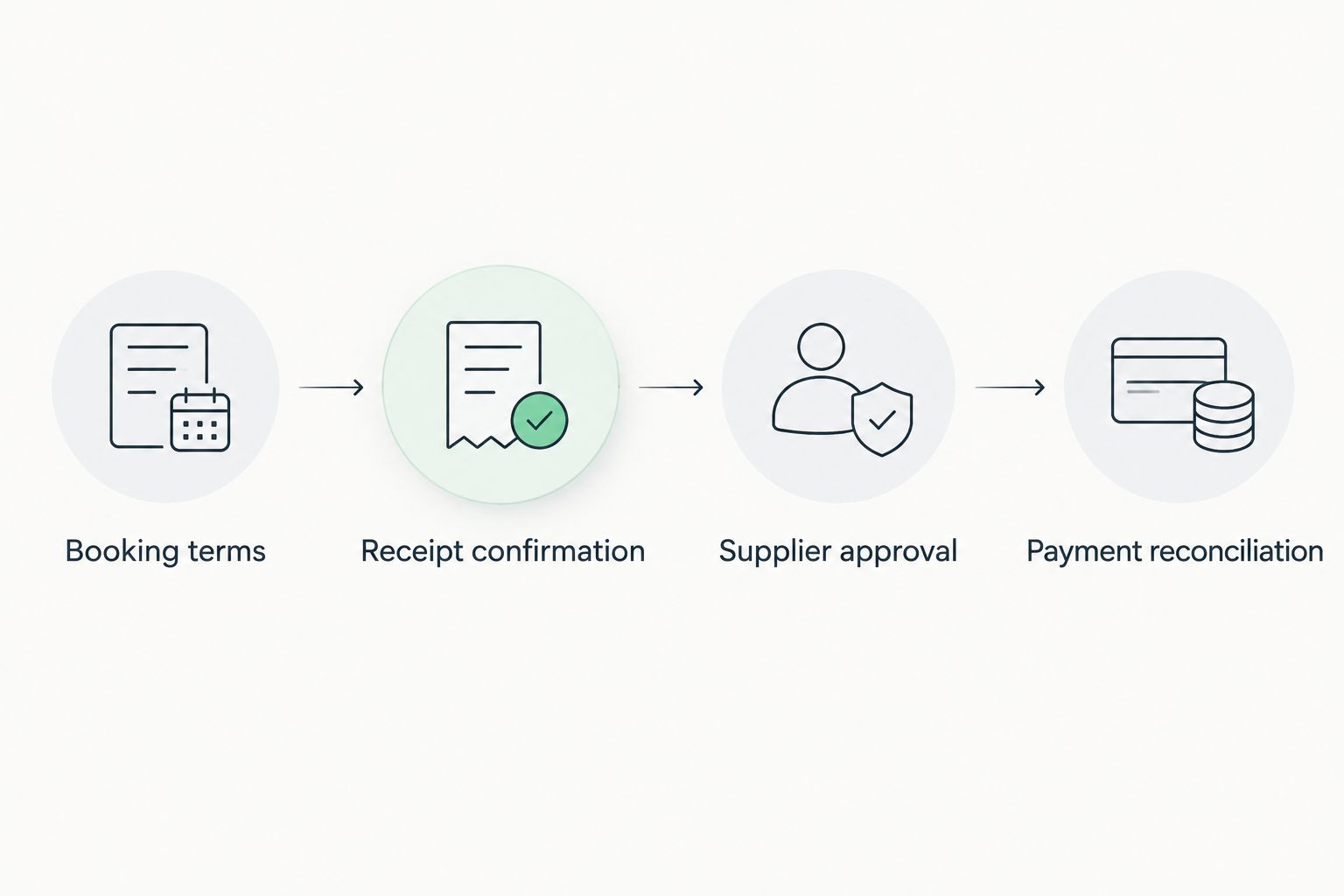
Retain 4 records for each supplier payment: the invoice, verified beneficiary details, approval evidence and payment confirmation. These records connect the purchasing decision to the money movement. Store the guest’s booking documents alongside them only where the transactions relate.
For your 2026 process, assign responsibility for checking receipts and approving supplier payments before busy booking periods. Do not describe an expected receipt as money already received, or a prepared payment as a completed supplier settlement.
Start your business account application
Apply, complete verification and confirm the receiving and supplier-payment routes your business needs.
How the options are ranked
The ranking prioritises the operating job: combining receipts and supplier payments, settling a bank invoice, using supplier checkout or controlling approvals. Currency handling, payment-route fit, reconciliation and verification determine whether an option belongs in your workflow.
There is no continent-wide winner on the information here. A valid comparison requires the same business, supplier, currency and transaction purpose. Do not compare one provider’s receiving features with another provider’s outbound payment features and call them equivalent.
Which supplier payment option should you choose?
For a tourism business collecting overseas booking payments and paying local suppliers, start with Zeam, complete verification and confirm the required routes. Keep card acceptance or a booking system wherever those tools perform a separate job.
For a direct import invoice, start instead with the supplier’s settlement requirement. Choose a confirmed bank route for bank-only settlement, a card for an accepted checkout, or approval software when coordination is the bottleneck. Add tools to solve a defined problem, not to accumulate overlapping accounts.
Before moving a 2026 supplier payment, confirm who receives it, in which currency, through which approved route and against which invoice. If those answers are unclear, hold the payment instruction until they are resolved.
FAQ
What’s the best supplier payment platform for African importers?
The best supplier payment platform is one that confirms your business eligibility, supplier destination, invoice currency and transaction purpose. Choose between a money-management platform, bank transfer, card or approval system according to the job you need completed.
Can a South African tour operator receive USD and EUR booking payments?
Zeam provides USD and EUR receiving details in the business’s name for payments from US and European clients. Apply, complete verification and confirm the receiving arrangements available to your business before issuing payment instructions.
Does a USD receiving account also let me pay overseas suppliers?
USD receiving capability does not establish outbound supplier-payment support. Confirm the destination, beneficiary, currency, payment purpose and plan requirements separately.
Should I pay an overseas supplier by bank transfer or card?
Use a confirmed bank route when the supplier requires bank settlement, or a card when the supplier accepts it for that purchase. Compare the transaction terms and retain the invoice and payment evidence either way.
Can payment links replace my booking system?
Do not treat a payment link as a replacement for a booking system. Collecting payment and managing booking availability, guest details and cancellation terms are separate requirements.
How much does an international supplier payment cost?
The total depends on the provider and the specific transaction. Review transaction charges, conversion terms and any recipient-side deductions before authorising the payment.
What should I check before paying a new supplier?
Check the invoice, independently verify beneficiary details and confirm the payment route before approval. Keep the invoice, beneficiary verification, approval evidence and payment confirmation together.
One last thing
A guest’s payment currency and a supplier’s invoice currency are separate decisions. Before converting a booking receipt, map the business’s upcoming obligations by currency and due date. That makes the conversion decision part of your payment plan rather than an automatic reaction to money arriving.