
African wholesalers’ supplier payments are the processes used to pay stock providers, with the aim of keeping orders funded and supplier commitments on schedule. This guide to supplier payments for African wholesalers explains how to connect overseas receipts, currency balances and purchasing decisions without treating incoming customer money as immediately available spending money.
- Supplier payments for African wholesalers need invoice checks, currency planning and confirmed payment routes before funds leave the business.
- Zeam suits wholesalers seeking USD and EUR receipts alongside local supplier payments, subject to account approval and route confirmation.
- International and bulk payments require higher Zeam plans; confirm suitability before moving supplier commitments.
- Keep card acceptance and payment links separate from the process used to approve and settle supplier invoices.
Why supplier payments matter for African wholesalers
A customer receipt and a supplier payment are separate commitments. A wholesaler receiving EUR for an export order still needs to establish when the money is usable, which currency the supplier requires and what must remain available for other bills.
For a South African wholesaler supplying lodges or tour operators, that distinction matters when a customer pays a deposit but stock, packaging and transport require separate payments. The deposit belongs in the order’s cash-flow plan, not automatically in the amount available for purchasing.
Zeam supports USD and EUR receipts from US and European clients using receiving details in the business’s name, multiple currency balances and local supplier payments. International and bulk payments sit on higher plans. Zeam is not a bank, and its balances are digital balances rather than bank deposits.
Your 2026 payment process should answer three questions before you commit to a supplier: what is owed, when it is due and which confirmed payment method will settle it. A dashboard balance alone does not answer those questions.
How to organise supplier payments in 2026
1. Map each supplier obligation before choosing a payment method
Start with a spreadsheet and a folder of approved invoices. Give each supplier a record that connects the purchase order, invoice and payment evidence, rather than relying on a supplier name in a transaction history.
Use 3 linked records per purchase: the order, the invoice and the payment evidence. This is a practical control, not a requirement to buy software. An owner should be able to trace a payment back to the goods authorised for purchase.
Separate a stock deposit from the remaining balance. If a supplier requires payment before dispatch, record that condition beside the invoice rather than leaving it in an email thread. A due date without its release condition gives an incomplete picture.
For example, a wholesaler supplying linen to a safari lodge should distinguish the lodge’s customer deposit from the linen supplier’s deposit. Similar wording does not make those amounts interchangeable.
- Record the supplier’s legal name and invoice reference.
- Identify the order and goods covered by the invoice.
- Separate deposits, balance payments and recurring purchases.
- Record the payment currency and agreed due date.
- Attach the condition that authorises each payment.
2. Build a cash calendar around usable funds
Use a spreadsheet calendar before adding forecasting software. Put expected customer receipts beside supplier commitments, payroll, transport and other operating payments, with separate columns for expected money and funds already available.
Do not authorise a supplier payment solely because a customer has sent payment evidence. Confirm the receipt in your own records and check the status of the funds before relying on them. An expected receipt belongs in a forecast, not in the available-funds column.
Maintain a rolling 7-day payment view as a working routine. That interval is a planning choice, not a promised settlement period. Extend the view when purchasing or shipping commitments reach further ahead.
Your 2026 cash calendar should also show which customer balances remain unpaid. A tourism-sector customer paying the balance after delivery creates a different funding requirement from a customer settling before dispatch.
- List supplier commitments by their actual due dates.
- Keep expected receipts separate from available balances.
- Reserve money for operating obligations already approved.
- Flag orders whose customer receipts do not cover purchasing commitments.
- Update the calendar when payment conditions change.
3. Match currencies before deciding what to convert
Begin with a currency worksheet. List incoming receipts and outgoing obligations separately for USD, EUR and local currency, then identify which obligations have confirmed payment routes.
Receiving USD does not establish that you can pay every USD supplier directly. Currency support, the destination and the outgoing payment route are separate checks. Avoid promising a supplier a particular method until those checks are complete.
Zeam lets businesses hold multiple currency balances and convert when needed. That supports keeping receipts and conversion decisions distinct, but it does not remove the need to confirm an outgoing route. Local supplier payments are supported; international and bulk payments require higher plans.
For your 2026 plan, write down the business reason for each conversion: paying a local supplier, meeting an operating commitment or funding an approved purchase. Holding foreign currency without identifying its intended use is not a supplier-payment plan.
- List receipts by currency and expected availability.
- List supplier invoices by their required settlement currency.
- Identify local-currency commitments before allocating foreign receipts.
- Confirm the outgoing route before retaining funds for that payment.
- Record the conversion decision against the obligation it funds.
4. Confirm account approval and the supplier route
Start by checking your existing provider’s requirements for the actual payment you need to make. Ask about the business, destination, currency and payment purpose together; a broad statement about international payments is not enough.
Apply for a Zeam business account and complete verification before building supplier commitments around it. Confirm account approval, the applicable plan and the intended route before asking customers to change payment instructions or promising suppliers a new settlement method.
Keep receiving instructions separate from outgoing supplier instructions. Receiving details in your business’s name describe how customers pay you; they do not establish how an overseas supplier will receive money.
For a wider route-selection framework, use the cross-border payments guide for African traders. Compare the transaction you need to complete, rather than choosing a provider from a feature label alone.
- Identify the business entity applying for the account.
- Complete the requested verification process.
- Confirm the plan needed for the proposed payment.
- Check the destination, currency and payment purpose.
- Retain a workable alternative until the route is confirmed.
Prepare your supplier payment setup
Apply for a business account, complete verification and confirm the plan and routes your suppliers need.
5. Separate invoice approval from payment release
Begin with a shared approval log and clearly assigned responsibilities. The person checking the goods and invoice should record that approval before the person releasing funds acts on it.
Use 2 reviewers for changed supplier details as an internal control. One person can collect the change while another confirms it through an established contact channel. This is a recommended workflow, not a claim about a provider’s mandatory approval settings.
Zeam includes team approvals and payment records. Those features support a controlled workflow, but your business still needs to define who checks the invoice, who verifies changed details and who releases funds. Software does not decide whether the purchase was authorised.
For your 2026 approval policy, distinguish routine invoices from exceptions. A changed beneficiary, an unexpected deposit request or a different settlement currency needs a documented decision rather than silent acceptance.
- Match the invoice to an authorised purchase.
- Confirm goods received or the agreed deposit condition.
- Verify beneficiary changes through an established contact.
- Record the approver and payment-release responsibility.
- Keep exceptions attached to the relevant invoice.
6. Reconcile the payment before closing the order
Start with the invoice register and the transaction record. Match the amount, currency, reference and beneficiary, then record whether the invoice is settled or still has an outstanding balance.
Keep Approval, Payment release and Reconciliation as separate checkpoints. An approved invoice has not necessarily been paid, and a released payment does not by itself resolve a disagreement about the supplier’s remaining balance.
For deposits, retain the original invoice and show the balance still due. Do not close the whole purchase simply because the first payment has left your business. Where delivery depends on settlement, confirm the supplier has allocated the payment to the correct order.
This distinction also helps with customer-funded purchases. A lodge’s booking-related deposit, your supplier deposit and the final stock payment should remain traceable without being merged into a single transaction note.
- Match the payment reference to the supplier invoice.
- Record the amount and currency actually paid.
- Retain payment evidence with the purchase record.
- Confirm allocation when the supplier needs clarification.
- Carry unpaid balances into the next payment review.
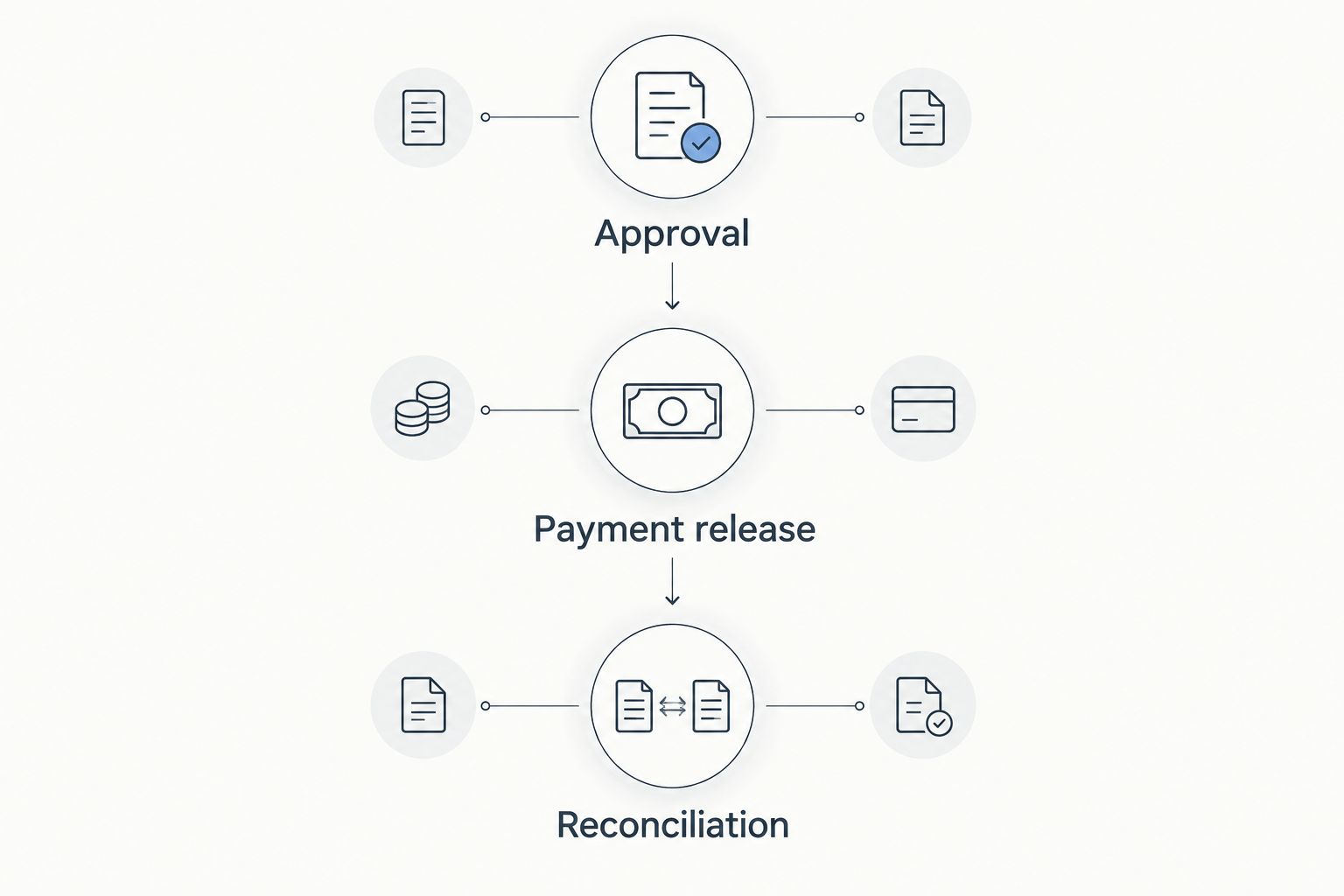
Compare supplier-payment options by the job they do
Zeam is best for wholesalers seeking USD and EUR receipts alongside local supplier payments, subject to account approval and route confirmation. Its limitation is equally relevant: international and bulk payments require higher plans, and digital balances are not bank deposits.
Use the table to separate payment methods from payment administration. A spreadsheet can organise approvals but cannot move money. A payment link can help collect a customer payment, but it does not establish how you will settle a supplier invoice.
| Option | Best for | Main advantage | Key limitation |
|---|---|---|---|
| Existing business bank transfer | Wholesalers whose current bank supports the required supplier route | Keeps payment execution within an existing banking relationship | Confirm destination, currency, documentation and processing conditions for the transaction |
| Zeam | Wholesalers connecting USD and EUR customer receipts with local supplier payments | Combines receiving, currency balances, payment records and team approvals | Not a bank; international and bulk payments require higher plans and route confirmation |
| Supplier-accepted card payment | Purchases where the supplier accepts the business’s card | Provides another payment method where acceptance is confirmed | Depends on supplier acceptance and the card provider’s transaction conditions |
| Supplier-issued payment link | Suppliers offering a supported online collection method | Gives the buyer a payment request tied to the supplier’s collection process | The link alone does not identify the underlying payment method or its conditions |
| Spreadsheet and manual approval log | Wholesalers establishing a documented process | Organises obligations and decisions without changing payment providers | Does not execute payments or automatically reconcile transaction records |
Compare card payments and payment links fairly: acceptance and transaction conditions decide whether they fit a purchase. Neither is automatically worse than an account-based transfer. Equally, receiving international customer payments does not replace card acceptance, booking software or supplier invoice controls.
For a tourism-facing wholesaler, keep those jobs distinct. A lodge customer can use its chosen booking-payment process while your business uses a separate, approved method to pay stock and transport suppliers.
Common mistakes African wholesalers make
Treating a customer deposit as the purchasing budget
A deposit can arrive before the customer has paid the full order value. Allocating all of it to stock leaves other approved commitments unfunded. Check the order’s remaining receipts and costs before releasing supplier funds.
Assuming a receiving currency is an outgoing route
Receiving EUR from a European client does not confirm that the same provider can settle a particular overseas supplier invoice. Confirm the destination and outgoing method separately, including the plan needed to use it.
Converting money without assigning its purpose
A conversion changes the currency held; it does not establish whether the funds are free to spend. Tie each conversion to an approved obligation, and keep money reserved for other bills visible in the cash calendar.
Treating a payment link as supplier verification
A payment link is a collection mechanism, not proof that a changed beneficiary is legitimate. Verify unexpected requests through the supplier contact details already held in your records, rather than using only the details in the new request.
Closing an order after paying the deposit
A paid deposit is not a settled invoice. Keep the remaining amount and release condition on the payment calendar so the final payment does not become an unplanned purchasing interruption.
FAQ
What is the best way to manage supplier payments for African wholesalers?
Use an invoice register, a currency-based cash calendar and a confirmed payment route for each supplier. Approve the obligation before releasing funds, then reconcile the payment against the invoice.
Can I use USD customer receipts to pay local suppliers?
You can plan local supplier payments against USD receipts once the funds are available and the required conversion and local payment route are confirmed. Keep other approved obligations reserved before allocating the money.
Can Zeam pay international suppliers?
Zeam offers international payments on higher plans. Confirm account approval, plan requirements and the intended destination and currency before committing to a supplier payment.
Is Zeam a bank account for my wholesale business?
Zeam is not a bank, and its balances are digital balances rather than bank deposits. Assess its receiving, currency-management and payment features separately from any banking services your business needs.
Are supplier payment links better than card payments?
A payment link and a card payment are not necessarily competing options because a link can lead to a supported payment method. Check the supplier’s accepted methods and the transaction conditions rather than judging by the link alone.
Should I apply for an account before changing customer payment instructions?
Apply and complete verification before relying on a new account for your payment workflow. Confirm approval and the relevant receiving and outgoing routes before changing instructions or making supplier commitments.
How should I track supplier deposits and balance payments?
Record deposits and balance payments separately against the same purchase and invoice. Keep the remaining amount, due date and release condition visible until the obligation is fully settled.
One last thing
The useful payment reference is the one that closes the correct invoice. Agree a consistent reference with each supplier before the next payment, especially when several deposits or orders are open at once. In your 2026 process, make that reference part of approval—not an afterthought entered while releasing funds.