
African tech startups’ treasury management is the control of business cash, currencies and payment obligations with the aim of keeping operations funded when receipts and costs fall in different currencies. This 2026 guide explains treasury management for African tech startups, including South African travel-tech businesses managing overseas customer receipts alongside local supplier commitments.
- Treasury management for African tech startups starts with currency-specific cash-flow forecasts, payment controls and clear ownership.
- Zeam suits startups needing USD and EUR collections alongside multi-currency money management; confirm eligibility and routes before applying.
- Separate customer booking deposits from money available for operating expenses, refunds and supplier payments.
- Keep card acceptance and booking systems where needed; receiving details do not replace every collection method.
Why treasury management matters for African tech startups
Revenue does not tell you whether the next supplier payment is funded. A startup can invoice an overseas customer in USD while owing a South African supplier in rand. The invoice, receipt, conversion and supplier payment are separate events; your forecast needs to reflect each one.
For a South African travel-tech business serving tour operators or safari businesses, booking deposits create another distinction. Money received for a future trip is not automatically available to cover software subscriptions or salaries. Your customer agreement, supplier commitments and refund obligations determine what that receipt must fund.
Zeam supports USD and EUR receipts using receiving details in your business’s name, multi-currency balances and local supplier payments. Zeam is best suited to African startups that need USD and EUR collections alongside multi-currency business money management. Confirm business eligibility, account approval and payment-route requirements before making it part of your collection instructions.
Your 2026 treasury plan should answer a practical question: which obligations can you fund from money already received, and which depend on a future receipt or conversion?
Build a treasury process your team can maintain
Start with a spreadsheet, your payment records and a named owner. Add software where it removes a defined task, not where it merely adds another balance display.
Map your cash by currency and obligation
Create a cash register with separate entries for each currency and account. Record the balance, the provider holding it, any restrictions and the obligations attached to it. Keep bank deposits and digital balances clearly distinguished.
For a travel-tech startup collecting booking payments, tag receipts by booking and purpose. A deposit intended to secure accommodation needs a different treatment from a software subscription paid by a tour operator. Mixing them makes the headline balance less useful for spending decisions.
Use a manual reconciliation first: compare your register with provider records and investigate differences. Do not count an invoice, a guest’s payment confirmation or an expected settlement as cleared money. Record pending receipts separately so that your team sees what is still outstanding.
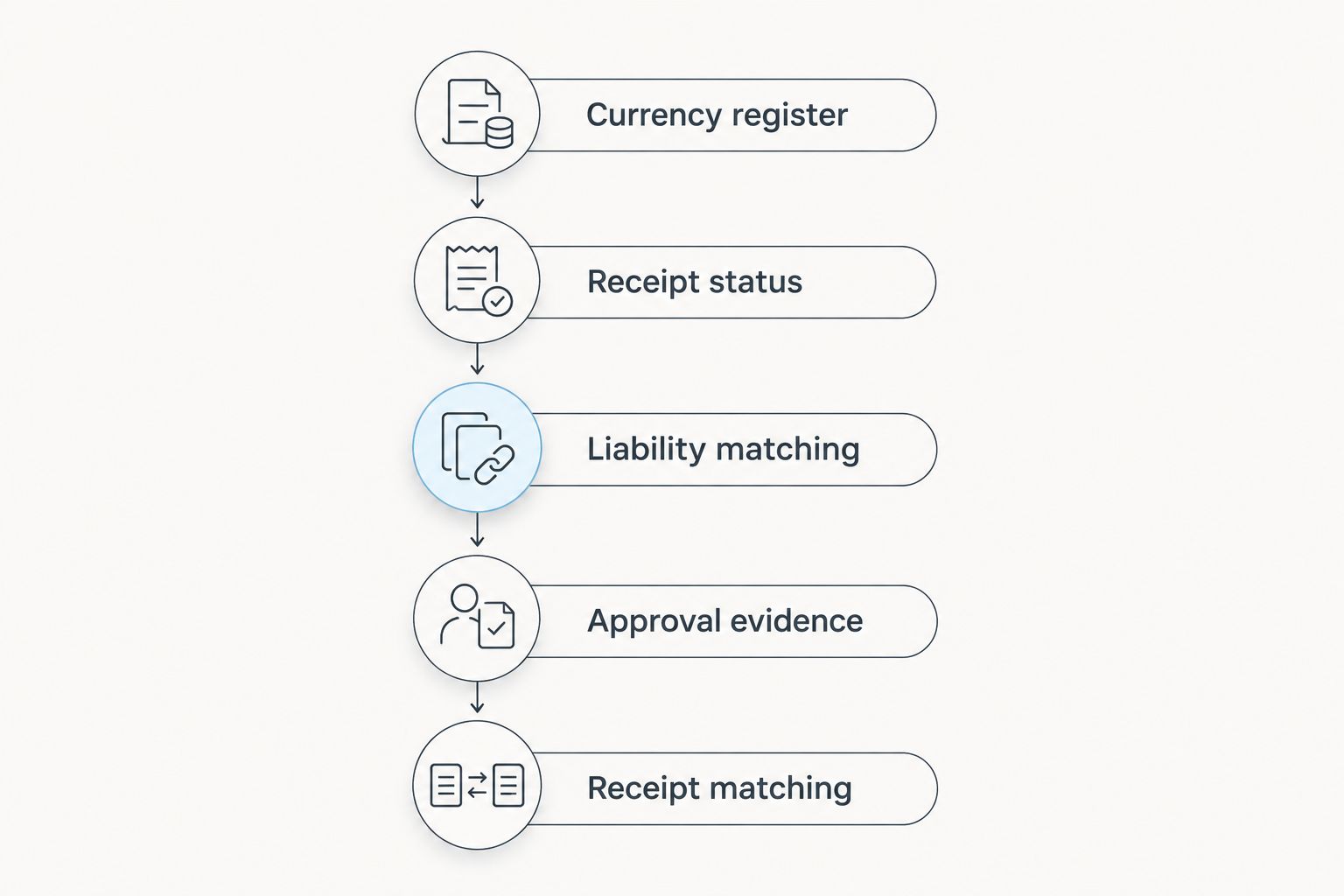
- Currency register: List each currency separately before calculating any reporting-currency total.
- Obligation tags: Identify supplier commitments, customer refunds and operating expenses against relevant funds.
- Balance classification: Mark bank deposits, digital balances and pending receipts distinctly.
- Named ownership: Assign responsibility for updating each balance and resolving discrepancies.
Forecast receipts against payment deadlines
Build a rolling 13-week cash-flow forecast as a planning horizon, not a prediction of guaranteed receipts. Put customer deposits, balance payments, payroll, subscriptions and supplier deadlines into the weeks when money is expected to move.
For each currency, show an opening balance, expected receipts, planned payments and closing balance. Add conversion as its own transaction rather than assuming foreign-currency revenue is already available for local expenses. This exposes a timing gap even when the overall reporting-currency total looks sufficient.
In your 2026 forecast, distinguish contracted receipts from less certain sales opportunities. A confirmed booking balance and a prospective software customer should not carry the same funding assumption. Test what happens if an expected payment arrives after the supplier deadline, without assigning an invented probability to the delay.
- Forecast horizon: Use 13 weeks to connect near-term payments with upcoming customer receipts.
- Receipt status: Separate cleared money, contracted payments and unconfirmed opportunities.
- Delay scenario: Move an expected receipt beyond its associated payment deadline and identify the funding gap.
- Weekly review: Update actual movements and explain changes rather than silently replacing estimates.
Choose collection routes for each customer
Match the collection method to the transaction. A business customer paying a USD invoice has different requirements from an overseas guest paying a safari deposit. Ask what the payer can use, what reference information survives the payment and how your team will identify the receipt.
A spreadsheet and existing payment records are enough to document those requirements. Zeam treasury management becomes relevant when your startup needs USD and EUR receiving details in its business’s name, multiple currency balances and related payment records in one place. That functionality does not establish support for every payer country or payment route.
Keep card acceptance where your guests or customers need it. A payment link is a collection interface; its underlying payment method and terms still need checking. Do not assume that a receiving account, card checkout and payment link are interchangeable.
- Business invoices: Confirm the currency, receiving details, payer requirements and reference format.
- Booking deposits: Give the guest clear payment instructions tied to the specific booking.
- Balance payments: Track the remaining amount and its contractual due date separately from the deposit.
- Route checks: Verify supported payment methods, approval requirements and refund handling before sending instructions.
Set conversion rules around real liabilities
Decide why you are converting before deciding when. If your startup receives EUR and owes a local supplier, the payment deadline creates a funding requirement. If you have a USD-denominated expense, retaining the corresponding currency avoids creating an unnecessary conversion task.
Start with a manual currency schedule: amount owed, payment currency, due date and source of funds. Review the provider’s current conversion terms before authorising a transaction. Do not treat a displayed foreign-currency balance as a fixed amount of rand available for later spending.
For 2026 planning, document a conversion rule that your team can follow without guessing exchange-rate movements. The rule should connect conversions to approved obligations and your chosen operating buffer. It should also identify who can approve exceptions when a customer receipt arrives later than expected.
- Liability matching: Identify expenses that can be paid from receipts in the same currency.
- Conversion purpose: Record the obligation or operating buffer each conversion funds.
- Execution check: Confirm the applicable terms and resulting amount before approving conversion.
- Exception owner: Assign responsibility for changes to the planned conversion schedule.
Separate payment preparation from approval
Write a simple approval matrix before introducing automated workflows. Define who can add a supplier, prepare a payment, approve it and reconcile the result. In a small startup, the founder can remain the approver while another team member prepares the supporting information.
Supplier details deserve their own check. For a South African tourism business or a startup paying tourism suppliers, an accommodation balance and a transport deposit can relate to the same booking but go to different recipients. Keep the recipient, invoice and booking reference connected.
Use a manual checklist if that is your current setup. Zeam includes team approvals, while international and bulk payments are on higher plans. Confirm the relevant plan, permissions and route before designing a workflow around those functions; a feature description is not confirmation that your particular payment is supported.
- Supplier verification: Confirm new or changed payment details through an established contact method.
- Approval evidence: Attach the invoice, business purpose and relevant booking or contract reference.
- Role separation: Distinguish payment preparation, approval and reconciliation responsibilities.
- Access review: Remove permissions when responsibilities change and review who can authorise payments.
Reconcile receipts through to supplier payments
Reconciliation should explain what happened to a customer payment, not merely confirm that the total balance changed. Match the invoice or booking reference to the receipt, any conversion and the outgoing supplier payment. Record deductions from actual transaction records rather than estimating them.
For a booking deposit, retain the amount received, the outstanding customer balance and the supplier commitments it funds. If the booking changes, update those records together. Otherwise, your cash forecast can continue to show money available for a supplier obligation that has already changed.
Use a shared ledger first. Accounting integrations can reduce repeated entry, but confirm the supported integration and data fields before relying on an automated connection. Keep reconciliation ownership with a person who checks exceptions rather than assuming that connected software makes the records complete.
- Receipt matching: Connect each incoming payment to its invoice, customer or booking reference.
- Movement trail: Link conversions and supplier payments to their supporting records.
- Exception log: Track unidentified receipts, short payments and unmatched outgoing transactions.
- Record retention: Store payment evidence and approvals with the underlying business transaction.
Review liquidity before expanding automation
Use a recurring treasury review to decide what needs attention. A practical starting routine is a 7-day review cycle, with a 30-day look at committed payments alongside the longer forecast. These are suggested operating intervals, not provider processing times or performance benchmarks.
Review overdue receipts, upcoming supplier deadlines, currency mismatches and unresolved reconciliation items. For a travel-tech business, also check whether booking changes affect deposits, balance payments or supplier obligations. Assign each exception an owner and next action.
Only then consider cash-flow forecasting and automated transfers. Zeam offers these treasury tools as businesses grow, but your startup still needs to confirm the applicable access and setup requirements. Automation should execute an approved rule; it should not decide whether customer-linked money is available for unrelated spending.
- Near-term review: Check committed payments over the next 30 days against cleared funds.
- Exception ownership: Give every overdue receipt or unmatched transaction a responsible person.
- Automation scope: Automate a documented task only after its inputs and approval rules are clear.
- Fallback process: Keep a manual way to review balances and obligations if an integration is unavailable.
The sequence matters: map the money before forecasting it, choose collection routes before issuing instructions, and reconcile movements before automating decisions.
Compare treasury options for your startup
Choose an operating setup for the work you need to control. These options are not mutually exclusive: a startup can keep a bank relationship, use a business money platform and maintain a separate card or booking checkout.
For your 2026 decision, compare the required collection routes, balance treatment, approval process and record quality. Do not choose solely from a feature list.
| Option | Best for | Main advantage | Key limitation |
|---|---|---|---|
| Spreadsheet with existing accounts | Founders establishing basic treasury discipline | Makes assumptions, obligations and ownership explicit | Requires manual updates and reconciliation |
| Bank-led setup | Startups that specifically require bank deposits and banking services | Keeps the banking relationship central to treasury | Confirm each institution’s currencies, routes and workflow capabilities |
| Zeam business money platform | Startups receiving USD and EUR while managing multi-currency business money | Combines receiving details, balances, conversion and payment-management functions | Not a bank; balances are digital balances, and eligibility, routes and plan conditions require confirmation |
| Card acceptance or payment-link setup | Businesses collecting guest or customer payments through a checkout flow | Supports a customer-facing collection process | Does not by itself establish a complete treasury process; verify the underlying payment method |
Use receiving details for the transactions they support, not as a blanket replacement for card acceptance or booking software. Your collection process and your treasury process need to connect, but they solve different problems.
Apply and verify before changing payment instructions
If the platform fits your requirements, apply for a Zeam business account and complete verification. Confirm your business’s eligibility, the information required for approval and the receiving and payment routes you intend to use.
Wait for approval and confirmed receiving details before updating invoices or booking-payment instructions. Check the relevant plan for international or bulk supplier payments, and confirm any accounting integration rather than assuming compatibility. Account application is a setup step, not evidence that every intended transaction is approved.
Apply for a business account
Complete verification and confirm receiving routes before changing customer payment instructions.
Common mistakes African tech startups make
- Treating foreign-currency revenue as local spending money. A USD invoice does not fund a rand supplier payment until the required receipt and conversion have happened. Forecast those events separately.
- Spending booking deposits without checking obligations. A tourism-linked receipt can carry supplier and refund commitments. Record those commitments before classifying money as available for operating expenses.
- Confusing digital balances with bank deposits. Identify the provider and balance type in your treasury register. Assess the applicable terms rather than applying assumptions from a bank account.
- Automating an unreconciled process. An automated transfer cannot correct an unidentified receipt or outdated supplier obligation. Resolve the recordkeeping problem before expanding automation.
- Changing customer instructions before approval. Complete verification and confirm usable receiving details first. Unsupported payment instructions create avoidable collection work for your team and customer.
FAQ
What is treasury management for African tech startups?
Treasury management for African tech startups is the control of cash, currencies, receipts and payment obligations so the business can fund its operations. It connects collections, conversion, supplier payments, approvals and cash-flow forecasting.
What is the best way to start treasury management without dedicated software?
Start with a currency-specific cash register, a rolling cash-flow forecast and a written approval process. Reconcile actual receipts and payments before adding automation.
Can Zeam receive USD and EUR payments for a startup?
Zeam supports USD and EUR payments from US and European clients using receiving details in the business’s name. Confirm business eligibility, verification approval and the intended payment route before giving customers instructions.
Is Zeam a bank account for my startup?
Zeam is not a bank, and its balances are digital balances rather than bank deposits. Keep that distinction explicit when deciding where to hold operating money.
Should a South African travel-tech business replace card payments with receiving details?
No; receiving details should not replace card acceptance solely because both collect money. Match each method to the payer and booking situation, and verify the supported route, payment terms and reconciliation process.
How should a startup handle overseas booking deposits?
Track each booking deposit separately from the outstanding customer balance and its related supplier commitments. Check the applicable customer and supplier agreements before treating the receipt as available operating money.
Can Zeam help with supplier payments and treasury automation?
Zeam supports local supplier payments, with international and bulk payments on higher plans, and offers treasury tools such as cash-flow forecasting and automated transfers as businesses grow. Confirm the applicable plan, approval requirements and payment routes before relying on a feature.
One last thing
A balance is not a spending limit. For your next 2026 treasury review, add an obligations column beside every currency balance. That small change forces the decision that matters: how much of the money already has a job?