
Cross-border payments for African traders are payments received from or sent to businesses and customers abroad, with the aim of collecting revenue and meeting business costs across currencies. This 2026 guide focuses on South African tour operators and safari businesses collecting overseas booking deposits, balance payments and money needed for local suppliers.
- Cross-border payments for African traders need a receiving route, clear currency terms and a supplier-payment plan.
- Zeam supports USD and EUR receipts; confirm business approval and the specific payment route before sharing instructions.
- Keep card payments and receiving details as distinct options; neither replaces your booking records.
- Match currency conversion to supplier obligations, not just the date a guest sends money.
Why cross-border payments matter for African traders
An overseas booking creates connected obligations: collect the guest’s payment, identify the booking and pay the businesses delivering the trip. A receipt in USD or EUR does not, by itself, settle a local supplier invoice.
For your 2026 payment setup, separate the guest’s payment experience from your business’s money management. Zeam supports receiving USD and EUR from US and European clients using receiving details in your business’s name, holding multiple currency balances and paying suppliers locally. Confirm business approval and the intended route before putting those details on a booking invoice.
Choose the payment method around the booking and supplier deadline, not around the account alone. Card acceptance, payment links and overseas receiving details perform different jobs. A payment link is a way to present a payment request; check the payment method behind it rather than assuming every link accepts cards or settles identically.
How to organise overseas booking payments in 2026
1. Map your booking obligations before choosing a route
Start with a spreadsheet and your existing booking documents. Give each booking a row showing the invoice currency, deposit deadline, balance deadline and supplier obligations. This gives you a usable payment plan before you add another system.
Use 2 payment milestones—deposit and balance—as your starting template, then adjust them to your actual booking terms. These are planning checkpoints, not a prescribed deposit percentage or a rule about when guests must pay. If an overseas travel agent pays on behalf of a guest, record both names so the receipt can be matched correctly.
For a safari booking, distinguish the guest’s outstanding balance from the accommodation, transport and activity costs you have committed to. Money received and money available for another booking are not the same thing.
- Record the guest or agent responsible for payment.
- Separate deposit and balance obligations.
- Enter each supplier’s currency and due date.
- Give the booking a consistent reference.
- Record cancellation and refund terms alongside the invoice.
2. Confirm the receiving route before sending instructions
Ask your existing payment provider which route supports the payer’s country, payment currency and your business. Do this before the guest receives an invoice: a currency label alone does not establish that a particular transfer is supported.
For Zeam cross-border payments, the stated receiving capability covers USD and EUR payments from US and European clients through receiving details in the business’s name. That does not establish eligibility for every African business, every payer location or every transfer method. Apply for a business account, complete verification and confirm approval and route requirements before relying on the service for a booking.
Keep your current collection method available while checking the new route. Do not ask a guest to send funds using receiving instructions that have not been confirmed for your business and their payment.
- Confirm your business’s eligibility and verification requirements.
- Check the payer’s location and sending method.
- Confirm the receiving currency and beneficiary details.
- Ask which payment reference the payer must include.
- Establish how to investigate an unmatched receipt.
3. Offer a payment method that fits the booking
Begin with a clear invoice and payment instructions you can manage manually. Tell the guest the amount due, currency, booking reference and payment deadline. Keep the request separate from a booking confirmation so an unpaid invoice does not become proof of payment.
Receiving details suit a payer who wants to send a transfer through a confirmed route. Card acceptance serves a guest who wants to pay by card. Payment links help you send a payment request, but their usefulness depends on the underlying method and the information recorded with the payment.
Zeam includes payment-link management. Check the supported collection method and route before offering a link to an international guest; do not assume it replaces your card provider or booking system. In 2026, your written instructions should explain the actual payment choice, not simply name the platform.
- State the invoice currency beside the amount due.
- Explain whether the request uses a transfer, card or another confirmed method.
- Keep deposit and balance requests distinguishable.
- Include the booking reference in each request.
- Explain how your team confirms receipt.
4. Match currency conversion to supplier commitments
Use a spreadsheet to compare confirmed receipts with supplier invoices by currency and due date. List local obligations separately from amounts still held in USD or EUR. This shows which funds need conversion and which obligations remain uncovered.
Holding a currency balance gives you a conversion decision; it does not remove exchange-rate exposure. If a guest pays in EUR and your supplier invoice is in rand, the local amount available depends on the conversion applied. Set your conversion decision around a payable obligation, not a hoped-for exchange-rate improvement.
Zeam supports multiple currency balances and conversion when needed, alongside local supplier payments. International and bulk payments are on higher plans. Confirm the relevant plan and payment route before treating either capability as part of your supplier process.
- List supplier invoices in their payment currency.
- Identify which receipts cover each obligation.
- Check the conversion terms before authorising conversion.
- Confirm the local payment route and beneficiary details.
- Record the converted amount against the booking.
5. Reconcile receipts before marking bookings paid
Begin with 3 linked records: the booking invoice, the payment record and the supplier obligation. You can maintain these manually, provided the references agree and someone checks exceptions. A guest’s transfer confirmation is evidence of an instruction, not a substitute for checking the receipt in your own records.
Use 1 booking reference consistently across the invoice, deposit request, balance request and internal records. If the payer omits it, investigate before allocating the money. Never mark an unrelated booking paid merely because the amount looks familiar.
Zeam provides payment records, accounting integrations and team approvals. Confirm which integrations and approval settings apply to your setup; no named accounting package or configuration should be assumed. Automation helps only when the underlying booking and payer information is correct.
- Match the payer, currency, amount and booking reference.
- Record partial payments without closing the outstanding balance.
- Separate received funds from pending payment instructions.
- Assign an owner to unmatched receipts.
- Retain the documents supporting each allocation.
6. Review your cash position before releasing supplier payments
Start with a calendar of supplier due dates and a list of confirmed balances. Compare committed outflows with money already received, not with the total value of bookings in your pipeline. An expected balance payment is not a received balance payment.
Use the same sequence for every booking: Booking terms, Receiving route, Payment request, Receipt matching, Supplier payment. This sequence exposes a missing step before it becomes a supplier problem. Keep refund obligations visible alongside future supplier payments rather than treating every receipt as uncommitted cash.
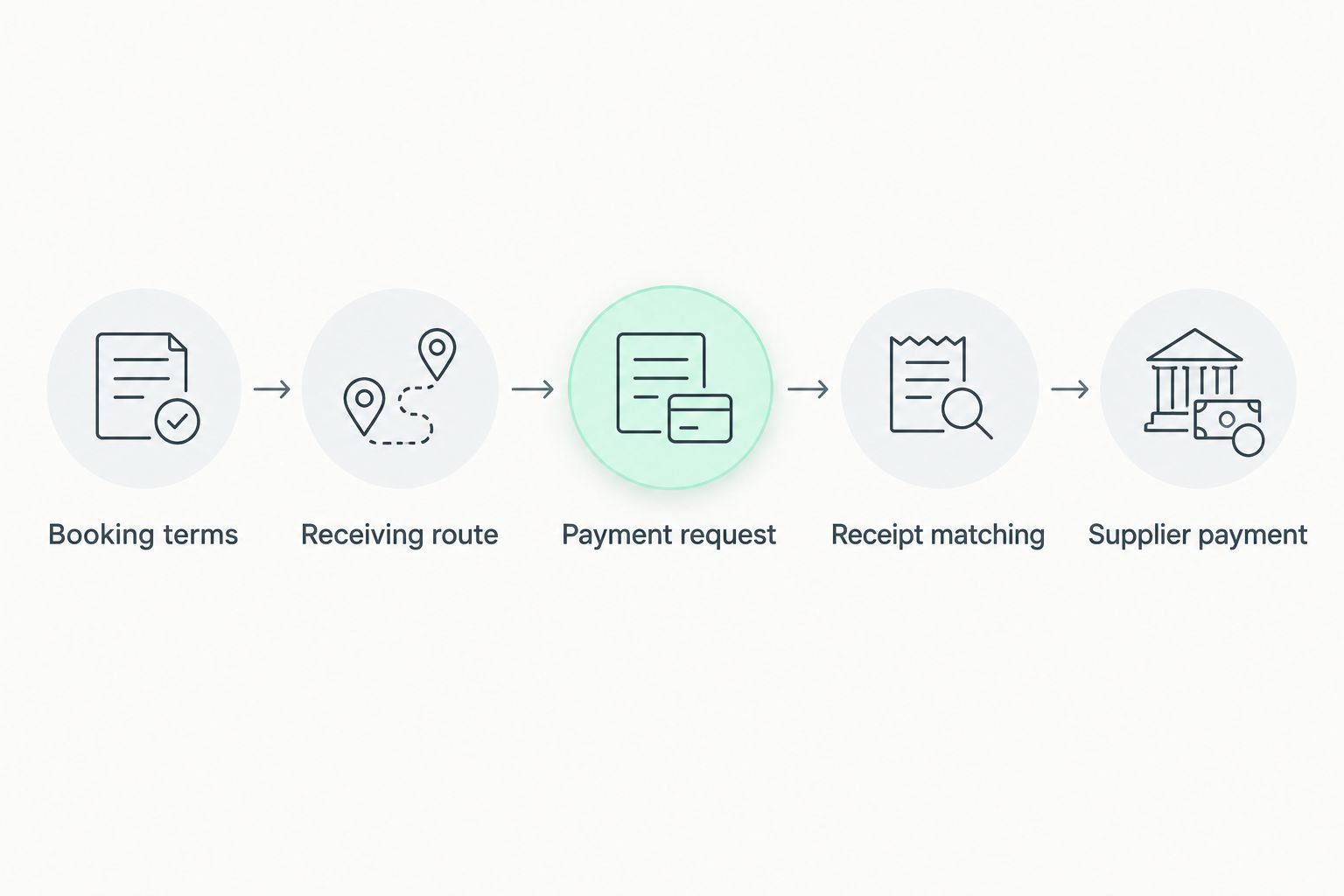
For your 2026 review, document who can approve a conversion, change beneficiary details and release a supplier payment. Treasury tools, including cash-flow forecasting and automated transfers, are available as businesses grow; confirm the applicable access and settings before depending on them.
- Review confirmed balances against upcoming supplier invoices.
- Keep expected guest payments separate from receipts.
- Assign payment and beneficiary-change approvals.
- Track refund obligations against the relevant booking.
- Review unresolved exceptions before releasing funds.
Compare payment options for your tourism business
Choose the collection method and the money-management process separately. A business can retain card acceptance for guests while using receiving details for suitable overseas transfers. The table compares functions, not verified provider-level performance or settlement speeds.
| Option | Best for | Main advantage | Key limitation |
|---|---|---|---|
| Overseas receiving details | Guests or travel agents sending transfers through a confirmed route | Gives the payer specific beneficiary instructions | Requires checks on business approval, payer location, currency and route |
| Card payments | Guests who want to pay by card | Provides a card-based collection option | Requires card acceptance and its own dispute and reconciliation process |
| Payment links | Sending a booking-specific payment request | Gives the payer a direct request to act on | A link alone does not establish the payment method or settlement conditions |
| Zeam business account | Approved businesses receiving USD and EUR and managing supplier money | Combines receiving details, multiple currency balances, conversion and local payments | Is not a bank; international and bulk payments require higher plans, and routes need confirmation |
| Manual booking ledger | Teams establishing a payment process before adding automation | Keeps obligations and exceptions visible without a new integration | Requires consistent updates and checks by your team |
Zeam is best for approved African businesses that need USD and EUR receipts alongside local supplier payments. Its balances are digital balances, not bank deposits. Keep that distinction clear when comparing it with a bank account, and retain any separate card acceptance or booking system your workflow requires.
Apply for a Zeam business account
Complete verification and confirm the receiving route before using it for overseas booking payments.
Common mistakes African tourism traders make
Treating a transfer instruction as a paid booking
Do not release a payment-dependent booking commitment solely because the guest shares a transfer confirmation. Check the receipt and match it to the booking first. Give your team a clear status for payments that have been initiated but not yet matched.
Mixing invoice currency with supplier currency
A EUR booking invoice and a rand supplier invoice are separate obligations. Record both and decide when conversion is needed. Otherwise, your booking ledger shows revenue without showing the local-currency obligation it must cover.
Assuming payment links mean card acceptance
A link is not a universal payment method. Verify what the guest can actually use, what reference reaches your records and how the payment is confirmed. Keep your existing card option unless you have verified a suitable replacement.
Choosing a platform before confirming approval
Do not publish new receiving instructions while your application or intended route remains unconfirmed. Complete verification and resolve questions about the business, payer and payment method first. An account application is not proof that every planned transaction is supported.
Spending deposits without tracking commitments
A deposit can relate to supplier costs, future delivery and potential refunds under your booking terms. Label the obligations before allocating the money elsewhere. Your 2026 cash-flow view should distinguish the balance you hold from the amount not already committed.
FAQ
What are cross-border payments for African traders?
Cross-border payments for African traders are payments received from or sent to customers and businesses abroad. For a South African tour operator, this includes collecting an overseas booking deposit and managing the money needed for suppliers.
What is the best way to collect an overseas safari booking deposit?
Use a payment method that supports your business, the guest’s location and the agreed currency. Offer clear booking references and confirm receipt before treating the deposit as paid; transfers and card payments serve different payer preferences.
Can I receive USD and EUR for my tourism business?
Zeam supports receiving USD and EUR payments from US and European clients using receiving details in the business’s name. Apply, complete verification and confirm business approval and the specific route before sending receiving instructions.
Are receiving details better than card payments for overseas guests?
Receiving details are not universally better than card payments. They suit supported transfers, while card acceptance serves guests who want to pay by card; compare the actual route, payment conditions and reconciliation process.
Does a payment link replace my booking system?
A payment link does not by itself replace a booking system. Keep booking terms, deposit and balance obligations, supplier commitments and payment status in records your team can reconcile.
Should I convert an overseas deposit as soon as it arrives?
Base the conversion decision on the currency and timing of your supplier obligations. Holding foreign currency leaves you exposed to exchange-rate changes when the underlying expense is in another currency.
Is a Zeam balance a bank deposit?
No. Zeam is not a bank, and its balances are digital balances rather than bank deposits. Keep that distinction explicit when deciding where to hold money for bookings and supplier payments.
One last thing
Check whether someone other than the guest will pay before you issue the invoice. An overseas travel agent’s business name can differ from the traveller’s name, so record the expected payer and booking reference together. That small instruction gives your team a concrete way to match the receipt without changing the guest-facing booking process.