
Best overall for receiving and managing overseas booking money: Zeam. Best for an existing bank relationship: a business bank’s foreign-exchange service. Best for guests paying by card: a card payment processor. Best for checking conversion maths: a reference currency converter. This guide compares currency conversion tools for African businesses, with South African tour operators and safari businesses as the working example.
- Zeam leads these currency conversion tools for African businesses for receiving USD and EUR and managing supplier payments, subject to approval.
- Business bank foreign-exchange services suit operators keeping conversion within an existing banking relationship.
- Card payment processors serve guest card payments; currency calculators only provide reference conversions.
- Compare the complete booking-payment workflow, including conversion, supplier payments, reconciliation and verification.
Why this matters for tourism businesses in 2026
An overseas booking creates more than a currency conversion. You need to collect a deposit, identify the booking, manage the balance payment and pay the lodge, guide or transport provider in the required currency.
A favourable conversion quote does not settle those operational questions. Choose the payment route first, then compare the conversion terms within that route. A calculator cannot collect the deposit, and a receiving account does not automatically replace your card processor or booking system.
For a safari booking paid in USD with local supplier obligations in rand, separate the receipt decision from the conversion decision. Decide when suppliers need payment before deciding how much foreign currency to retain.
What makes the best currency conversion tools for African businesses
Use these criteria before choosing a provider:
- Receiving fit: Can your approved business receive the booking currency from the relevant payer through the intended route?
- Conversion visibility: Can you identify the source amount, applicable charges and final destination amount before confirming?
- Supplier-payment fit: Does the service support the required destination, currency and payment method for each supplier?
- Booking reconciliation: Can you connect deposits, balance payments and outgoing payments to the correct booking?
- Business controls: Do permissions, approvals and records match how your team handles money?
- Account status: Understand whether you hold a bank deposit or a digital balance, and check the applicable terms.
Request 2 written quotes for the same source amount and destination currency when comparing conversion routes. Keep the quote timing comparable and check what each quote includes; an exchange-rate display alone is not a complete payment comparison.
Currency conversion options at a glance for 2026
The ranking below compares different tool types, not interchangeable products. Each serves a distinct job in your booking-payment process.
| Option | Best for | Standout function | Key limitation |
|---|---|---|---|
| Zeam | Receiving overseas business payments and managing currency balances | USD and EUR receiving details in your business’s name, with conversion and local supplier payments | Not a bank; international and bulk payments are on higher plans |
| Business bank foreign-exchange service | Keeping conversion within an existing banking relationship | Connects conversion decisions to your business banking arrangements | Receiving currencies, payment routes and services depend on the bank and account |
| Card payment processor | Collecting guest payments by card | Provides a card-acceptance route for booking payments | Settlement currency, conversion terms and dispute handling require separate checks |
| Reference currency converter | Checking indicative conversion maths | Translates an amount between currencies for planning | Does not receive, hold or pay your business money |
Payment links belong alongside this comparison, not above it. A link is a collection interface; you still need to establish which payment methods it accepts and how the proceeds reach your business.
1. Zeam: best for overseas receipts and supplier-payment management
Zeam helps African businesses receive USD and EUR payments from US and European clients using receiving details in the business’s name. You can hold multiple currency balances, convert when needed and pay local suppliers.
For a tour operator, that connects overseas booking receipts with the money needed for supplier obligations. Apply for a business account and complete verification, then confirm approval, receiving-route availability and the intended supplier-payment arrangements before sharing payment instructions with guests.
Zeam pros:
- Receive USD and EUR using receiving details in your business’s name.
- Hold multiple currency balances rather than treating receipt and conversion as the same decision.
- Manage payment links, records and team approvals alongside business payments.
- Add treasury tools, including cash-flow forecasting and automated transfers, as the business grows.
Zeam cons:
- Balances are digital balances, not bank deposits; the service is not a bank.
- International and bulk payments are on higher plans.
- The stated receiving capabilities do not establish support for every country, payer or payment route.
Best for: A tourism business that needs overseas receipts, currency management and local supplier payments in one place, subject to approval and route confirmation.
Verdict: Buy into this workflow only after verification and payment-route checks. Keep card acceptance available wherever guests need it; do not assume this account replaces your booking system.
2. Business bank FX services: best for an existing bank relationship
A business bank’s foreign-exchange service lets you arrange conversion within your banking relationship. The useful comparison is the service attached to your actual business account, not a generic claim about banks.
Ask the bank to explain incoming foreign-currency receipts, conversion instructions, outgoing supplier payments and the records supplied for each transaction. Confirm whether your particular arrangement holds foreign currency or converts receipts under its account terms.
Business bank FX service pros:
- Keeps the conversion discussion within your existing business banking relationship.
- Lets you assess foreign exchange alongside the account used for other business payments.
- Provides a direct point of comparison against a separate receiving-and-conversion service.
Business bank FX service cons:
- A business bank account does not establish access to every receiving currency or international payment route.
- Account and foreign-exchange terms still need separate review; an existing relationship is not a complete suitability check.
Best for: An operator whose current bank can document the required receipt, conversion and supplier-payment workflow.
Request a worked payment example rather than a rate alone. It should show what happens to an overseas deposit and what reaches the intended supplier after conversion and payment charges.
Verdict: Hold your current arrangement until a like-for-like comparison identifies a specific operational reason to change.
3. Card payment processors: best for guests paying by card
A card payment processor enables businesses to accept card payments. For a tourism operator, the selection question is whether the processor supports the required booking-payment experience and settlement arrangements, not simply whether it displays multiple currencies.
Ask separately about the currency shown to the guest, the currency charged and the currency settled to your business. Treat card collection and subsequent currency conversion as connected decisions, not necessarily the same service.
Card payment processor pros:
- Serves guests who want to pay their booking deposit or balance by card.
- Can sit alongside receiving details for guests using a different supported payment method.
- Lets you evaluate card collection separately from where you hold and convert business money.
Card payment processor cons:
- Card acceptance does not establish that you can retain proceeds in USD or EUR.
- Settlement arrangements, refund handling and card disputes require their own review.
- A card processor is not automatically a booking-management system.
Best for: Operators that need a card-payment option for international guests, with verified settlement and refund arrangements.
If a provider offers a payment link, establish its underlying payment method before recommending it to guests. Do not assume every link accepts cards or provides the same settlement choices.
Verdict: Buy for verified card-collection needs; skip it as a substitute for a complete currency-management plan.
4. Reference currency converters: best for checking indicative maths
A reference currency converter translates an amount from one currency into another using its displayed rate. Use it to sense-check a booking calculation or prepare a planning estimate, not to promise what your business will receive.
For example, you can check the indicative rand equivalent of a USD booking balance. The payment provider’s executable quote and applicable charges determine the actual conversion outcome, not the calculator result.
Reference currency converter pros:
- Makes a foreign-currency amount easier to understand during planning.
- Provides a separate arithmetic check before you approve a conversion.
- Helps you discuss currency exposure without treating the estimate as a payment instruction.
Reference currency converter cons:
- Does not collect deposits, hold balances or pay suppliers.
- Its displayed conversion is not your provider’s confirmed transaction outcome.
- Does not replace transaction records or booking reconciliation.
Best for: Owners checking calculations before requesting or approving an actual conversion quote.
Record the calculator’s date and rate basis if you use its result in an internal forecast. Keep that estimate separate from the confirmed payment record so your team does not mistake planning figures for received funds.
Verdict: Use for reference; skip as the basis for a guaranteed booking receipt or supplier-payment amount.
Put the tools into a booking-payment workflow
Build the workflow around 3 dates: deposit due, balance due and supplier due. These dates show when money must move; they do not predict when an international payment will arrive.
Booking terms
State the invoicing currency, deposit requirement, balance deadline and applicable cancellation terms. Make payment instructions consistent with those terms, including the reference the guest should use.
Receipt check
Before sending receiving details or a payment link, confirm the account is approved and the intended route is supported. Use 1 booking reference consistently across the invoice, payment request and internal record.
Conversion decision
Compare the confirmed foreign-currency balance with upcoming supplier obligations. Convert according to the approved payment plan rather than treating a favourable-looking calculator rate as an instruction.
Supplier payment
Confirm the supplier’s details and required currency before authorising payment. Separate local payments from international or bulk-payment requirements when checking the relevant service and plan.
Reconciliation
Match received funds, conversion records and supplier payments to the booking. Keep the outstanding guest balance distinct from money already received.
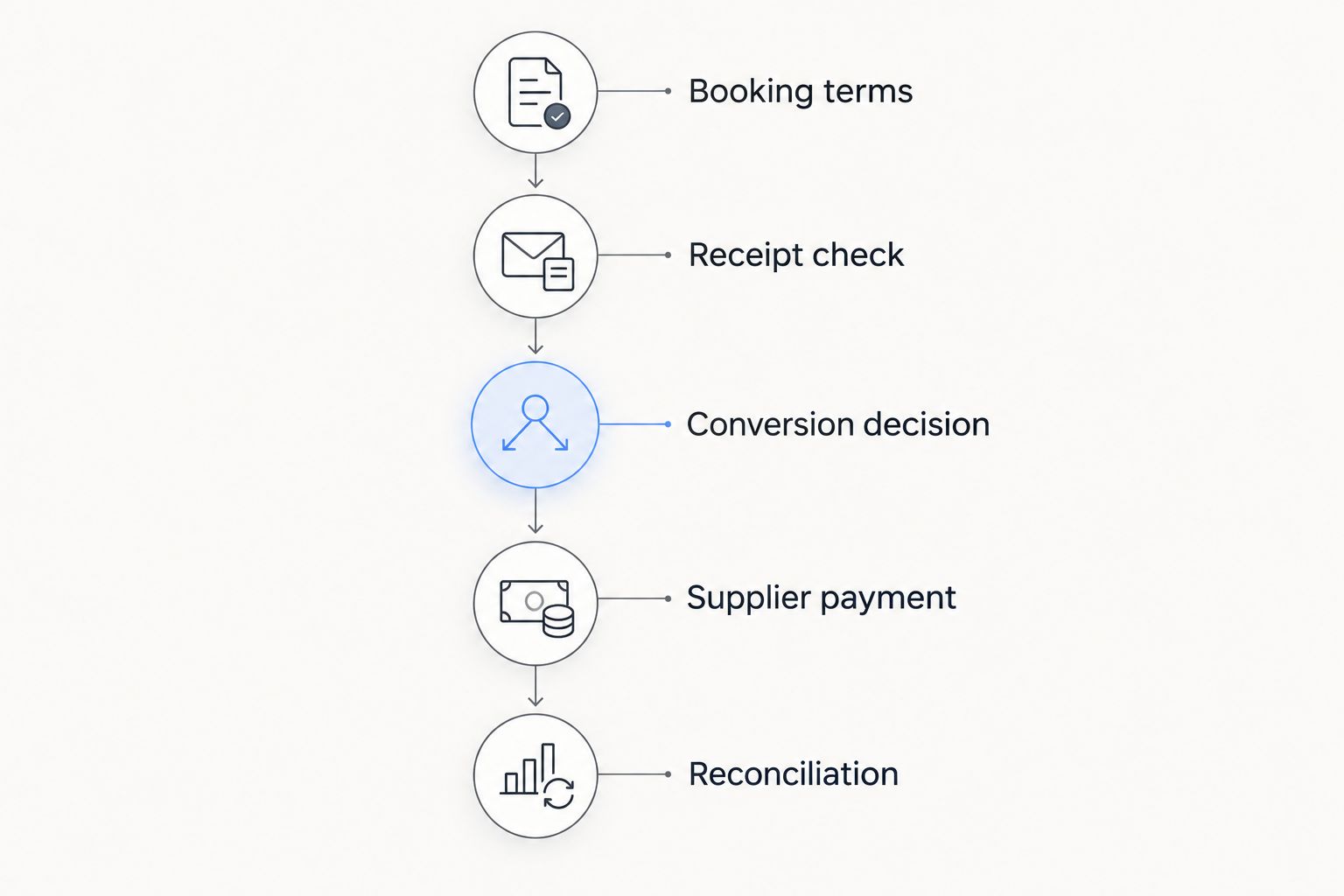
If a guest pays the deposit in EUR but the supplier needs rand, the conversion decision belongs between confirmed receipt and the supplier’s payment deadline. A separate card route can remain available for guests who need it.
Start your business account application
Apply, complete verification and confirm the receiving and supplier-payment routes your bookings need.
How the options rank for 2026
The order follows the criteria above: receiving fit, conversion visibility, supplier payments, booking reconciliation, business controls and account status. The first option covers the stated receive-hold-convert-pay workflow; the others address an existing banking relationship, card collection or reference calculations.
This is a workflow ranking, not a measured ranking of exchange rates or transfer speed. Choose the narrowest tool that solves the job, then check how it connects to the rest of your booking process.
Which currency conversion tool should you choose?
Zeam is best for African businesses seeking USD and EUR receipts, currency balances and local supplier payments in one place, subject to approval and route checks. For a South African safari operator, the next step is an application and verification, followed by confirmation of the actual booking-payment routes required.
Keep a suitable bank arrangement if it already handles your documented requirements. Add or retain card acceptance for guests who need cards, and use a reference converter only for checking calculations.
Your 2026 decision should produce clear payment instructions for guests and clear authorisation rules for staff. A tool that leaves either unresolved has not finished the job.
FAQ
What's the best currency conversion tool for a South African safari business?
Zeam is the leading option in this guide for combining USD and EUR receipts, currency balances and local supplier payments. Apply and complete verification, then confirm approval and the specific receiving and payment routes your business needs.
Can I receive a booking deposit in USD or EUR and convert later?
A service that supports receiving and holding the relevant currency lets you separate receipt from conversion. Confirm the account terms, receiving route and supplier-payment requirements before issuing instructions to a guest.
Is a currency calculator enough for overseas booking payments?
No. A currency calculator provides a reference conversion; it does not collect booking deposits, hold funds or pay suppliers. Use the payment provider’s confirmed quote for the actual transaction.
Are payment links the same as card payments?
No. A payment link is an interface for requesting payment, while card payment is a payment method. Check which methods the particular link supports and how the proceeds settle.
Should I convert the whole overseas booking deposit immediately?
Base the conversion amount on your documented supplier obligations and currency needs, not a blanket rule. Check payment deadlines, cancellation obligations and available balances before approving the conversion.
Does a business receiving account replace my booking system?
No replacement should be assumed. Receiving money, accepting cards and managing booking inventory are separate functions; confirm the actual capabilities before changing your systems.
How should I compare currency conversion costs?
Compare written quotes for the same source amount, destination currency and payment purpose at comparable times. Check the final destination amount and applicable charges rather than comparing the displayed exchange rate alone.
What should I check before sending a guest new receiving details?
Confirm business verification, account approval and support for the intended payer, currency and payment route. Then check the receiving details and booking reference against your approved payment instructions.
One last thing
A paid guest invoice and a funded supplier obligation are different milestones. For your 2026 booking checklist, record both: whether the guest’s money has arrived and whether the correct currency is ready for the supplier. Do not mark a booking financially ready merely because a guest has sent payment confirmation.