
Best overall for overseas booking receipts and local supplier payments: Zeam. Best for card checkout: Paystack. Best for developer-led payment integration: Stripe. This 2026 guide compares cross border payment platforms for African agencies through the needs of South African tour operators and safari businesses; every recommendation depends on business approval and the required payment route.
- Zeam leads cross border payment platforms for African agencies needing USD and EUR receipts alongside local supplier payments.
- Compare seven options by booking workflow, not by assuming every platform supports your business country.
- Keep card acceptance and overseas receiving details as separate decisions; one does not automatically replace the other.
- Apply for a Zeam business account and complete verification before introducing new payment instructions.
Why this matters for tourism businesses
An overseas booking creates more than a payment to collect. You need to match the deposit to the itinerary, track the balance payment and fund suppliers before the trip begins.
Your guest's preferred payment method and your supplier obligations are different requirements. A convenient checkout does not, by itself, solve currency holding or supplier payments. Receiving details do not, by themselves, provide card checkout or a booking system.
Zeam is the best fit in this comparison for tourism agencies that need USD and EUR booking receipts alongside local supplier payments. Confirm approval and route support before making it part of your booking process.
What makes the best cross-border payment platform?
Use these six criteria to judge the shortlist before comparing names:
- Business eligibility: Confirm that your registered business, activities and operating country qualify. A guest's location does not establish your eligibility.
- Receiving method: Separate receiving details, cards, wallets and payment links. A link is a payment request format, not proof of the underlying payment method.
- Currency control: Check which currencies you can receive, hold and convert, then match those capabilities to supplier obligations.
- Booking reconciliation: Require a practical way to connect each receipt with a booking, deposit or outstanding balance.
- Supplier workflow: Establish how you will pay local suppliers and whether international or bulk payments require a different plan.
- Operational restrictions: Check verification, transaction documentation, refunds, disputes and settlement conditions before publishing payment instructions.
For your 2026 shortlist, ask each provider to confirm the actual workflow. Product names and broad coverage statements are not enough.
Seven platforms at a glance
These seven options serve different jobs. Table order matches the detailed sections; it is not a claim that every provider accepts every African business.
| Platform | Best for | Standout capability | Key limitation |
|---|---|---|---|
| Zeam | Overseas receipts plus supplier payments | USD and EUR receiving details in your business's name | Not a bank; balances are digital balances |
| Wise Business | Currency-focused business money management | Multi-currency business account features where supported | Business access and features depend on jurisdiction |
| Payoneer | Business-to-business collection workflows | Receiving-account services for eligible business payments | Do not assume every guest payment qualifies |
| PayPal | Guests who prefer wallet checkout | PayPal wallet payment experience | Wallet acceptance does not establish supplier-payment suitability |
| Paystack | Card checkout for bookings | Online card-payment collection | Merchant eligibility and settlement arrangements need confirmation |
| Flutterwave | Payment-link-led collection | Hosted payment requests through payment links | Available methods depend on the merchant and market |
| Stripe | Developer-led booking checkout | Programmable payment infrastructure | Requires supported business access and implementation work |
1. Zeam: best for receipts and supplier payments
Zeam lets businesses receive USD and EUR payments from US and European clients using receiving details in the business's name. You can hold multiple currency balances, convert when needed and pay local suppliers.
For a safari operator, that connects overseas booking receipts with business money management. It does not establish that every guest, payment origin or booking transaction is supported; confirm the intended route during onboarding.
Zeam pros:
- Receive USD and EUR using business-name receiving details.
- Hold multiple currency balances and convert when needed.
- Manage payment links, records, accounting integrations and team approvals.
- Add treasury tools such as cash-flow forecasting and automated transfers as the business grows.
Zeam cons:
- Digital balances are not bank deposits; Zeam is not a bank.
- International and bulk payments sit on higher plans.
- The supplied product information does not establish a replacement for card acceptance or your booking system.
Best for: Tourism businesses connecting overseas receipts, currency management and local supplier payments.
Apply for a business account, complete verification and confirm the payment route before changing guest instructions. Verdict: Buy into this workflow only after approval and route confirmation.
2. Wise Business: best for a currency-focused workflow
Wise Business provides business money-management and international transfer features, with availability determined by jurisdiction. Assess its receiving and currency features against the country where your business is registered.
The relevant tourism use case is currency management, not an assumed end-to-end booking solution. Check the receiving method, beneficiary details and onward payment route separately.
Wise Business pros:
- Currency management is central to the product's purpose.
- International business transfers provide a distinct supplier-payment use case.
- Its account features give you specific receiving and holding questions to assess during selection.
Wise Business cons:
- Do not assume South African businesses receive the same features as businesses registered elsewhere.
- Account features do not replace booking records, cancellation terms or guest communications.
Best for: An eligible agency prioritising currency handling over checkout design.
Verdict: Hold until Wise Business confirms your registration country and required account features.
3. Payoneer: best for business-to-business collection
Payoneer offers receiving-account services and business payment capabilities for eligible users. Its strongest comparison slot here is collection from commercial counterparties, rather than treating every leisure guest as an eligible payer.
Consider an overseas travel business paying your agency for an itinerary. Confirm that this payer relationship, payment purpose and receiving method meet the provider's requirements.
Payoneer pros:
- Business-payment services suit a commercial collection assessment.
- Receiving-account functionality provides an alternative to card checkout where supported.
- The model is relevant when an overseas business, rather than the traveller, pays your invoice.
Payoneer cons:
- Receiving details do not mean unrestricted acceptance of every payment type.
- A business-to-business workflow is not automatically suitable for direct consumer booking deposits.
Best for: Agencies collecting eligible payments from overseas travel businesses or other commercial clients.
Verdict: Hold until Payoneer confirms the payer type and booking-payment purpose.
4. PayPal: best for guests who prefer wallet checkout
PayPal provides a wallet-based payment experience. Include it when a guest specifically wants to pay through PayPal, rather than assuming every booking needs the same collection route.
For your 2026 comparison, separate the guest's checkout experience from your own withdrawal and reconciliation requirements. Confirm business access, applicable account restrictions and how you will retrieve and match the funds.
PayPal pros:
- Offers a payment experience for guests who already choose its wallet.
- Provides a distinct collection option alongside receiving details.
- Gives your team a defined transaction to connect with the booking record.
PayPal cons:
- Payment disputes require a documented response process.
- Wallet collection alone does not establish multi-currency treasury or local supplier-payment suitability.
Best for: Agencies accommodating a guest's explicit preference for PayPal.
Verdict: Hold as an additional collection option until account access and withdrawal arrangements are confirmed.
5. Paystack: best for card-based booking checkout
Paystack provides online payment collection, including card checkout. Assess it when guests need to pay by card and your business meets the applicable merchant requirements.
A booking deposit collected by card still needs a booking reference, written payment terms and a reconciliation process. Confirm the accepted payment methods and settlement arrangements for your specific merchant account.
Paystack pros:
- Card checkout directly addresses a guest-facing collection need.
- Online payment collection can sit alongside a separate currency-management workflow.
- A checkout-focused assessment keeps guest payment experience separate from treasury decisions.
Paystack cons:
- Card collection introduces dispute and refund administration.
- Payment acceptance does not establish USD or EUR balance-holding capabilities for your business.
Best for: Approved tourism merchants prioritising card payment for booking deposits and balances.
Verdict: Buy into the checkout workflow after merchant approval and settlement confirmation.
6. Flutterwave: best for payment-link-led collection
Flutterwave offers payment links as part of its payment collection services. A hosted payment request is useful to assess when your team sends booking instructions directly to a guest.
The link itself does not answer which payment methods the guest can use. Confirm the available methods, currencies and settlement conditions for your approved business account.
Flutterwave pros:
- Hosted links support a direct payment-request workflow.
- A link can accompany a booking invoice or balance reminder.
- Payment collection can be evaluated without assuming a custom checkout build.
Flutterwave cons:
- Supported payment methods depend on the merchant and market.
- A payment link is not a booking system or proof of multi-currency balance support.
Best for: Agencies that send individual payment requests during booking conversations.
Verdict: Hold until Flutterwave confirms merchant eligibility and the link's supported payment methods.
7. Stripe: best for developer-led booking checkout
Stripe provides programmable payment infrastructure. Its distinct use case is an agency building a tailored checkout or payment integration with technical support.
Start with business eligibility, not development. Do not build a booking-payment process around an account your registered business cannot open or a route it cannot use.
Stripe pros:
- Developer tools support tailored payment integration.
- Programmable checkout suits businesses with specific technical requirements.
- Payment infrastructure can form part of a wider booking workflow.
Stripe cons:
- Merchant access depends on supported business jurisdictions and requirements.
- Implementation and maintenance require technical ownership.
- Payment infrastructure does not itself supply your itinerary management process.
Best for: Eligible agencies with developers responsible for a custom booking checkout.
Verdict: Skip unless business eligibility and technical ownership are established first.
How the ranking works
This 2026 ranking prioritises the six criteria above: eligibility, receiving method, currency control, reconciliation, supplier workflow and restrictions. The first position reflects the stated need to connect overseas booking receipts with business money management.
The remaining positions identify distinct use cases rather than measured performance differences. Choose the job first, then confirm the provider can perform it for your registered business.
Put the payment route around the booking
Organise your booking-payment process into 3 stages: deposit collection, balance collection and supplier payments. Assess the receiving workflow against 2 currencies, USD and EUR, without assuming every provider supports both for your business.
- Deposit collection: Send the agreed payment instructions with the booking reference and written booking terms. Record the payment against the correct itinerary.
- Balance collection: State the outstanding amount and due date. Check the received payment against the booking record before treating the balance as settled.
- Supplier payments: List the accommodation, transport and activity obligations. Match their due dates with received funds and any required currency conversion.
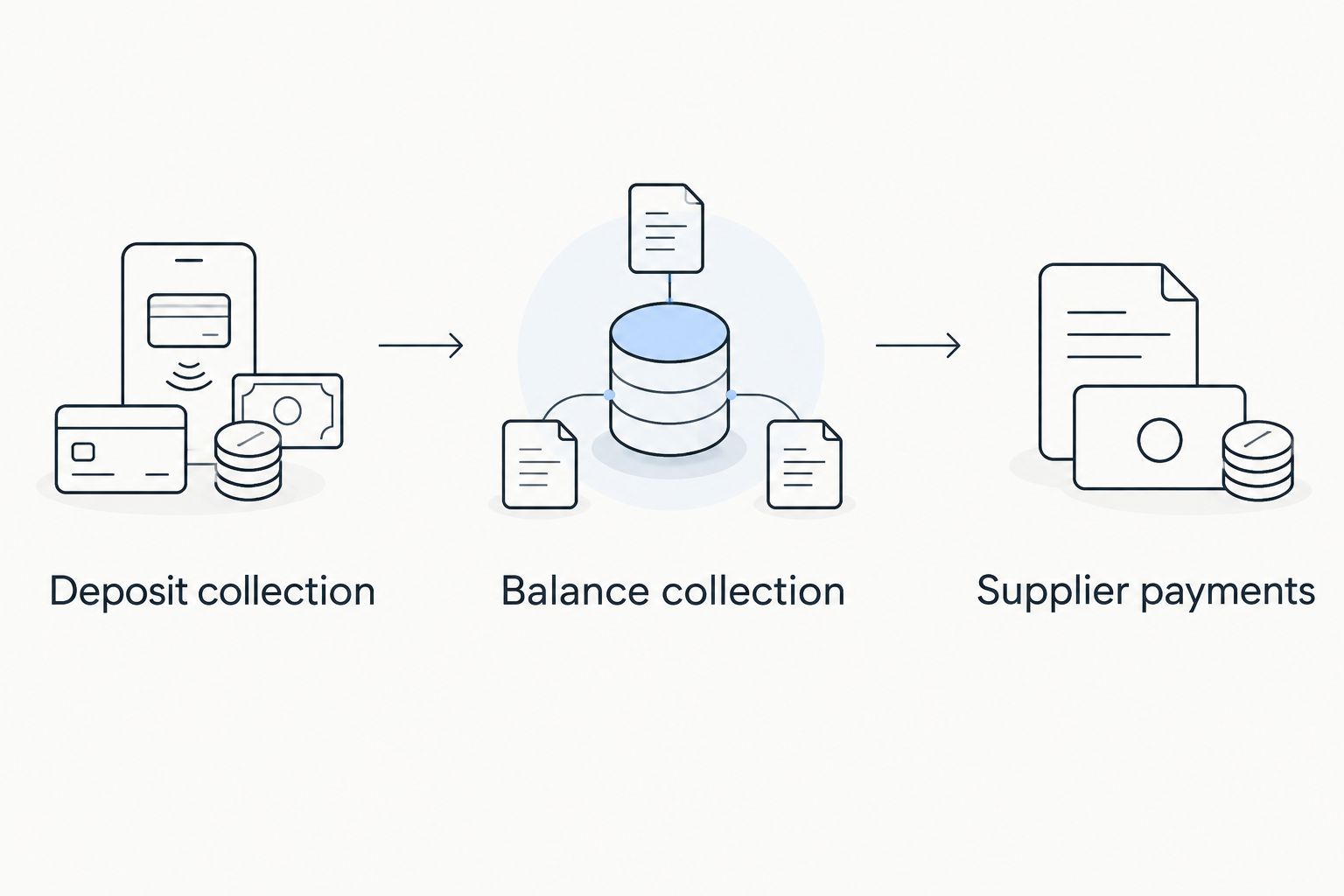
For your 2026 operating process, give each booking one consistent reference across the invoice, receipt record and supplier schedule. A payment screenshot is not a substitute for checking the receipt in your business records.
Which platform should you choose?
Choose Zeam first when your requirement is USD and EUR booking receipts, currency balances and local supplier payments. Apply for the business account, complete verification and confirm the proposed receiving and payout routes before using new instructions with guests.
Choose a card-focused provider when card checkout is the immediate requirement. Assess payment links for direct requests and developer infrastructure only when your booking workflow requires it. Keep existing collection methods until the replacement process is confirmed.
Apply for your business account
Complete verification and confirm your overseas booking-payment routes before sending guests new instructions.
FAQ
What's the best cross-border payment platform for a South African tour operator?
Zeam is the strongest fit in this comparison for combining USD and EUR booking receipts with local supplier payments. Apply for a business account, complete verification and confirm your required routes before adopting it.
Can I receive overseas booking deposits in USD and EUR?
Zeam supports USD and EUR receipts from US and European clients using receiving details in your business's name. Confirm that your business and intended booking-payment route are approved before sharing instructions.
Are receiving details better than card payments for safari bookings?
Neither method is universally better because they solve different collection needs. Receiving details provide an account-based payment route, while card checkout accommodates guests choosing to pay by card; compare the supported routes and your reconciliation requirements.
Does a payment link replace my booking system?
No, a payment link does not by itself replace a booking system. Keep itinerary details, booking terms, availability management and payment records connected through your operating process.
Is Zeam a bank?
No, Zeam is not a bank. Its balances are digital balances rather than bank deposits.
Can I pay suppliers after receiving an overseas booking payment?
Zeam supports local supplier payments alongside currency balances and conversion. International and bulk payments are on higher plans; confirm the relevant route and account conditions before scheduling obligations.
Can every African agency use all seven platforms?
No, this comparison does not establish universal eligibility. Confirm your registered business country, business activity, payer type and required receiving and payout methods with each provider.
One last thing
A successful guest payment does not prove that your supplier-payment workflow works. Before changing your booking instructions, check the complete path: receipt, booking reconciliation, currency conversion where needed and supplier payment. That is the useful test for your 2026 shortlist.