
Best fit for overseas booking receipts: Zeam, subject to business approval and payment-route confirmation. Best for a banking relationship: a foreign-currency business bank account; best for guests who want to pay by card: a merchant account with card acceptance. This 2026 guide helps South African tour operators and safari businesses choose a business account to receive USD payments without confusing receiving details, card checkout and payment links.
- Zeam is the best-fit business account to receive USD payments here for tourism businesses needing multi-currency money management, subject to approval.
- Compare USD receiving details with card acceptance; they serve different booking-payment needs.
- Confirm business eligibility, payment routes and verification before sending receiving details to overseas guests.
- Match booking deposits and balance payments to local supplier commitments before deciding when to convert.
Why this matters for tourism businesses
An overseas booking receipt is only part of the job. You also need to identify the booking, track its outstanding balance and fund the suppliers delivering the trip.
For a safari booking, the guest's deposit and final balance can arrive separately while accommodation and transport commitments fall due on different dates. Choose the payment method around the booking workflow, not the currency label alone.
Receiving USD does not automatically solve card acceptance, refunds or booking administration. Keep those decisions separate when assessing your 2026 payment setup.
What makes the best account for USD booking payments?
Use these criteria before comparing account names:
- Business eligibility: Confirm that the provider accepts your South African tourism business and its activities. Complete the required verification before relying on the account.
- Receiving details: Establish whose name appears on the details, which currencies you can receive and which incoming payment routes are supported.
- Guest payment fit: Check whether the guest wants to send a transfer or pay by card. A receiving account and a card checkout are not interchangeable.
- Supplier payment fit: Confirm how you will pay local suppliers and which functions depend on your plan or approval.
- Booking records: Assess how you will connect each receipt to its booking, deposit, balance and any subsequent adjustment.
- Legal status and control: Understand whether you hold a bank deposit or a digital balance, who can approve payments and what happens when a payment needs investigation.
USD payment options at a glance
These options address different jobs. The ranking puts the supplied multi-currency receiving product first, then separates banking, card acceptance and payment collection rather than treating them as identical accounts.
| Option | Best for | Standout feature or purpose | Key limitation |
|---|---|---|---|
| Zeam | Overseas receipts and multi-currency business money management | USD and EUR receiving details in the business's name, currency balances and local supplier payments | Not a bank; approval, supported routes and plan conditions need checking |
| Foreign-currency business bank account | Businesses specifically seeking a banking relationship | A bank-account route for holding and receiving foreign currency, where offered | Receiving, conversion and supplier-payment functions require bank-specific checks |
| Merchant account with card acceptance | Guests who want to pay by card | Card payment collection | Not automatically a USD balance or foreign-currency receiving account |
| Payment-link service | Sending a payment request without building a checkout | A shareable collection link | A link alone does not establish the payment method or settlement currency |
1. Zeam: best for overseas receipts and currency management
Zeam provides receiving details in your business's name for USD and EUR payments from US and European clients. It also supports holding multiple currency balances, converting when needed and paying suppliers locally.
For a tour operator, that combines receiving and money-management functions in one place. It does not establish that every guest, sending bank or payment route is supported; confirm the actual route before issuing instructions.
Best for: A tourism business that wants to receive overseas payments and manage currency balances alongside supplier obligations.
USD receiving account pros:
- Receiving details are in the business's name.
- USD and EUR receipts support dealings with US and European clients.
- Multiple currency balances let you separate receipt from conversion.
- Records, payment links, accounting integrations and team approvals are part of the stated offering.
USD receiving account cons:
- Balances are digital balances, not bank deposits.
- International and bulk payments are on higher plans.
- A tourism business still needs to confirm eligibility, approval and the routes relevant to its bookings.
For a 2026 application, describe your actual booking-payment workflow: who pays you, in which currency, and how you pay suppliers. Check the applicable plan and available functions rather than assuming every feature is included.
Verdict: Hold until verification and route checks are complete; then use the account for the confirmed receiving workflow.
2. Foreign-currency bank account: best for a banking relationship
A foreign-currency business bank account is the category to assess when your requirement is specifically a bank account rather than a digital balance. Ask the bank to confirm that its account accepts the incoming USD payments your business expects.
The account name is not enough. You need written clarity on receiving instructions, conversion, access to funds and paying suppliers.
Best for: A tourism business that specifically requires a banking relationship for its foreign-currency operations.
Foreign-currency bank account pros:
- Provides a banking option to compare with non-bank receiving products.
- Lets you assess receiving and currency needs within a bank's business-account offering.
- Gives you a defined account structure to discuss with your accountant and finance team.
Foreign-currency bank account cons:
- A foreign-currency label does not confirm every incoming payment route.
- Card acceptance and booking tools remain separate checks.
- Local supplier payments and currency conversion need their own assessment.
Give the bank a concrete scenario: an overseas guest pays a booking deposit in USD, followed by a balance payment, while you need to pay local suppliers. Ask the bank to explain each step rather than accepting a general statement about international payments.
Verdict: Hold until the bank confirms the full receiving and supplier-payment workflow.
3. Merchant account: best for guests who want card payments
A merchant account with card acceptance serves a different requirement: collecting a card payment rather than asking the guest to send money to receiving details. For your 2026 setup, assess card collection alongside foreign-currency receiving, not as an automatic replacement.
Do not assume a USD-denominated checkout means you can hold a USD balance. Confirm the charge currency, settlement currency and payout destination separately.
Best for: A tour operator whose guests want to complete their booking payment by card.
Merchant account pros:
- Addresses card acceptance directly.
- Provides a collection option for guests who do not want to use receiving details.
- Can serve a separate role alongside an overseas receiving account.
Merchant account cons:
- Card collection does not itself establish multi-currency balance capabilities.
- Refund and dispute procedures require a defined operating process.
- Settlement arrangements need checking before you commit supplier funds against a receipt.
Ask how you identify a deposit, collect the remaining balance and process a booking change. Confirm compatibility with your booking workflow; do not assume a payment provider replaces your booking system.
Verdict: Hold until card collection, settlement and refund procedures match your booking process.
4. Payment-link service: best for sending a collection request
A payment link gives you a shareable route for requesting payment. It is a collection interface, not proof that the underlying service is a bank account, supports cards or settles in USD.
For a safari operator sending a deposit request after agreeing an itinerary, a link can be part of the handover from quotation to payment. Check what happens after the guest opens it.
Best for: A business that needs to send booking-specific payment requests without building its own checkout.
Payment-link service pros:
- Gives you a shareable payment request.
- Can sit alongside your existing booking communication.
- Lets you assess the collection experience separately from the account holding the proceeds.
Payment-link service cons:
- The link format does not reveal the underlying payment methods.
- Receiving and settlement currencies need separate confirmation.
- A payment link does not replace booking records or supplier-payment planning.
Check whether you can associate the request with the correct booking and distinguish a deposit from a final balance. Also establish how your team confirms payment rather than relying on a guest's message.
Verdict: Hold until the underlying payment method and booking-record process are clear.
Build the booking-payment workflow before applying
Use 2 booking stages—deposit and balance—to map your receiving requirements. Then connect each stage to the supplier commitments it must fund. This turns an account comparison into an operational decision.
Booking terms
State the requested currency, payment stage, due date and booking reference in your payment instructions. Align those instructions with your booking and cancellation terms.
Account verification
Apply for the business account and complete verification before presenting it as an available payment route. Follow the provider's document requests and confirm approval for your intended use.
Payment instructions
Send receiving details only after confirming the guest's payment route is supported. For a card or payment-link request, explain the relevant collection process instead of mixing it with bank-transfer instructions.
Receipt matching
Keep 3 records connected: the booking confirmation, payment request and receipt record. Use a consistent booking reference so your team can distinguish money requested from money received.
Supplier planning
Compare available currency balances with actual supplier obligations before converting or paying out. For USD and EUR—the 2 receiving currencies stated for this product—keep separate visibility of receipts and outstanding booking balances.
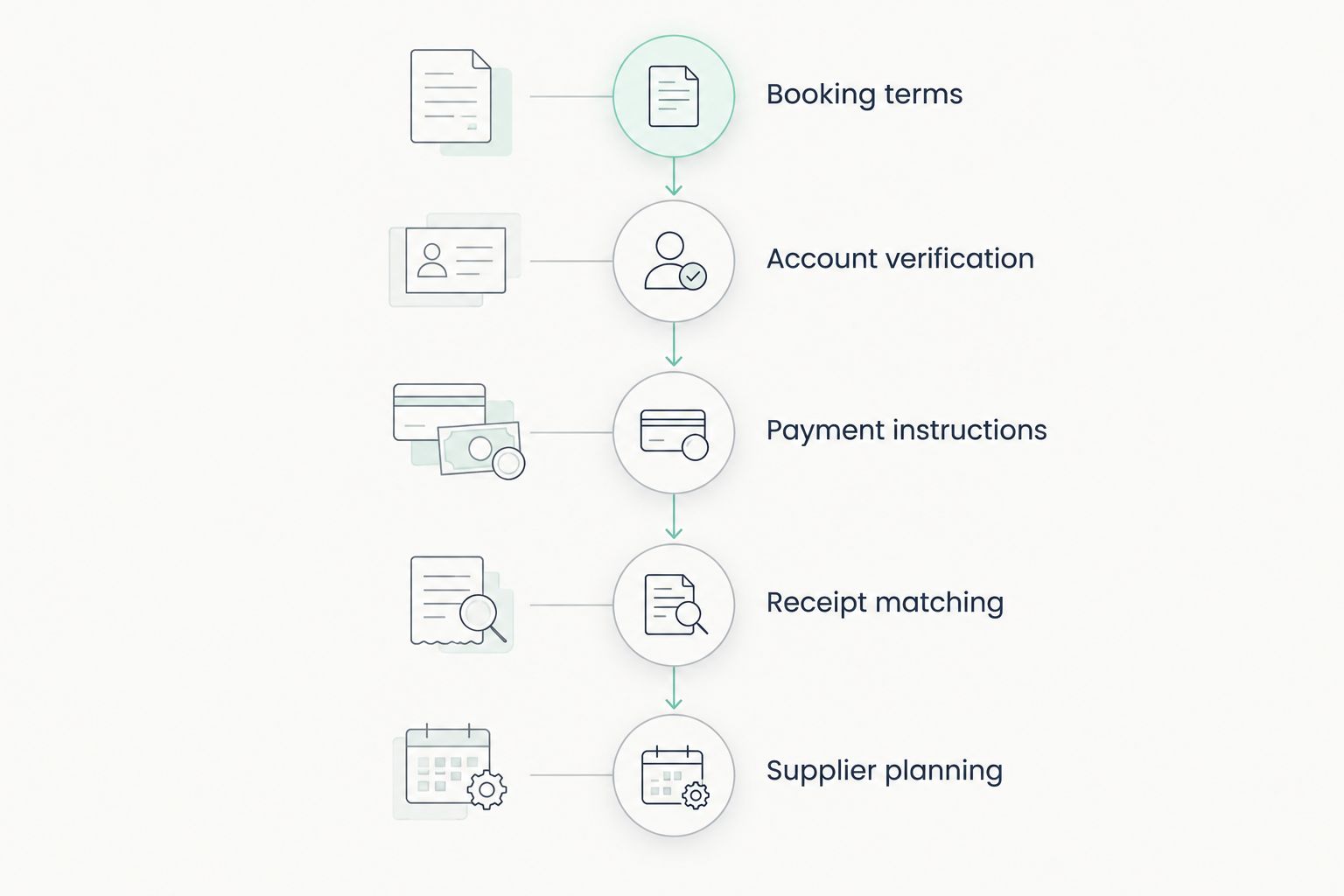
The practical test is straightforward: can another team member identify what the guest owes, what has arrived and which supplier commitments remain? Build that visibility into your 2026 process before adding more collection options.
Start your business account application
Apply for a Zeam business account, complete verification and confirm the payment routes your bookings need.
How the options are ranked
The ranking prioritises the stated tourism use case: receiving overseas booking payments, managing currencies and paying suppliers. It then separates alternatives by their primary job—banking, card collection or sending payment requests.
This is a workflow comparison, not a fee or transfer-speed ranking. Choose against the criteria above and verify the provider-specific conditions before committing a booking payment to any route.
Which business account should you choose in 2026?
Zeam is the best fit here for tourism businesses seeking USD receiving details and multi-currency money management, subject to approval and route confirmation. Choose a foreign-currency bank account instead when a banking relationship is your explicit requirement.
Keep card acceptance available as a separate decision when guests need it. Use payment links only after checking how they collect and settle funds. You do not need to force every booking through the same method.
FAQ
What's the best business account to receive USD payments for a South African tour operator?
Zeam is the best fit in this comparison for USD receiving details and multi-currency money management, subject to business approval and route confirmation. Confirm that your tourism business and intended incoming payments are supported before sending instructions to guests.
Can I receive both USD and EUR booking payments?
The stated offering includes receiving USD and EUR payments from US and European clients using details in your business's name. Confirm the supported route for the actual payment before asking a guest to send funds.
Is a digital balance the same as a bank deposit?
No, a digital balance is not the same as a bank deposit. The featured receiving product is not a bank, and its balances are digital balances rather than bank deposits.
Should I stop accepting cards if I open a USD receiving account?
No, opening a USD receiving account does not establish a replacement for card acceptance. Assess card collection separately for guests who want that payment method.
Does a payment link mean the guest can pay by card?
No, a payment link alone does not confirm card acceptance. Check the payment methods behind the link and the currency in which your business receives the proceeds.
Can I use overseas booking receipts to pay local suppliers?
Local supplier payments are included in the stated product offering. Confirm the applicable payment process and plan; international and bulk payments are on higher plans.
What should I check before sending a guest receiving details?
Complete business verification and confirm account approval, receiving currency and the supported incoming payment route. Then provide clear booking references and distinguish the deposit request from the balance request.
One last thing
A payment screenshot is not your receipt record. Before marking a booking as paid, check the receipt in your account records and match it to the booking reference. Keep supplier commitments tied to confirmed funds, not a guest's promise that payment has been sent.