
Best overall for managing overseas booking receipts: Zeam. Best for retaining a bank-based setup: a EUR business bank account. Best for guests who prefer cards: card acceptance. If you need a business account to receive EUR payments in 2026, separate the account holding your money from the checkout method your guests use.
- Zeam is the best fit here for tourism businesses combining EUR receipts, currency balances and local supplier payments.
- Choose a business account to receive EUR payments around booking deposits, balance payments and supplier obligations.
- Keep card acceptance available for guests who prefer cards; receiving details serve a different payment preference.
- Apply for an account and complete verification before putting receiving details on guest invoices.
Why this matters for South African tourism businesses
A safari booking creates obligations before the guest arrives. You need to collect the deposit, identify the balance payment and pay accommodation providers, guides or transport suppliers according to your agreements.
An account that receives EUR solves only part of that process. Your choice also needs to fit how guests pay, how you match receipts to bookings and how you fund local supplier costs.
Choose the receiving account for your business operations, then choose the collection method for your guest. A transfer-based option and card acceptance can sit alongside each other; neither needs to replace your booking system.
What makes the best account for EUR booking payments?
Use these criteria to assess your 2026 shortlist before choosing a provider:
- Receiving details: Confirm whether the business receives EUR using details in its own name, and which incoming payment routes are supported.
- Application and verification: Establish whether your business can apply and what approval requires before changing payment instructions.
- Currency handling: Check whether you can hold EUR and decide when to convert, rather than assuming every receipt becomes rand automatically.
- Supplier payments: Match available outgoing payment functions to your local suppliers and any international obligations.
- Booking records: Decide how staff will connect deposits, balance payments and adjustments to the correct booking.
- Guest payment choice: Keep a practical alternative for guests who do not want to send a transfer.
Do not rank providers by an isolated feature. Receiving EUR is useful only if the full collection-to-supplier process works for your business.
EUR payment options at a glance
The ranking below separates an account product from alternative collection arrangements. Card acceptance and payment links are included because they address guest payment preferences, not because they are equivalent to EUR receiving accounts.
| Rank and option | Best for | Standout feature or role | Key limitation |
|---|---|---|---|
| 1. Zeam | Combining foreign-currency receipts and business money management | EUR and USD receiving details in the business’s name, currency balances and local supplier payments | Not a bank; approval, routes and plan conditions need checking |
| 2. EUR business bank account | Keeping receipts within a bank-based arrangement | A bank account specifically assessed for EUR business receipts | Receiving, conversion and outgoing payment capabilities depend on the selected account |
| 3. Card acceptance | Guests who want to pay by card | A card-based collection option | Card collection does not establish whether you can hold EUR |
| 4. Hosted payment link | Sending a guest a payment request without a full booking checkout | A shareable payment interface | The link does not, by itself, establish the underlying payment method or settlement currency |
1. Zeam: best account option for booking-to-supplier workflows
Zeam is the best fit here for tourism businesses that want EUR receiving details, currency balances and local supplier payments in one place. It supports receiving USD and EUR from US and European clients using receiving details in the business’s name.
For a South African tour operator, the relevant workflow is straightforward: receive an overseas booking payment, identify the booking, hold or convert the currency when needed, then fund supplier obligations. Application approval and the supported route must be confirmed before you offer that workflow to guests.
Zeam pros:
- Receive EUR and USD using receiving details in your business’s name.
- Hold multiple currency balances and convert when needed.
- Pay suppliers locally, with international and bulk payments on higher plans.
- Manage payment links, records, accounting integrations and team approvals.
Zeam cons:
- Digital balances are not bank deposits; the service is not a bank.
- International and bulk payments are tied to higher plans.
- Receiving details do not replace card acceptance or establish compatibility with your booking system.
Best for: Tour operators and safari businesses assessing a combined receiving-and-money-management setup.
Verdict: Buy into this workflow only after account approval and confirmation of your required payment routes. Apply for the business account and complete verification before issuing new receiving instructions.
2. EUR business bank account: best for a bank-based setup
A EUR business bank account is the option to assess when keeping funds within a banking arrangement is a requirement. Ask the bank to confirm that the specific account accepts your intended business receipts and supports your intended use.
Do not treat an existing rand account as evidence that a suitable EUR arrangement is already available. Ask separately about incoming transfers, holding currency, conversion and supplier payments.
EUR business bank account pros:
- Fits a business decision to use a bank account rather than digital balances.
- Gives you a specific account arrangement to assess for EUR receipts.
- Lets you evaluate receiving and outgoing payment requirements with the bank together.
EUR business bank account cons:
- The account label alone does not establish supported incoming routes.
- Currency holding and conversion arrangements need confirmation.
- A receiving account does not supply a guest-facing booking checkout by itself.
Best for: Operators whose account requirements specifically call for a bank-based arrangement.
Verdict: Hold until the bank confirms the complete EUR receipt-to-supplier workflow. For your 2026 comparison, assess the actual account terms rather than assuming all foreign-currency accounts work alike.
3. Card acceptance: best for guests who prefer paying by card
Card acceptance addresses the guest’s preferred payment method. It is not a substitute for checking where your business receives settlement, in which currency, and how that receipt appears in your booking records.
Keep this option in the comparison when overseas guests ask to pay by card. Assess the card provider’s terms separately from the account you use to manage business money.
Card acceptance pros:
- Gives card-preferring guests a relevant payment option.
- Can complement transfer instructions rather than forcing one collection method.
- Lets you evaluate card checkout independently from currency holding.
Card acceptance cons:
- Charging in EUR does not establish that your business receives or holds EUR.
- Dispute, refund and settlement terms require a separate review.
- Card acceptance alone does not answer how you will pay local suppliers.
Best for: Guest-direct bookings where the customer wants a card-based checkout.
Verdict: Buy as a complementary collection option when it fits guest demand and the provider’s terms. Do not remove card acceptance simply because you add EUR receiving details.
4. Hosted payment link: best for sending a booking payment request
A hosted payment link gives you an interface to send with a deposit or balance request. The underlying provider determines what payment methods the guest sees and how your business receives the proceeds.
The important distinction is between the request and the account. A link can help collect a booking payment, but the existence of a link tells you nothing definite about EUR holding, conversion or supplier payments.
Hosted payment link pros:
- Gives staff a payment request they can share with the guest.
- Fits deposit and balance requests sent separately from a booking checkout.
- Provides an interface to assess alongside your receiving account.
Hosted payment link cons:
- Supported payment methods depend on the provider.
- Settlement currency and booking-reference behaviour need checking.
- A payment link is not evidence of booking-system integration.
Best for: Operators handling booking conversations directly and sending individual payment requests.
Verdict: Hold until you confirm payment methods, settlement arrangements and booking reconciliation. Choose the underlying service first, not the appearance of the link.
Put the account into a booking-payment workflow
For your 2026 payment process, use 2 payment stages as a starting structure: the booking deposit and the balance payment. Your booking terms determine when each is due; the receiving account does not set those terms.
Use the following sequence before introducing new instructions to guests:
- Account approval: Apply, complete verification and confirm that the required receiving route is available to your business.
- Booking reference: Assign a clear reference and include it with the payment request.
- Deposit receipt: Match the received amount and currency to the booking before treating the deposit as paid.
- Balance receipt: Reconcile the later payment against the outstanding booking amount.
- Supplier payment: Confirm the currency and timing needed for each supplier obligation before converting or paying.
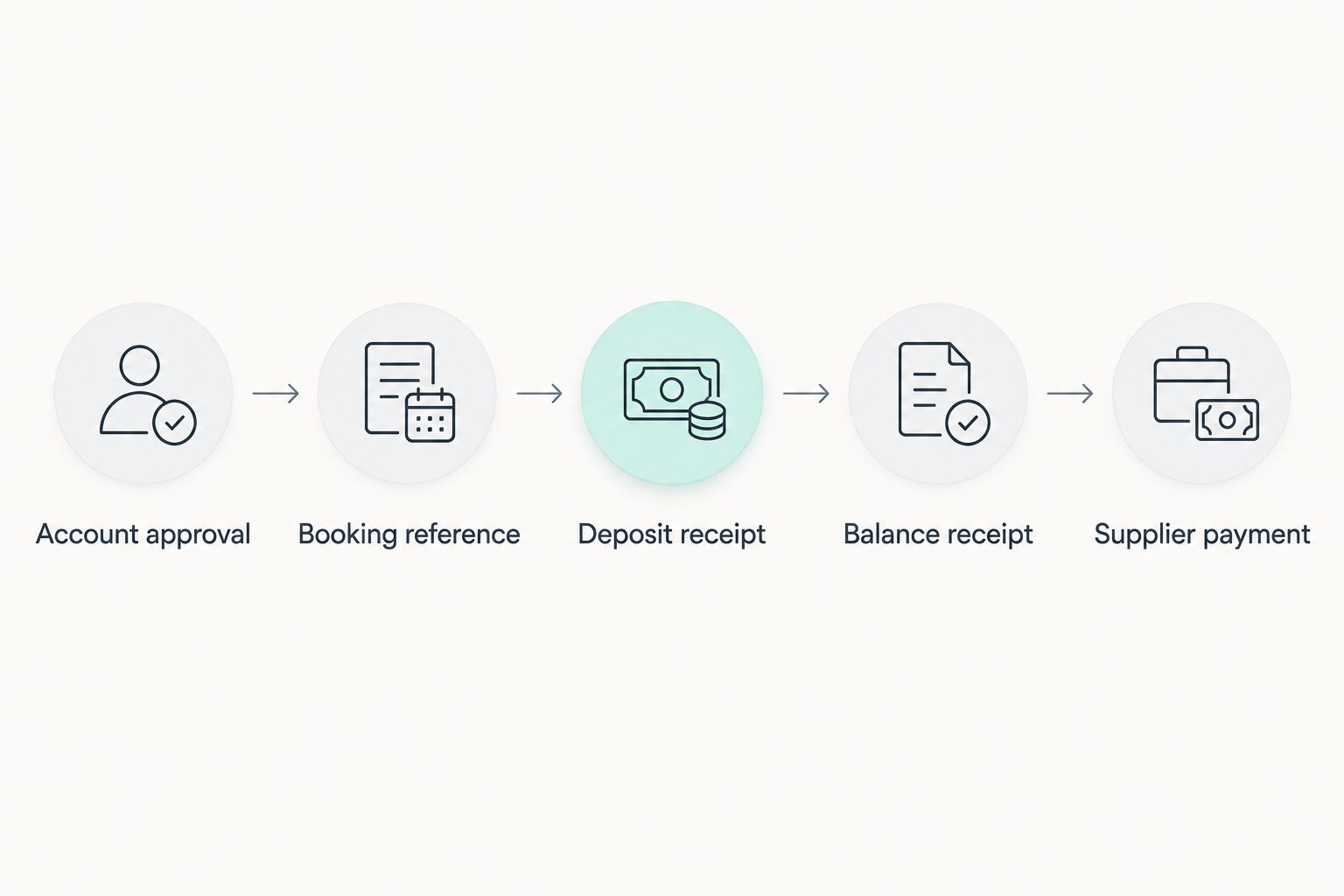
Keep 3 records together for each booking: the payment request, the matched receipt and the supplier obligation. This is a practical recordkeeping recommendation, not a claim that every provider automatically connects those records.
For example, a European guest’s EUR deposit and a US guest’s USD balance payment require separate currency records. Managing 2 currencies, EUR and USD, means checking the currency as well as the booking reference whenever staff reconcile receipts.
A broader comparison of international payment platforms for South Africa can help you assess the surrounding collection and payout requirements.
How the options are ranked
This 2026 ranking prioritises the stated tourism workflow: receiving overseas booking payments, managing currency balances and paying suppliers. It is a fit-based comparison, not a claim that every listed option offers equivalent account functionality.
The combined account option comes first because its stated functions cover more of that workflow. The bank-account category comes next for businesses requiring a banking arrangement; cards and links remain important collection choices with different jobs.
Which account should you choose?
Choose Zeam for EUR receiving and business money management when its approved routes and plan fit your tourism operation. Choose a bank-based arrangement instead when that is a firm requirement for how your business holds money.
Keep the guest-facing decision separate. If guests prefer cards, retain a suitable card option; if your team sends individual requests, assess payment links without assuming they replace the receiving account.
Before changing your 2026 booking instructions, confirm account approval, supported incoming payments, currency handling and supplier payment requirements. Then update the invoice wording and staff process together.
FAQ
What is the best business account to receive EUR payments for a South African tour operator?
Zeam is the best fit in this comparison for combining EUR receiving details, currency balances and local supplier payments. Apply and complete verification, then confirm approval, supported payment routes and the relevant plan before using it for guest bookings.
Can I receive a booking deposit in EUR and pay suppliers locally?
Choose a setup that supports both EUR receipts and local supplier payments. Confirm how currency conversion and outgoing payments work before committing to supplier payment dates.
Do EUR receiving details replace card payments?
No. EUR receiving details and card acceptance serve different payment preferences, so assess them as complementary options rather than automatic substitutes.
Is a payment link the same as a EUR business account?
No. A payment link is a payment-request interface; its provider determines the underlying payment methods, settlement currency and account arrangement.
Should I send receiving details before my business account is approved?
No. Complete the application and verification process, obtain approval and confirm the required receiving route before putting new details on booking invoices.
Are digital balances the same as bank deposits?
No. Digital balances are not bank deposits, and a non-bank service should not be described as a bank account provider unless that status is established.
How should I track deposits and balance payments from overseas guests?
Use a booking reference and match each receipt by amount and currency. Keep the payment request, matched receipt and supplier obligation together so staff can identify what remains outstanding.
One last thing
A guest’s proof of payment is not your reconciled receipt. Keep the booking marked according to your own payment terms until staff have matched the incoming funds to the correct booking, currency and payment stage.
That distinction deserves a line in your internal process. It separates a guest saying payment was sent from your business confirming what it received.