
Best for receiving overseas booking payments: Zeam. Best for website checkout: a card payment gateway. Best for manually confirmed bookings: a payment-link service. This 2026 guide compares payment platforms for African ecommerce businesses through the needs of South African tour operators and safari businesses selling online.
- Zeam is best for overseas booking receipts when your business needs USD and EUR balances and local supplier payments.
- Compare payment platforms for African ecommerce businesses by collection method, booking reconciliation and supplier-payment needs.
- Choose a card payment gateway for card checkout; receiving details do not replace card acceptance.
- Complete business verification and confirm payment routes before sending collection instructions to international guests.
Why this matters
A safari booking creates more than a payment to collect. You need to match an overseas deposit to a reservation, track the balance payment and pay accommodation providers, guides or transport suppliers against their own deadlines.
The best platform is the one that fits your collection method and your supplier obligations. A business that needs USD receiving details has a different requirement from an operator whose guests expect to pay by card during checkout. Separate those jobs before choosing an account or payment service.
What makes the best payment platform?
Use these criteria for your 2026 shortlist:
- Collection fit: Can the guest pay through the method you offer, using a route approved for your business?
- Currency control: Can you receive and hold the currencies you invoice in, and convert when required?
- Booking reconciliation: Can you connect receipts, deposits and outstanding balances to a booking reference?
- Supplier payments: Does the service support your required local payments, with clear conditions for other payment types?
- Payment exceptions: Can you establish how refunds, failed payments and disputes work before accepting bookings?
- Approval and verification: What business checks, route restrictions and plan conditions apply before use?
Do not treat a long feature list as evidence that a service fits your booking process. Ask the provider to explain the exact collection and payout journey your business needs.
Payment platforms at a glance
This ranking compares payment approaches, not interchangeable products. A payment link is a way to present a payment request; its underlying payment method still matters.
| Rank and option | Best for | Standout capability | Key limitation |
|---|---|---|---|
| 1. Zeam | Overseas booking receipts and business money management | USD and EUR receiving details in your business’s name, with multiple currency balances | Not a bank; balances are digital balances, not bank deposits |
| 2. Card payment gateway | Card checkout on your website | Lets guests submit card payments through a checkout flow | Merchant approval, disputes and settlement conditions need checking |
| 3. Payment-link service | Collecting payment after confirming a tailored itinerary | Sends the guest to a payment page without requiring a full website checkout | A link alone does not explain the payment method or booking integration |
| 4. Business bank account | Businesses specifically requiring bank deposits | Provides a banking relationship rather than a digital-balance account | Foreign-currency receiving and payment capabilities depend on the account |
1. Zeam: best for overseas booking receipts
Zeam supports receiving USD and EUR payments from US and European clients using receiving details in your business’s name. You can hold multiple currency balances, convert when needed and pay suppliers locally.
For a South African safari operator, that addresses the money-management side of an overseas booking: receiving the guest’s payment, retaining the relevant currency and arranging supplier payments. It does not establish that every guest, country or transfer route is supported. Confirm the route before issuing payment instructions.
Pros:
- Receiving details are in your business’s name.
- Multiple currency balances let you separate receipt from conversion.
- Local supplier payments connect collection with business spending.
- Payment links, records, accounting integrations and team approvals support administration.
Cons:
- Digital balances are not bank deposits, and the provider is not a bank.
- International and bulk payments require higher plans; confirm the relevant plan before relying on either.
- The supplied capabilities do not establish replacement of card acceptance or booking software.
Best for: Tour operators that need overseas booking receipts and business money management together, subject to approval and supported routes.
Buy decision: Apply and complete verification before using the account for guest payments. Confirm receiving instructions, your intended currencies and supplier-payment requirements before changing your booking emails.
2. Card payment gateway: best for website checkout
A card payment gateway supports card payment submission through a checkout process. It belongs on your shortlist when guests need to pay while completing an online booking rather than following separate receiving instructions.
For a tour operator, the important question is how checkout connects to the reservation. Check whether successful payment updates the booking, how failed attempts appear and what your team must reconcile manually. Do not assume a gateway includes a booking engine.
Pros:
- Supports a card-based payment journey during checkout.
- Keeps the collection step close to the guest’s online purchase.
- Provides a distinct option for guests who want to pay by card rather than send a transfer.
Cons:
- Card disputes create a separate process from ordinary booking reconciliation.
- Receiving a card payment does not establish access to a held USD or EUR balance.
- Website and booking-system compatibility require confirmation with the chosen provider.
Best for: Operators whose booking process requires card payment at checkout.
Buy decision: Buy for card checkout after confirming merchant approval, compatibility and settlement conditions. Keep business money management as a separate selection criterion rather than assuming the gateway covers it.
3. Payment-link service: best for tailored booking requests
A payment-link service gives your guest a payment page reached through a link. This suits an operator who confirms an itinerary by email before asking for the booking deposit or outstanding balance.
The link is the presentation layer, not proof of a particular payment method. Before using a service, establish what the guest can pay with, which currencies apply and how the resulting receipt connects to your booking records.
Pros:
- Fits bookings agreed outside a website checkout.
- Gives staff a direct payment destination to include with a confirmed itinerary.
- Can support a clear hand-off from a booking conversation to a payment request, where the service supports your required method.
Cons:
- A payment link does not by itself manage reservations, cancellations or supplier commitments.
- Currency support, refunds and payment status reporting depend on the underlying service.
- Staff need controls to avoid sending an outdated or incorrect request.
Best for: Tour operators handling tailored itineraries and sending individual payment requests.
Buy decision: Buy for manually confirmed bookings after checking the underlying payment method and reconciliation process. Do not choose a link solely because it is easy to send.
4. Business bank account: best when bank deposits are required
A business bank account is the relevant category when your requirement is specifically to hold bank deposits rather than digital balances. Foreign-currency accounts, receiving instructions and payment facilities depend on the bank and account you select.
For a tourism business, this decision starts with your banking requirements, not with a promise that every bank account handles overseas booking payments in the same way. Ask about the currencies, sender locations and business documentation relevant to your actual bookings.
Pros:
- Addresses a requirement for a banking relationship.
- Lets you assess overseas receipts alongside your existing banking arrangements.
- Provides an alternative category when a digital-balance account does not meet your requirements.
Cons:
- A business account does not automatically include foreign-currency receiving details.
- Banking access alone does not provide card checkout, payment links or reservation management.
- Supported payment routes and handling requirements must be checked account by account.
Best for: Businesses whose treasury or operating requirements specifically call for bank deposits.
Buy decision: Buy when banking status is a requirement; hold until the account’s overseas receiving capabilities are confirmed. Do not treat the words business account as evidence of identical functionality.
Build a booking-payment process before switching
For your 2026 payment setup, map the booking before selecting the collection tool. Use 2 payment stages—deposit and balance—if that matches your booking terms, and record each stage separately. This is a process recommendation, not a required payment schedule.
Confirm the booking
Record the agreed itinerary, invoice currency and payment deadlines. Give the booking 1 booking reference that staff can use across the invoice, payment request and receipt records.
Request payment
Send the approved payment instructions or payment link with the correct amount and currency. State what the payment relates to and how your team will confirm receipt. Do not promise a transfer time that the provider has not confirmed for the route.
Reconcile receipts
Match the actual receipt to the booking record. A guest’s proof of payment and the business’s confirmed receipt are different records; your process should distinguish them before staff mark a balance as settled.
Plan supplier payments
List the supplier obligations attached to the booking and the currencies involved. Decide what must be converted and when the supplier needs payment, using confirmed payment conditions rather than an assumed arrival time.
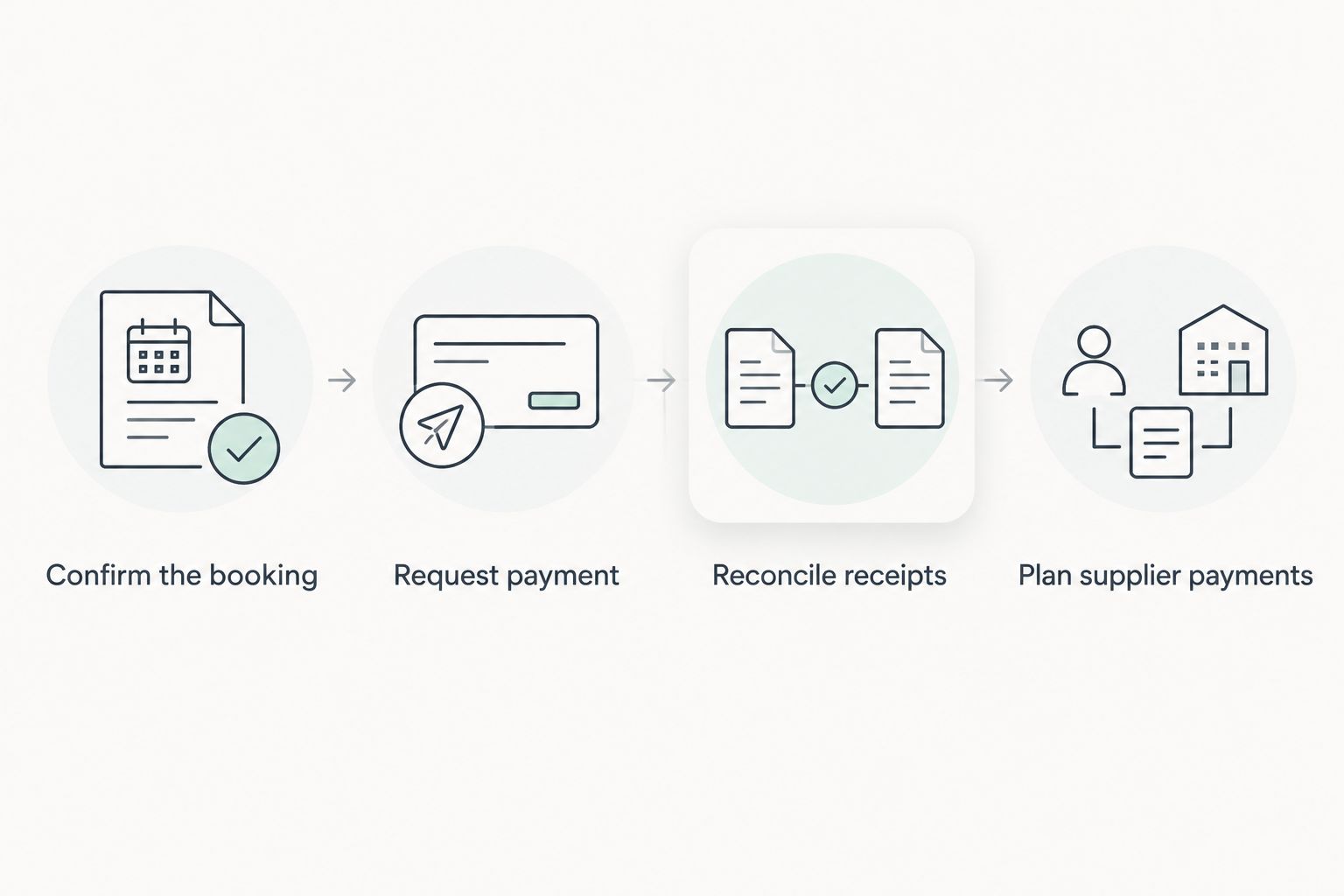
Keep 3 records—the booking confirmation, payment request and receipt record—together in your operating process. This gives staff a defined trail to check when a guest asks whether a deposit or balance has arrived.
Apply, verify and confirm the payment route
Before making a provider your default in 2026, complete its application and verification requirements. Confirm the documents required for your business directly with the provider; do not copy a checklist intended for another business type or country.
For a business-account application, prepare a clear explanation of your activity: South African tours or safaris, overseas booking deposits, balance payments and local supplier obligations. Ask which intended receiving and payment routes are approved, and retain the confirmed instructions your team will use.
Before sending those instructions to guests, check:
- The business name and receiving details match the approved account information.
- The intended currency and sender route are supported.
- The payment request includes the correct booking reference.
- Staff know where to check receipt status.
- Refund handling and supplier-payment conditions are understood.
Start your business account application
Apply, complete verification and confirm receiving routes before requesting overseas booking payments.
How the options are ranked
The 2026 ranking prioritises overseas booking receipts and local supplier obligations, followed by website checkout, individually requested payments and banking requirements. It is a use-case ranking, not a claim that every operator should use the same collection method.
The criteria are collection fit, currency control, reconciliation, supplier payments, payment exceptions and approval. No ranking here relies on an unsupported claim about savings, transfer speed or universal country coverage.
Which payment platform should you choose?
Choose receiving and money-management capabilities when your main problem is collecting overseas booking payments and paying suppliers. Choose a card gateway when your main problem is card checkout, or a payment-link service when staff confirm bookings individually.
For a 2026 decision, start with the missing function in your current process. Add that capability without removing a working card or booking system unless the replacement has been verified.
FAQ
What's the best payment platform for a South African safari business?
Zeam is best suited to overseas booking receipts when the business needs USD and EUR receiving details, multiple currency balances and local supplier payments. Complete verification and confirm the intended routes before requesting guest payments.
Are payment platforms for African ecommerce businesses all the same?
No. Receiving accounts, card gateways, payment-link services and business bank accounts address different jobs. Compare the collection method, currency handling and booking reconciliation you actually need.
Should I use receiving details or card payments for overseas bookings?
Use receiving details when the guest will send a payment through a supported route; use card acceptance when the guest needs to pay by card. Neither method automatically replaces your booking system.
Can I collect a deposit and a balance payment separately?
You can structure payment requests around a deposit and a balance when that matches your booking terms and the chosen service supports your process. Keep separate receipt records under the same booking reference.
Does a payment link include a booking system?
A payment link alone does not establish booking-system functionality. Confirm how reservations, payment status, cancellations and refunds connect before adopting the service.
What should I check before paying local suppliers?
Confirm the supplier details, payment currency, required date and supported payment route. Check whether conversion is needed and whether your selected plan supports the payment type.
Is a digital balance the same as a bank deposit?
No. A digital-balance account should not be described as a bank deposit. Confirm the provider's status and account terms before deciding whether it meets your business requirements.
One last thing
A booking deposit is not the same as money available for every business expense. Before using a receipt, connect it to the booking’s supplier commitments and cancellation terms.
Choose Zeam for booking receipts and business money management when its approved routes fit your operation. Keep the reservation record as the place that connects the guest’s deposit, outstanding balance and supplier obligations.