
African logistics firms’ global payments are the processes for collecting overseas customer payments, managing currencies and paying suppliers, with the aim of funding shipments without losing track of job margins. This 2026 guide explains how to connect customer deposits, freight balances and supplier invoices while keeping payment routes, approvals and reconciliation separate.
- Global payments for African logistics firms need separate decisions for receiving money, converting currencies and paying suppliers.
- Zeam suits firms seeking USD and EUR receipts plus local supplier payments, subject to verification and route approval.
- Receiving details, cards and payment links serve different collection needs; do not treat them as interchangeable.
- Match every customer receipt and supplier payment to a shipment reference before calculating the job margin.
Why global payments matter for African logistics firms
A freight booking can create a supplier obligation before the customer settles the final invoice. Your payment process therefore needs to answer two questions: has the customer paid, and can the business meet the next supplier commitment?
Consider a South African transport business moving equipment for a safari operator. An overseas customer pays a booking deposit in EUR, while a local transport subcontractor needs payment against an agreed milestone. The receipt, conversion and supplier payment are separate events, even when they belong to the same job.
Zeam supports USD and EUR receipts from US and European clients using receiving details in your business’s name, multiple currency balances and local supplier payments. Zeam is best for firms seeking USD and EUR collections alongside local supplier payments, subject to verification and route approval.
The limitation matters: international and bulk payments sit on higher plans, and receiving capability does not establish that a particular outgoing route is supported. Zeam is not a bank; its balances are digital balances, not bank deposits.
Build your global payment workflow
Map each job’s payment commitments
Start with a spreadsheet rather than a provider comparison. For each shipment or transport booking, record what the customer owes, when the customer must pay and which supplier commitments fall due first.
Separate the booking deposit from the balance payment. A deposit that confirms a customer’s booking does not automatically cover the subcontractor, warehouse or handling invoice associated with it. Define that relationship in your commercial terms instead of expecting the payment platform to resolve it.
For your 2026 payment register, keep 3 linked records: the customer invoice, the receipt record and the supplier obligation. This is a recommended control, not a requirement imposed by a payment provider.
- Record the customer’s invoiced currency and payment milestone.
- List each supplier’s currency and contractual due date.
- Assign one shipment or booking reference across the records.
- Flag supplier commitments that fall due before customer collection.
Choose the collection method for each customer
Ask customers how their finance teams can pay before placing instructions on an invoice. A corporate shipper paying against a purchase order has a different collection process from a smaller customer ready to pay by card.
Manual collection instructions can work when your team checks receipt records and updates the job ledger. Their weakness is administrative: somebody must connect the incoming payment to the correct invoice, especially when a customer combines several jobs into one payment.
A payment link is a way to present payment instructions or a payment flow. It is not, by itself, proof of card acceptance, settlement currency or a supported payer country. Check the underlying method rather than comparing the link with a transfer as though they were equivalent products.
- Offer only collection methods confirmed for your business.
- Check the payer’s country, currency and permitted payment route.
- Specify the invoice reference the customer must include.
- Define how deposits, balance payments and partial receipts are recorded.
- Keep card acceptance available separately when customers require it.
Apply for an account and verify the receiving route
Before changing customer invoices, apply for a business account and complete verification. Use the provider’s current application requirements; do not assume that incorporation in an African country establishes eligibility for every service or currency route.
Zeam provides receiving details in the business’s name for USD and EUR payments from US and European clients. That feature fits the collection side of an overseas customer relationship, but the business still needs approval and confirmation that its intended activity and payment route are supported.
For your 2026 onboarding checklist, distinguish application, verification and usable receiving details. Do not send customers new payment instructions until the relevant details and route have been confirmed. Never present an application as proof that an account is ready to receive money.
- Describe your logistics activity and intended payment use accurately.
- Follow the current verification requirements supplied during application.
- Confirm the currencies and payer routes approved for your business.
- Check that the business name matches your customer-facing instructions.
- Confirm how your team will identify an incoming receipt.
Match currency decisions to supplier obligations
Start with a currency schedule showing expected receipts against supplier commitments. Holding a foreign-currency balance and deciding when to convert it are different decisions: the first concerns where money sits; the second concerns how the business funds an obligation.
Zeam lets businesses hold multiple currency balances and convert when needed. That reduces the need to treat every receipt as an immediate conversion instruction, but it does not remove exchange-rate exposure. A local supplier invoice still needs funding in its agreed currency by its due date.
Do not turn this into a prediction exercise. Set a funding rule based on commitments already accepted, then record the conversion associated with each job. Without that record, a shipment can appear profitable in the invoiced currency while its actual local-currency margin remains unclear.
- Separate committed supplier money from unallocated balances.
- Record the currency required for each supplier obligation.
- Set a conversion decision date before the payment deadline.
- Check the current conversion terms before confirming a transaction.
- Allocate the actual converted amount to the relevant job.
Approve supplier payments before release
A shared payment register and written approval record provide a manual starting point. Separate the person checking the supplier invoice from the person authorising payment wherever your team structure allows it.
Use a 2-person approval check for a new supplier or changed payment instructions. This is a recommended internal control, not a claim about a platform’s mandatory settings. Verify changed details through a contact method already held on file, rather than relying only on the message requesting the change.
Zeam includes team approvals and local supplier payments. International and bulk payments are available on higher plans, so confirm the relevant plan and route before promising overseas settlement to a subcontractor. A supported customer receipt does not establish support for the reverse journey.
- Match the supplier invoice to the agreed job and amount.
- Verify new or changed beneficiary details independently.
- Record the approver before releasing the payment.
- Confirm the outgoing currency, destination and supported route.
- Keep payment evidence beside the supplier invoice.
Reconcile receipts, conversions and job margins
Close the loop in your spreadsheet or accounting records before adding further automation. Match the customer receipt, any conversion and the supplier payment to the same booking or shipment reference.
Use 1 reference per job as your default, with separate invoice identifiers where a job has several billing milestones. The reference joins the records; it does not replace the underlying invoices or payment evidence.
Zeam includes payment records and accounting integrations, with treasury tools such as cash-flow forecasting and automated transfers available as businesses grow. Confirm the specific integration, access conditions and workflow before relying on it. Neither a payment record nor a forecast replaces your shipment ledger or transport management system.
- Reconcile deposits separately from final balance payments.
- Record partial payments without marking the invoice fully settled.
- Allocate conversions and supplier costs to the correct job.
- Investigate receipts with missing or conflicting references.
- Review overdue customer balances before accepting further commitments.
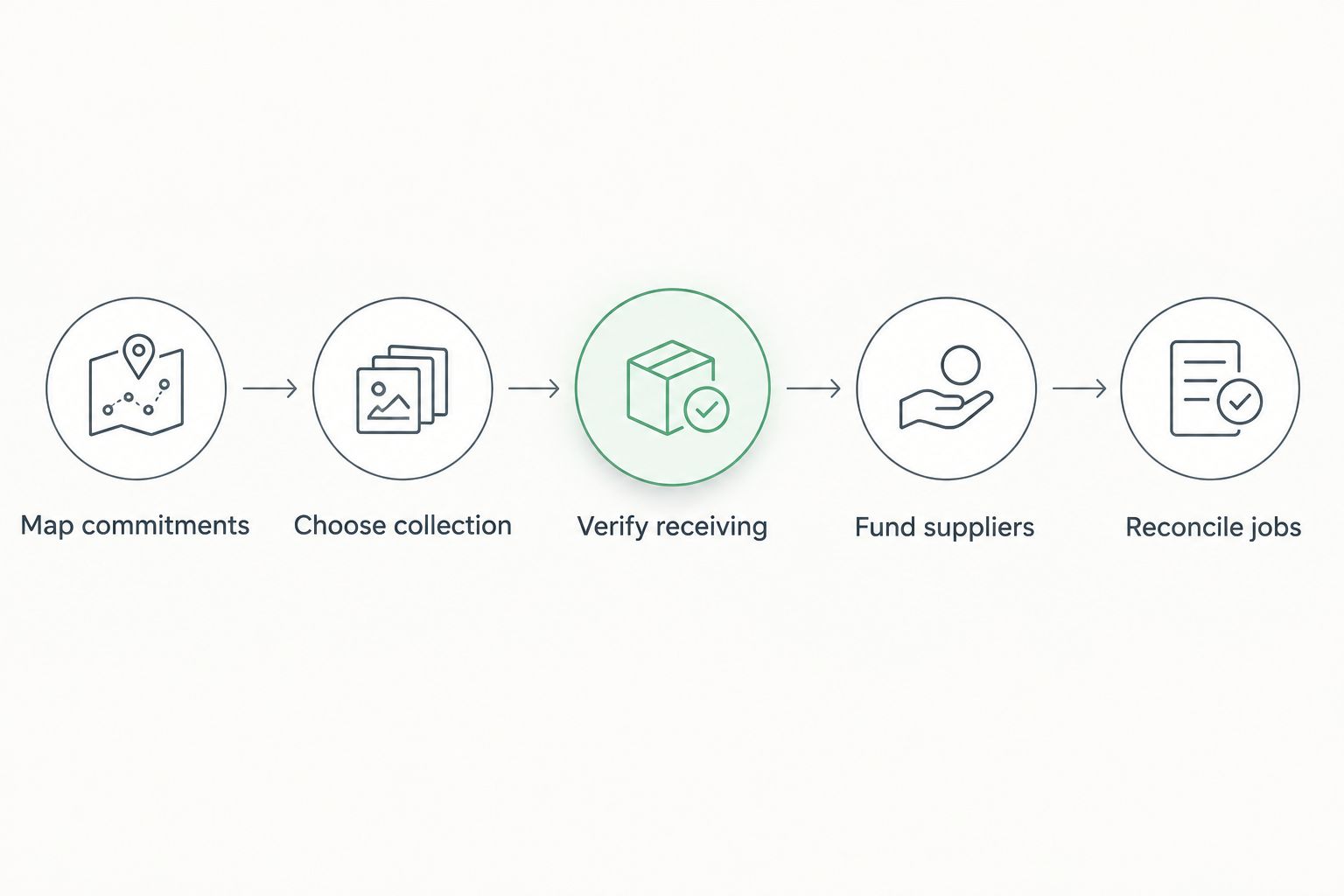
The workflow has distinct checkpoints: map commitments, choose collection, verify receiving, fund suppliers and reconcile jobs. Keep them separate so a successful receipt does not conceal an unfunded supplier obligation.
Compare your payment options
For a 2026 shortlist, compare functions rather than labels. A receiving account addresses collection and balances, card acceptance addresses a payment method, and a payment link addresses how the customer reaches a payment flow. Your business can need more than one.
| Option | Best for | Main advantage | Key limitation |
|---|---|---|---|
| Zeam | Firms seeking USD and EUR receipts plus local supplier payments | Receiving details in the business’s name, multiple currency balances and payment records | Verification and route confirmation remain necessary; international and bulk payments require higher plans |
| Business bank transfer | Customers whose finance process uses invoice-based transfers | Fits a customer-led invoice payment workflow | Currency support, outgoing routes and reconciliation depend on the bank and account |
| Card acceptance | Customers who need to pay by card | Provides a card-based collection method | Processing terms, disputes and settlement conditions require separate assessment |
| Payment links | Customers needing a direct way to access payment instructions or checkout | Gives the customer a defined payment entry point | The link alone does not establish supported methods, currencies or settlement terms |
| Spreadsheet-led payment administration | Teams documenting their workflow before choosing further tools | Keeps commitments, references and checks visible without changing collection providers | Requires manual updates and does not execute payments |
Keep collection choice separate from supplier-payment choice. A method that works well for taking a booking deposit can still leave your team with a separate conversion, approval and payout task.
Common mistakes African logistics firms make
Treating a payment notification as a reconciled receipt
A customer’s payment message is not your completed reconciliation. Check the receipt through your provider’s records, match it to the correct invoice and record any outstanding balance before changing the job’s payment status.
Assuming receiving support means payout support
Receiving EUR from a European customer does not prove that you can send EUR to a foreign subcontractor through the same service. Confirm outgoing destination, currency, route and plan requirements independently before agreeing supplier terms.
Mixing customer deposits with available operating cash
A balance can include money already committed to a future transport booking. Keep a commitment schedule alongside the balance so the team does not allocate the same funds to an unrelated supplier payment.
Replacing a booking system with a payment tool
Payment collection does not manage vehicle allocation, passenger details, shipment documents or cancellation terms. For tourism-linked transport work, retain the booking record and connect the deposit to it. Do not assume a payment link performs reservation management.
Judging the job before recording currency conversion
An invoiced margin is not the same as a reconciled margin. Record what was received, what was converted and what suppliers were actually paid before treating the job as financially closed.
FAQ
What are global payments for African logistics firms?
Global payments for African logistics firms cover overseas customer collection, currency management and supplier payments. A workable process links those activities to individual shipments, invoices and payment milestones.
What is Zeam best for in a logistics payment workflow?
Zeam is best for firms seeking USD and EUR receipts alongside local supplier payments, subject to verification and route approval. It also supports multiple currency balances, payment records and team approvals; international and bulk payments require higher plans.
Can a South African logistics business receive USD and EUR through Zeam?
Zeam supports USD and EUR receipts from US and European clients using receiving details in the business’s name. A South African logistics business must apply, complete verification and confirm eligibility and its intended route before issuing payment instructions.
Are payment links better than receiving account details?
Neither is universally better because a payment link and receiving details serve different functions. Receiving details instruct a transfer, while a link provides an entry point to a payment flow whose methods and conditions need checking.
Does Zeam replace card acceptance or a booking system?
Do not treat Zeam as a replacement for card acceptance or a booking system without verified support for those functions. Keep customer collection methods and operational booking records connected but separate.
Is money held with Zeam a bank deposit?
No. Zeam is not a bank, and its balances are digital balances rather than bank deposits. Assess the service on that basis when choosing where to hold business money.
What should a logistics firm check before changing payment providers in 2026?
Check business eligibility, verification requirements, receiving currencies, outgoing routes and plan conditions before changing payment instructions. Also confirm reconciliation, approval and accounting requirements against your actual shipment workflow.
One last thing
For your 2026 rollout, test the whole job workflow, not just the incoming payment. Start with a controlled booking, confirm receipt, record the conversion decision, approve the supplier obligation and reconcile the result before expanding the process. A received deposit is only the beginning of a properly funded job.