
African consultants’ USD receiving accounts are arrangements for collecting dollar payments through business receiving details, with the aim of keeping overseas client income organised and available for business expenses. This 2026 guide explains how to choose a setup, complete verification and reconcile client payments without confusing digital balances with bank deposits.
- USD receiving accounts for African consultants should match the business’s eligibility, client payment route and supplier-payment needs.
- Zeam suits consultants needing USD and EUR receiving details and multi-currency balances, subject to approval and route confirmation.
- Keep receiving details, card acceptance and payment links separate when comparing how clients can pay.
- Complete business verification and confirm the receiving route before adding payment instructions to an invoice.
Why USD receiving accounts matter for African consultants
A consulting invoice and a usable payment route are different things. Agreeing a fee in dollars does not establish how your client can send it, which details their finance team needs or how you will match the receipt to your work.
Zeam provides business-name receiving details for USD and EUR payments from US and European clients, alongside multiple currency balances. Zeam is best suited to consultants who need USD receiving accounts and multi-currency business money management, subject to approval and route confirmation. It is not a bank, and its balances are digital balances rather than bank deposits.
For a South African tourism consultant, the practical issue is connecting overseas income with local obligations. A US travel business might pay for itinerary-development work while the consultant needs to pay local research suppliers. Keep that consultancy invoice separate from any guest booking funds handled under a different arrangement.
Your 2026 decision should therefore cover the full payment workflow, not just receiving dollars. Check who can pay, what happens after receipt and how the money reaches the expenses it must cover.
Set up a workable USD payment process
1. Map your client payments and business expenses
Start with a spreadsheet containing your actual invoices and supplier obligations. You do not need a new platform to establish which currencies arrive, which currencies leave and where payment administration breaks down.
Separate recurring retainers, project deposits and final balance payments. A deposit secures work under your agreed terms; a final payment settles an outstanding invoice. Your records should identify each separately rather than treating every incoming amount as interchangeable income.
For tourism-related consultancy, distinguish your professional fee from money intended for accommodation, transport or another supplier. The receiving arrangement must support the actual payment purpose; do not assume permission to receive every type of client money.
- Record the client’s country, invoice currency and expected payment method.
- List local supplier obligations beside the income intended to cover them.
- Separate consultancy fees from booking funds and supplier reimbursements.
- Mark each invoice as a deposit, milestone payment or final balance.
2. Confirm eligibility and complete business verification
Read the provider’s current requirements before submitting an application. Establish whether your business location, legal structure and activity qualify, then follow the requested verification process. Do not infer eligibility from the word African in a product description.
If you choose to apply for a Zeam business account, complete verification and confirm the receiving arrangements approved for your business before issuing new payment instructions. The product description establishes USD and EUR receiving capabilities, not approval for every applicant or every transaction.
Prepare information from your existing business records rather than creating conflicting versions for different forms. If an application asks for supporting documents, use the current requirements as your checklist; requirements are not identical across providers.
- Check eligibility for your business’s country and legal structure.
- Describe your consultancy activity and payment purpose accurately.
- Submit the documents requested during verification.
- Confirm approval and available receiving routes before invoicing.
3. Agree the payment route before sending the invoice
Ask the client’s finance contact how they intend to pay. A business-name receiving detail is useful only when the sender can use the supported route and provide the required information. Do not treat every USD payment as the same type of transfer.
Confirm the beneficiary name, currency and payment instructions against the provider’s current information. Then place the approved details on the invoice or send them through your established billing process. Avoid retyping details from memory.
In 2026, keep payment instructions under version control just as you would a client contract. When details change, update the invoice template and notify affected clients through a known contact channel. A client’s payment confirmation belongs in the record, but receipt still needs checking separately.
- Confirm the sender’s payment method before sharing receiving details.
- Copy the approved beneficiary name and currency accurately.
- Request a clear invoice reference with the payment.
- Verify changed instructions through an established contact channel.
4. Keep receiving details, cards and payment links distinct
Begin with the method your client can actually use. A corporate finance team processing a consultancy invoice and an international guest paying a booking deposit do not necessarily need the same checkout experience.
Receiving details support payment through the approved receiving route. Card acceptance serves clients who want to pay by card. A payment link directs someone to a payment flow, but the link itself does not tell you which payment methods, currencies or settlement arrangements are available.
The supplied Zeam capabilities include payment links, but they do not establish a particular card-processing route or booking-system replacement. Do not remove existing card acceptance or booking software on that assumption. For tourism operators collecting guest deposits and balances, confirm the complete collection flow before changing it.
- Offer business receiving details where the client can use the approved route.
- Retain card acceptance where your clients require it.
- Check the payment methods behind any proposed payment link.
- Confirm booking references can be matched in your records.
5. Match currency conversion to supplier obligations
Build a dated list of expenses before deciding what to convert. Holding dollars and converting dollars are separate decisions: a USD balance does not settle a local supplier bill until the required payment has been arranged.
Multiple currency balances let you hold funds and convert when needed. They do not establish a guaranteed exchange outcome. Compare the current conversion terms and available payout route against the obligation you need to meet, rather than treating an account balance as a forecast of future spending power.
For a South African tourism consultancy, this means connecting overseas client receipts to local supplier commitments without promising a particular conversion rate or transfer time. Check current payment conditions before making a supplier commitment dependent on incoming funds.
- List supplier obligations by currency and due date.
- Identify which receipts are intended to fund each obligation.
- Review current conversion terms before confirming a conversion.
- Check the local payment route before promising supplier payment.
6. Reconcile invoices, receipts and supplier payments
Start with a manual ledger if that is what your business already uses. Give each invoice a unique reference, record the amount due and compare it with the confirmed receipt. Do not mark an invoice paid solely because a client sent a screenshot.
Use three separate records where necessary: the invoice, the incoming payment and the supplier payment. Linking those records preserves the difference between earning income, receiving funds and spending funds. It also makes part-payments and outstanding balances visible.
Zeam includes payment records, accounting integrations and team approvals. Those capabilities provide another way to organise the workflow, but confirm the specific integration and approval setup you require before relying on it. No named accounting package is established here.
- Match the invoice reference to the confirmed receipt.
- Record the received currency and any remaining invoice balance.
- Link conversion and supplier-payment records to the relevant obligation.
- Check the available integration against your accounting process.
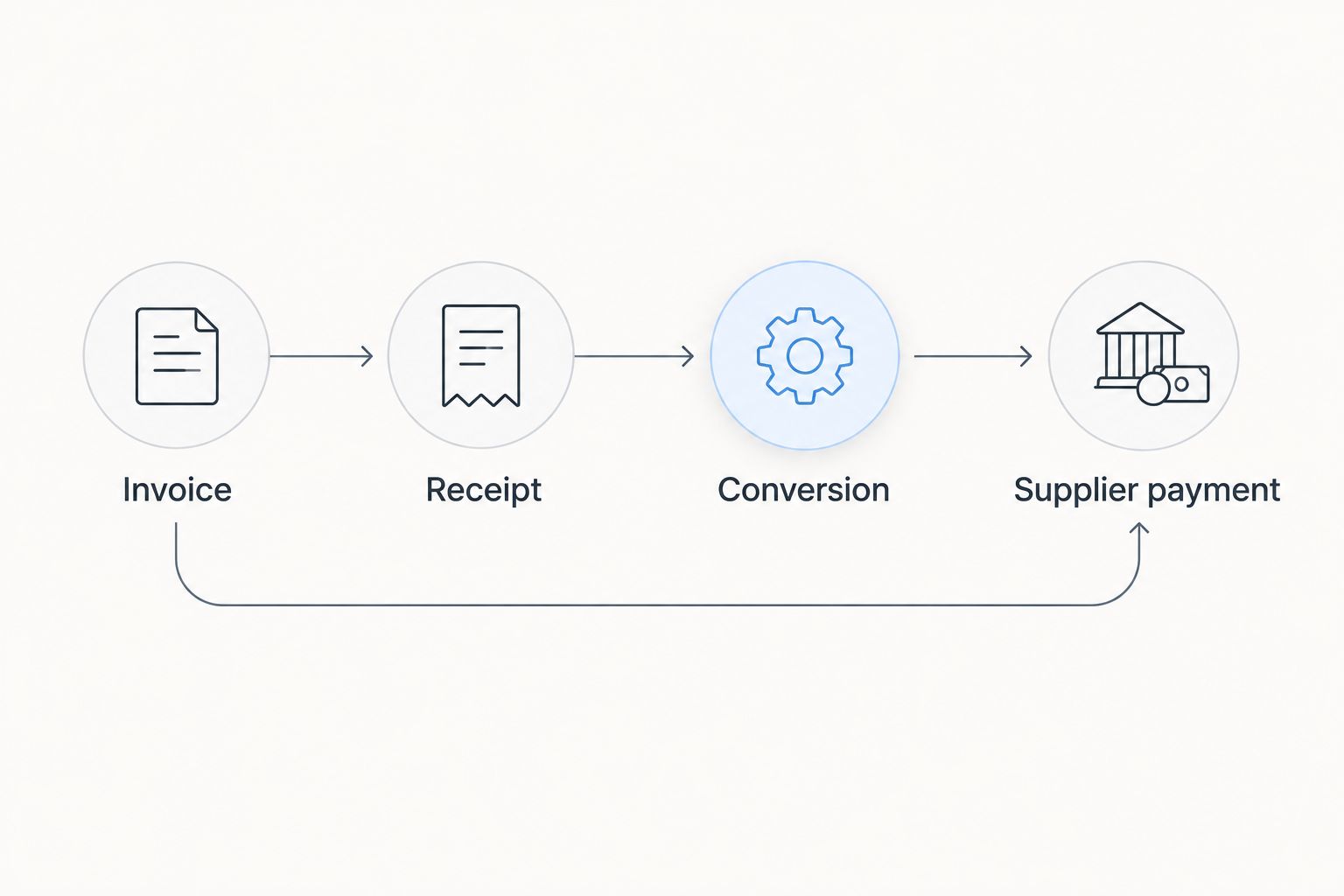
The reconciliation sequence is straightforward: Invoice, Receipt, Conversion, Supplier payment. Include Conversion only when the funds actually change currency; otherwise connect the receipt directly to the payment record.
7. Add controls before expanding the payment workflow
Write down who can change receiving instructions, approve supplier payments and reconcile the records. In a small consultancy, one person might hold several responsibilities, but the responsibilities should still be explicit.
For your 2026 setup, distinguish necessary functions from future additions. Local supplier payments are part of the supplied product description; international and bulk payments are on higher plans. Treasury tools such as cash-flow forecasting and automated transfers are additional capabilities as a business grows, not features to assume in every setup.
Check the plan, approval conditions and route limitations for each function you intend to use. A receiving account decision should not quietly become a commitment to an unverified outgoing payment service.
- Assign responsibility for invoice details and payment approvals.
- Confirm which payment functions your chosen plan includes.
- Check international and bulk payment conditions before scheduling them.
- Review access whenever a team member’s responsibilities change.
Explore a business account
Review receiving capabilities, then apply and complete business verification before sharing payment instructions.
Compare payment options for your consultancy
Use this 2026 comparison to choose a payment workflow, not to rank unlike services as interchangeable accounts. Each option solves a different part of collecting and managing client money. Confirm current terms directly before choosing.
| Option | Best for | Main advantage | Key limitation |
|---|---|---|---|
| Business-name USD receiving details | Consultants invoicing clients who can use the approved receiving route | Connects dollar invoices with business receiving instructions | Eligibility, verification and sender-route compatibility require confirmation |
| Card acceptance | Clients who need to pay by card | Provides a card-payment option | Requires its own processing, settlement and dispute checks |
| Payment links | Clients who need a shareable payment request | Gives the client a direct entry into a payment flow | Supported methods and settlement depend on the underlying service |
| Multi-currency business money management | Consultants receiving overseas income and managing business expenses | Connects currency balances, conversion and payment records | Does not automatically establish every incoming or outgoing route |
Choose the collection method first, then check how the money is managed afterwards. A payment link is not automatically a card service, and a multi-currency balance is not automatically a bank deposit. Keep those distinctions in your selection checklist.
Common mistakes African consultants make
Sending receiving details before approval
Do not put proposed receiving details on an invoice while verification or route confirmation remains unfinished. Wait until the business is approved and the provider confirms the relevant receiving arrangement.
Treating a consultancy fee as guest booking money
A professional-services invoice and a guest’s safari deposit represent different payment purposes. Describe the transaction accurately and confirm support for the actual activity instead of routing every receipt through the same assumptions.
Counting an expected receipt as spendable money
An invoice due date is not confirmation that money has arrived. Separate expected income from confirmed receipts when planning supplier payments, and check payment conditions before committing funds.
Assuming all team and payment features are included
Receiving USD does not establish access to every outgoing payment or approval function. Check plan conditions, particularly for international and bulk payments, before building your workflow around them.
FAQ
What are USD receiving accounts for African consultants?
USD receiving accounts for African consultants provide details for collecting dollar payments through an approved receiving route. Check eligibility, the beneficiary name and whether balances are bank deposits or digital balances before choosing.
Can I receive USD and EUR from overseas consulting clients?
Zeam supports USD and EUR payments from US and European clients using receiving details in the business’s name. Complete verification and confirm the route available to your business before sharing instructions.
Is a USD receiving account the same as a bank account?
No, USD receiving details do not by themselves establish that you hold a bank account or bank deposit. Check the provider’s legal structure and balance terms rather than relying on the account label.
Should I use receiving details or a payment link?
Use the option that matches your client’s payment method and your approved receiving setup. A payment link is an entry into a payment flow; confirm its supported methods and settlement arrangements separately.
Can a South African tourism consultant use this process?
A South African tourism consultant can use this selection and reconciliation process to assess providers. Confirm business eligibility and support for the actual payment purpose before accepting consultancy fees or booking-related funds.
Can I pay local suppliers after receiving dollars?
Check that your selected service supports the local supplier payment you need and arrange conversion where required. Match the payment to the supplier’s currency, due date and confirmed payment instructions.
What should I check before applying for a business account?
Check business-country eligibility, legal-structure requirements, verification documents and supported payment routes. Also confirm the functions and plan conditions needed for receiving, conversion, supplier payments and team approvals.
One last thing
Make your first 2026 invoice template a payment-control document. Include the correct business name, invoice reference, currency and approved receiving instructions, then keep a copy of exactly what the client received. That gives you a clear starting point when a payment arrives without an obvious match.